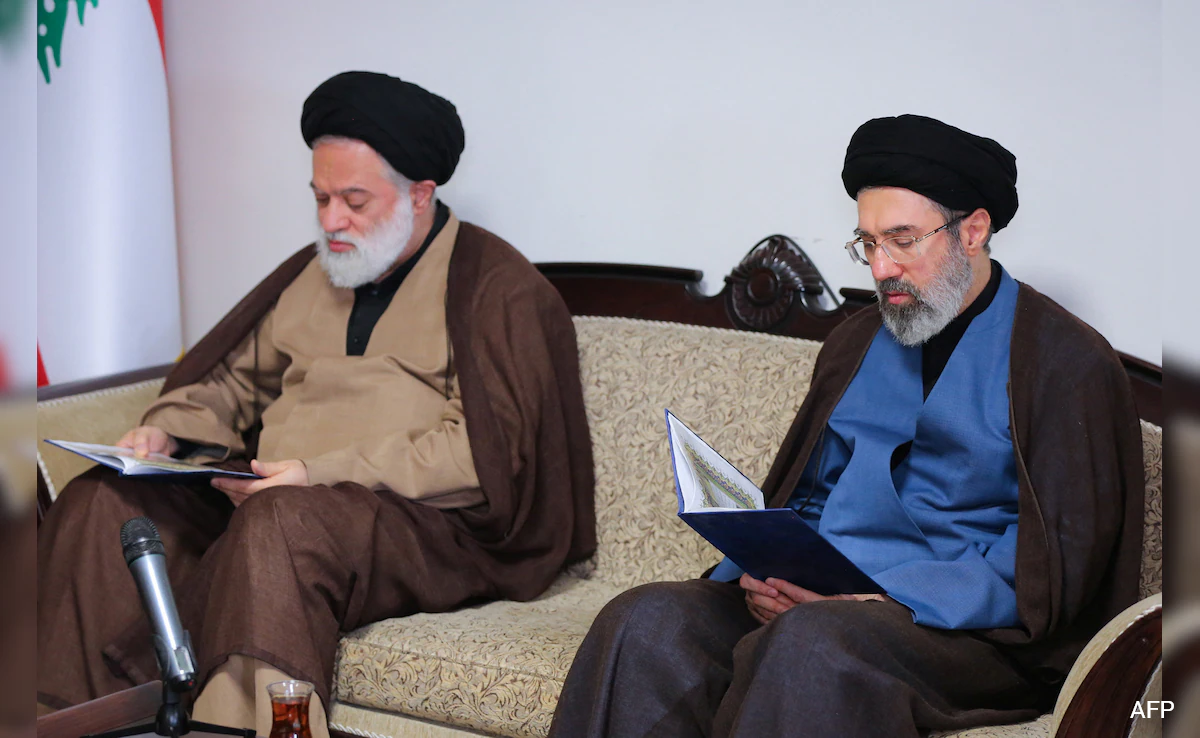
For most of his 56 years, Mojtaba Khamenei has kept a low profile in the Islamic Republic, quietly building networks of influence in the country's security apparatus, its clergy and within its wealthy business elite.
As he steps into his father's shoes, he faces not only a US and Israeli war machine bent on his downfall but a population in turmoil, much of which is desperate to see the back of his regime.
The second-eldest son of Ali Khamenei - the Supreme Leader killed in the opening hours of the US-Israel onslaught on Iran nine days ago - Mojtaba's ascent comes as the system of rule his father pioneered, and over which he kept a tight grip, battles the biggest existential threat in its near-50 year history.
Mojtaba Khamenei embodies everything that the many thousands of people who have protested against the Islamic Republic in recent years oppose. That includes the impunity with which his father's regime frequently targeted and killed citizens and political opponents, and the financial cronyism and corruption that's enveloped the economy.
Follow LIVE Updates
For years, proximity to the elder Khamenei often brought access to resources. Mojtaba amassed a multibillion-dollar international property portfolio, but it also fueled the phenomenon of the so-called aghazadeh - the moniker Iranians attach to the wealthy sons and daughters of the architects of the theocracy, who are largely insulated from the privations the rest of the population have been forced to endure.
January's bloody demonstrations were initially sparked by anger over the cost of living, but quickly spiraled into anti-government unrest. At least 7,000 civilians, and probably many more, were killed, according to human rights groups.
Khamenei's appointment signals that the regime is less likely to concede to Trump's demand that Iran surrender and that he'll continue his father's hardline approach to rule: Prioritising Islam and an anti-US foreign policy above all else. He could also use his leadership to avenge the killing of his father, mother and wife in the February 28 strikes.
After a delayed vote by the Assembly of Experts - the 88-member clerical body that's tasked with appointing a supreme leader - and days of speculation and infighting between Iran's political factions, the decision to appoint Khamenei's son looks like a defiant statement. A veteran of the 1980s Iran-Iraq war he's seen as close to the security forces, which indicates that the Islamic Revolutionary Guard Corps - the powerful wing of Iran's armed forces - will keep fighting in a war that's plunged the Middle East into a crisis, roiled energy markets and threatens to spread further into the global economy.
It's a decision that will aggravate Trump, who's expressed disdain for Khamenei and may use his appointment as a pretext to further intensify bombardments on Tehran, which on Sunday was covered in black smoke following air strikes by Israel on major oil depots.
"Selecting Khamenei signals continuity and defiance: a commitment to his father's legacy and the Islamic Republic's core tenets, alongside a rejection of US and Israeli efforts to reshape the system," said Dina Esfandiary, geo-economics analyst at Bloomberg Economics. "Khamenei will likely continue the war effort and project resistance."
On Friday, Trump called on Tehran to agree to an "unconditional surrender," which it rejected. Esfandiary believes Khamenei is "unlikely to seek engagement with the West and de-escalation."
The Supreme Leader has been the most powerful single authority in Iran since the Islamic Republic was established after the 1979 revolution. The position represents the highest level of religious authority in Twelver Shi'ism, the type of Shia Islam that's dominant in Iran, Iraq and Lebanon. The Supreme Leader is not just the head of state, but also controls the armed forces in Iran.
But the appointment of Mojtaba Khamenei violates a longstanding belief within the clerical establishment in Iran that the Islamic Republic should not be governed by dynastic rule. With his selection all pretense that the theocracy is based on a consensus-driven system that puts the needs of the people first, has been abandoned - at a time of war - as it seeks to protect the interests of the hardliners in power.
His Father's Son
All four of Khamenei's sons entered the clergy. Only Mojtaba sought to attain the theocratic credentials needed to be regarded as the highest level of cleric in Shia Islam, according to Mohsen Sazegara, a founding member of the IRGC and former deputy minister for budget and planning. Sazegara, who's based in Washington DC, became a vocal critic of Iran's Islamic constitution and Khamenei's rule. He left the country after being arrested several times for his dissenting views in the early 2000s.
Mojtaba was born in September 1969 in the holy city of Mashhad in northeastern Iran. He spent his early adult life in seminaries in Qom - the center of religious study in the country. Since then, he's widely seen as having interfered in politics and key institutions while building ties with wealthy business people close to the regime. During his time on the frontlines of the Iran-Iraq war he forged important relationships that would help him build influence inside the regime, including within its intelligence organisations, Sazegara said.
"Many of the friends that he found during the war he still has around him," Sazegara said, adding that the speaker of parliament, Mohammad-Bagher Ghalibaf, who is helping to manage Iran's war response, is among them and very likely pushed for his appointment as Supreme Leader.
According to Sazegara, the remaining political and military elite in charge of the country was heavily divided over picking Khamenei, who was backed by some of the country's most hardline, ultra-conservative clerics and most of the IRGC. Another faction, Sazegara said, most likely led by Ali Larijani, the secretary of the Supreme National Security Council, were in favor of retaining the interim leadership council - appointed as a stop-gap body to run things after the elder Khamenei was killed in the initial attacks.
Underscoring apparent divisions in the current wartime leadership over how Iran is handling its response to the attacks, on Saturday President Masoud Pezeshkian - who sits on the three-member interim council - said the armed forces, which had been given a high degree of autonomy over their actions at the start of the conflict, had been instructed "not to attack or launch missiles at neighboring countries unless attacked from there."
He was immediately criticised by hardliners and the attacks continued on Saturday and Sunday.
With Khamenei now helming the Islamic Republic, the IRGC will be more involved in state affairs and there will be no tolerance of internal dissent.
Sanctioned by the US in 2019, Mojtaba was accused of seeking to "advance his father's destabilizing regional ambitions and oppressive domestic objectives," alongside elements within the IRGC. Those deep ties to the Guards position him to wield influence and play a conductor's role much like his father.
He's rarely photographed in public, although images of him in state media surfaced more frequently as discussion of who would succeed his octogenarian father - supreme leader since 1989 - grew in recent years. Direct biographical details are scarce, but several reports paint him as a supporter of hardline former president Mahmoud Ahmadinejad, who won two terms in office between 2005 and 2013.
Ahmadinejad's 2009 re-election sparked a backlash by millions of voters who protested the result, accusing the regime of fraud and manipulation. The demonstrations were crushed by security forces. It was a watershed moment for many Iranians as they realized that the elder Khamenei was prepared to kill his citizens in order to exert full control over the country.
Mojtaba's association with those events and the crushing of the so-called Green Movement that was led by Ahmadinejad's main reformist rivals - former prime minister Mir Hossein Mousavi and cleric Mehdi Karroubi - has defined his public persona alongside his association with some of the country's most powerful businessmen.
It was around this time that Mojtaba's plans to establish himself as a credible successor to his father started, according to Sazegara. Having attained the necessary theological credentials to be eligible for the top job, he "worked to prepare for leadership."
From his office, he would liaise with IRGC units, particularly the Guard's intelligence organization and the network of Friday prayers leaders across the country.
In a 2017 letter, Karroubi wrote to the late Khamenei, he condemned the way that the 2009 elections were handled and how the IRGC had been allowed to build so much economic and political influence in the country. He singled out Mojtaba for his interference in the outcome of the elections. The letter, initially published on social media and on pro-reform websites, said that Mojtaba, the IRGC and its plain-clothed, volunteer paramilitaries - known as the Basij - worked together to crush protests and suppress dissent in order to protect Ahmadinejad's presidency.
Mousavi and Karroubi have both been under house arrest for 15 years and are likely to remain there following Khamenei's appointment.
Cleric With a Property Empire
A Bloomberg News investigation in January revealed that the younger Khamenei had built a large property empire including luxury houses in London and hotels in Europe. The foundations for this were laid in the late 2000s as sanctions tightened on Iran and the country's elite searched for ways to move capital offshore.
Khamenei spent years "planting his own team of allies throughout intelligence and religious bodies and he also kept a number of the country's corrupt oligarchy around him," Sazegara said.
He relied heavily on businessman Ali Ansari, whose fast-growing banking, construction and trading interests served as a conduit for shifting funds abroad, according to the Bloomberg investigation. Profits primarily tied to Iranian oil sales were routed through intermediaries in the United Arab Emirates before landing in offshore companies in jurisdictions such as the Isle of Man and Saint Kitts and Nevis. Those entities were then used to acquire luxury homes and five-star hotels across Europe.
The structure allowed Khamenei to assemble a global portfolio while keeping his name off the paperwork. A hotel in Frankfurt, Germany's financial capital, is now under review by Hilton Worldwide Holdings Inc. amid questions over its ultimate beneficial owner.
People familiar with the arrangements said Khamenei was closely involved in the deals despite avoiding direct legal ownership. Over time, the network developed into a sophisticated financial web capable of channeling billions of dollars into Western real estate and hospitality assets, a scale of wealth accumulation that contrasted sharply with the austere image projected by the Islamic Republic's ruling clerical establishment.
Ansari was sanctioned by UK authorities last year over his links to the IRGC. A lawyer representing him has previously said he would appeal against the UK decision and denied that Ansari had ever had any relationship with the new supreme leader. Khamenei has never responded to requests for comment from Bloomberg about his property business.
Trump dismissed Khamenei as a "lightweight" who wouldn't change the regime's policies in comments to the US news site Axios on Thursday. "Khamenei's son is unacceptable to me," Trump said, as he insisted that he should be personally involved in picking the country's next leader. "We want someone that will bring harmony and peace to Iran."
His father ruled Iran for 37 of the Islamic Republic's 47 years. Few would bet on Mojtaba Khamenei having that same longevity even if the Islamic Republic survives.
(Except for the headline, this story has not been edited by NDTV staff and is published from a syndicated feed.)
Track Latest News Live on NDTV.com and get news updates from India and around the world


