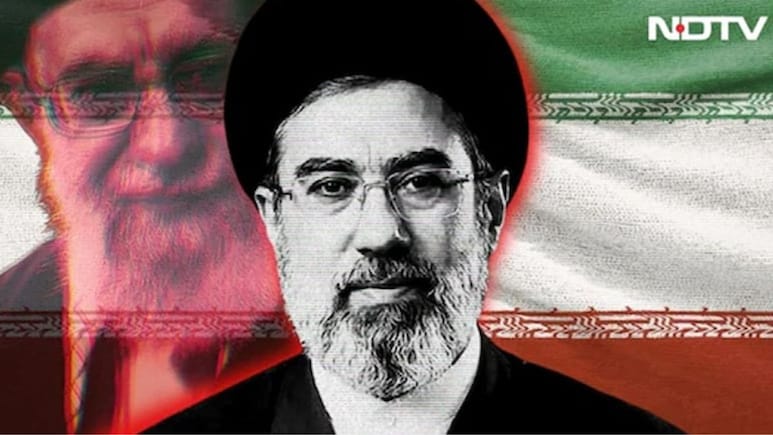
It's been over six weeks since Mojtaba Khamenei was announced as the new supreme leader of Iran following the assassination of his father, but Iranians have still not seen or heard from him. Now, US officials believe his efforts to remain hidden amid assassination threats might be one of the reasons behind the Iranian delay in the second round of peace talks, facilitated by Pakistan.
Quoting top Trump aides, CNN reported that the White House believes that with Khamenei absent from the active decision-making process, there were fractures within the current Iranian leadership, with leaders not having a clear consensus on their position or how much to empower the negotiators on decisions regarding the future of Tehran's nuclear programme.
Iran's current stockpile of enriched uranium-- an estimated 440 kilograms of 60 per cent enriched uranium, slightly short of the 90 per cent weaponisation threshold but enough to build eight to 12 bombs-- is a major sticking point in the peace talks.
Part of that complicating factor, Team Trump believes, is whether Mojtaba Khamenei was giving clear directions to his subordinates or whether they were simply guessing what he wanted without specific instruction.
ALSO READ: 'Iran Has Thousands Of Missiles To Continue War': Intel Belies Trump's Claim
Is Khamenei Part of the Action?
Ali Vaez, Iran project director at the International Crisis Group, told CNN that it appears that "Mojtaba is not in a state where he can actually make critical decisions or micromanage the talks." He, however, believes that "the system" was "using him to get final approval for key broad decisions and not (for) the tactics for the negotiations."
"The system does deliberately highlight Mojtaba's involvement because it provides a protective shield for that against internal criticism...unlike his father, who would come out regularly and comment on the state of negotiations," Vaez said.
"Mojtaba is missing in action, so attributing views to him is a good cover for Iranian negotiators to protect themselves from criticism," he added.
ALSO READ: Iran Found Its 'Nuclear Weapon'. Now The US Has To Adapt
Despite those significant hurdles, one official told CNN that there was still a chance that the US and Iran would return to the negotiation table soon. But if and when that happens is far from certain.
Where Is Mojtaba Khamenei
Khamenei has been conspicuously absent from action since the start of the war, which seems to be posing an existential threat to the Islamic regime that has ruled over Tehran for nearly half a century. Instead, statements attributed to him have been read out on national television or posted on social media.
The Islamic regime has even used Khamenei's AI-generated videos to deliver messages, fanning speculation that he might either be incapacitated or abroad. The absence of the new Supreme Leader is in stark contrast to his father, the late Ayatollah Ali Khamenei, who, for decades, remained the face of Iranian decision-making. Under his regime, hardly any week passed without a speech or a ruling.
ALSO READ: Iran Found Its 'Nuclear Weapon'. Now The US Has To Adapt
Last month, CNN reported that Mojtaba Khamenei had suffered a fractured foot, a bruised left eye and minor lacerations to his face in the February 28 US-Iranian strikes that led to the war.
Another report on Reuters claimed that Khamenei was taking part in meetings with senior officials via audio conferencing and is engaged in decision-making on major issues, including the war and new negotiations with Washington.
Track Latest News Live on NDTV.com and get news updates from India and around the world


