








- Shahed drones cost $30,000 but shooting them down with missiles costs millions
- Ukraine developed advanced interceptor drones to combat Russian-launched Shaheds
- US is interested in Ukraine's high-speed Sting drone for countering Shahed threats
Radar operators at a United States military installation in the Gulf watched a small object moving steadily across their screens. It was flying low, approaching over water, and moving at a speed slow enough to confuse automated threat systems but fast enough to close the distance quickly. Within minutes, the object resolved into a familiar shape -- a delta-winged one-way attack drone.
It was a Shahed.
The Iranian-designed Shahed-136 drone has become one of the most recognisable weapons of the modern battlefield. Cheap, expendable, and increasingly numerous, it has reshaped how wars are fought. In recent months, as tensions escalated following US and Israeli strikes on Iran, Tehran responded by launching waves of these drones across the Middle East.
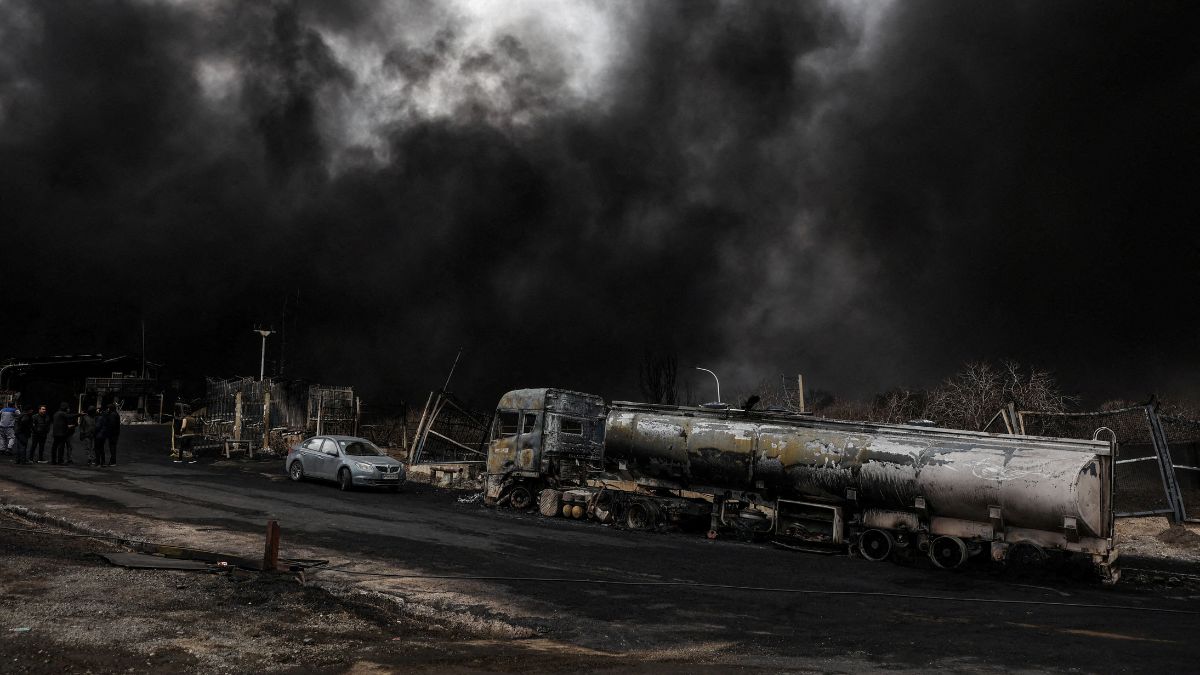
Some struck buildings in Bahrain, Kuwait, and the United Arab Emirates. One attack even hit a satellite antenna at a US naval facility in Manama, Bahrain -- the operational centre for the US Navy's Fifth Fleet.
The Cost Factor
The Shahed drone costs roughly $30,000. But the missiles often used to shoot it down such as the Patriot PAC-3 interceptor cost millions of dollars each. Gulf states have spent heavily deploying those interceptors in response to Iranian drone barrages, particularly since the outbreak of the latest conflict.
But those stocks are shrinking.
Now, the United States and several Middle Eastern partners are turning to another source for a solution: Ukraine.
Ukraine's Drone War Experience
For more than three years, Ukraine has been fighting nightly barrages of Shahed drones launched by Russia. Moscow acquired the Iranian technology early in its full-scale invasion of Ukraine and has since deployed them extensively against Ukrainian cities and infrastructure.
According to Ukraine's defence ministry, Russia launched roughly 54,000 of the drones last year alone. To counter the attacks, Ukraine has built what may be the most extensive anti-drone ecosystem in the world.
At the centre of this effort are specialised drone interception units, teams of operators trained to hunt down Shaheds using small, fast drones.
One such unit is the Signum battalion.
The Signum Fighters
The unit originated in the first days of Russia's full-scale invasion of Ukraine in 2022 as a volunteer detachment formed to defend Kyiv. Shortly afterwards, its members were redeployed to eastern Ukraine, where they joined the defence of positions held by the 3rd Battalion of the 93rd Mechanized Brigade.
At the time, the 93rd Brigade was defending one of the most contested sectors near Izium.
Russian forces frequently committed disproportionate armoured resources in assaults on individual villages.
"Russian forces frequently committed disproportionate armoured resources, deploying up to 10-12 tanks in assaults on individual villages," drone operators from Signum told NDTV.
Over time, the volunteer detachment was formally integrated into the Armed Forces of Ukraine. Today, it is one of many units specialising in drone interception.
How Ukraine Hunts Shaheds
According to Signum operators, Ukraine now deploys a wide range of interceptor drones.
"The Ukrainian military uses a wide range of interceptor drones, including FPV multicopters, high-speed drones such as the Sting, fixed-wing FPV drones, and drones with automated guidance using AI," the operators explained.
The Sting intercepor drone produced by Wild Hornets.
They added that Ukraine's drone industry has expanded dramatically during the war.
"Over the past few years, dozens of interceptor drone manufacturers have emerged in Ukraine. At the same time, Ukraine uses thousands of these drones every month," a drone pilot told NDTV.
Among these systems, one in particular has proved especially effective.
"Sting drones have proven particularly effective against Shahed drones, while systems like Techno-Taras perform well against reconnaissance drones," Signum members said.
The Sting intercepor drone produced by Wild Hornets.
But the operators said that the technology alone is not enough.
"However, drones themselves do not shoot anything down - effective use requires well-trained teams," they added.
The Sting drone, shaped like a bullet, is produced by Wild Hornets.
What The Pentagon Is Interested In
According to Ukrainian operators, the United States appears particularly interested in one class of interceptor.
"There are no detailed public specifics, but it appears that the United States is interested in our high-speed quadcopter interceptors such as the Sting, primarily for countering Iranian Shahed drones," Signum operators said.
The Sting drone is designed specifically to intercept airborne targets. It can reach high speeds and is capable of catching Shahed drones in flight before detonating near them.
According to Ukrainian operators, the drone's speed gives it a critical advantage.
"The Sting's cruising speed is about 150-170 km/h. At that speed it can fly more than 30 km. However, the higher the speed of the Sting, the shorter its operational range becomes," they said.
Against a Shahed drone cruising at around 185 km/h, that speed margin provides a narrow but workable window for interception.
The Anatomy Of A Drone Hunt
The process of intercepting a Shahed drone begins long before a pilot launches an interceptor. Ukraine has developed specialised detection networks that monitor incoming drone attacks.
"Ukraine has specialized systems that provide information about the direction of Shahed flights," the Signum operators explained.
Once a drone is detected, interception teams move into position.
A photograph taken on December 27, 2025 shows an Iranian-designed Shahed 136, (Geranium-2) drone used by Russian Army flying over Kyiv during a Russian drones and missiles attack.
Photo Credit: AFP
"Based on this information, mobile or stationary interception teams operate. Each team has a defined operational radius. One team can typically intercept Shaheds within a radius of about 15-20 km," Signum drone pilots told NDTV.
In recent months, videos of these interceptions have circulated widely online.
The Scale Of The Drone War
According to Ukrainian estimates, the country has faced more than 57,000 Shahed-type drone attacks since the start of Russia's invasion.
Wild Hornets' Sting drones have reportedly destroyed more than 1,500 targets. But Ukrainian operators say the real number of drone kills is far higher.
"It is important to clarify that Ukraine approaches countering Shaheds in a comprehensive way," Signum operators said. "We intercept them using helicopters, aircraft -- including F-16s -- small missiles, drones, and even machine guns mounted on pickup trucks."
In that ecosystem, FPV drones represent the cheapest solution.
"FPV drones are simply the cheapest way to shoot down Shaheds," they said.
Missed interceptions still occur, particularly when pilots lack experience.
"Missed interceptions are usually caused by limited pilot experience. Today the overall level of skill has increased significantly," Signum operators said. "The most important factor is early detection. If Shaheds are detected in time, their chances of success are very small."
"Drones destroy far more than 1,500 targets. In fact, in February 2026 alone, more than 1,500 Shaheds were reportedly shot down by drones in Ukraine," they added.
Why Drones Are Winning
Drone interceptors are increasingly dominating Ukraine's air defence. In January 2026, around 70 per cent of Shahed kills were reportedly achieved by interceptor drones rather than missiles or guns.
For the operators on the front line, that trend was not surprising.
"No, it did not surprise us," they said. "It is a natural development. The share will only increase. It will probably reach around 85-90%."
The reason is simple: cost.
A Patriot interceptor missile can cost several million dollars. A Shahed drone costs roughly $30,000.
By contrast, Ukrainian interceptor drones can cost around $2,500.
The Cost War
This cost imbalance has become one of the defining features of modern warfare. Gulf states defending against Iranian drones have been firing expensive Patriot missiles at comparatively cheap aerial threats.
A policeman inspects the wreckage of a drone in downtown Dubai on March 12, 2026.
Photo Credit: AFP
"How long can Patriot PAC-3 interceptors keep being spent on Shaheds?" Signum pilots asked. "Those systems are needed to intercept Russian ballistic missiles."
A Strategic Exchange
Ukraine also sees potential advantages in exporting its technology. If Gulf states use Ukrainian interceptor drones instead of Patriot missiles, more of those missiles could remain available for Ukraine's own air defence. Kyiv has therefore begun sharing its expertise.
Ukrainian President Volodymyr Zelenskyy confirmed that Ukrainian military specialists have been dispatched to the region.
"The first three countries to which we sent them, according to our agreements, are Qatar, the Emirates, and Saudi Arabia," he said recently. "When it comes to shooting down massive Shahed attacks, only Ukrainian experience can really help with this today."
The Ukrainian presidency later confirmed that experts were also sent to Jordan.
The Next Challenge
Despite Ukraine's success against Shaheds, the drone war continues to evolve. Russia has introduced a new version of the drone known as the Geran-3. Unlike earlier models, it is jet-powered.
The drone can fly at speeds exceeding 550 km/h, far faster than existing Ukrainian interceptor drones.
The Signum operators acknowledge that the threat is real.
"Ukrainians are not standing still. For such cases we have small missiles, and drones with jet boosters are also being developed," they said. "The real value is not the hardware. The value lies in our unique experience."
"The more the United States helps Ukrainian units, the more unique combat experience it gains - experience that could save many billions of dollars and many lives in the future," the Signum operators said. "American money works best when it supports the Ukrainian military."

