With Missiles Carrying 1,000 kg Explosives, A New Tactical Phase For Iran
Iran dropped a bombshell on Sunday after a senior Revolutionary Guard commander vowed to only launch missiles with explosives of 1,000kg or more
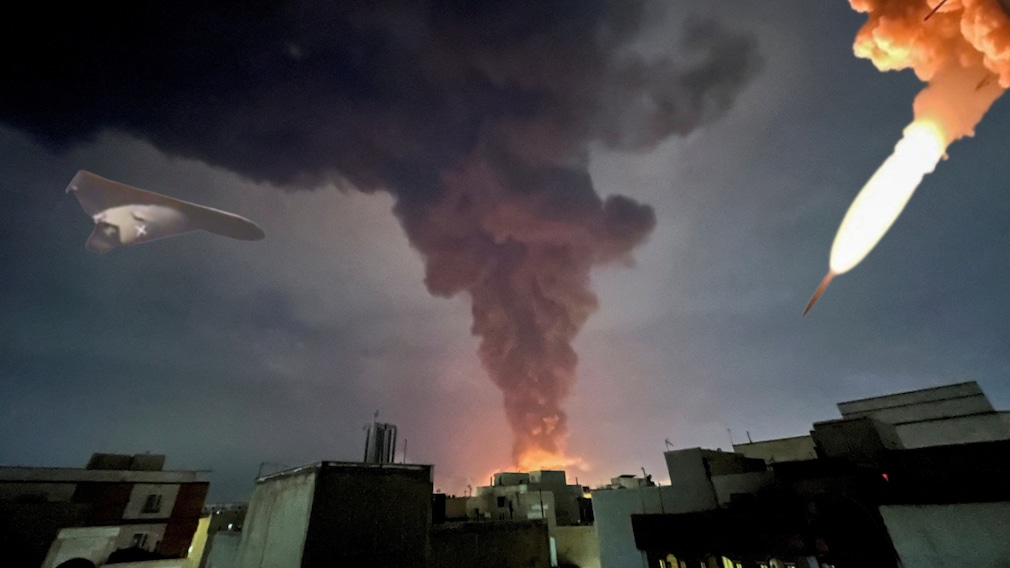
Iran dropped a bombshell Sunday after a senior Revolutionary Guard Corps commander said the regime would now only fire missiles with payloads of 1,000kg or more – a sharp escalation in the war with US and Israel forces since it more than doubles blast radius, range, and destructive power per missile.
Lebanese broadcaster Al Mayadeen quoted Brigadier General Majid Mousavi as also saying attacks that have targeted American and Israeli military bases so far, as well as regional infrastructure like the airport in Dubai and the Ras Tanura oil refinery in Saudi Arabia – will now increase in intensity and scale.
Military observers said this likely signals a new tactical phase for Iran – shifting from trying to overwhelm enemy air defences, with wave after wave of the cheap-but-deadly Shahed drones, to focus on potential high-impact penetration strikes in which fewer, faster, and harder-to-intercept missiles cause the same damage, specifically against hardened targets like airbases and underground command centres.
Geopolitical analyst Shanaka Anselm Perera argued on X this new phase is Iran 'changing the economics of (the) war', i.e., switching to heavier payload missiles to rewrite intercept math.
Iran possesses the largest and most diverse missile arsenal in the Middle East, according to the Washington-based Center for Strategic and International Studies. This arsenal includes the Soumar, a ground-launched cruise missile – nuclear-capable – with a presumed maximum range of 3,000km, and the Sejjil, a medium-range ballistic missile with a 2,000km-range.
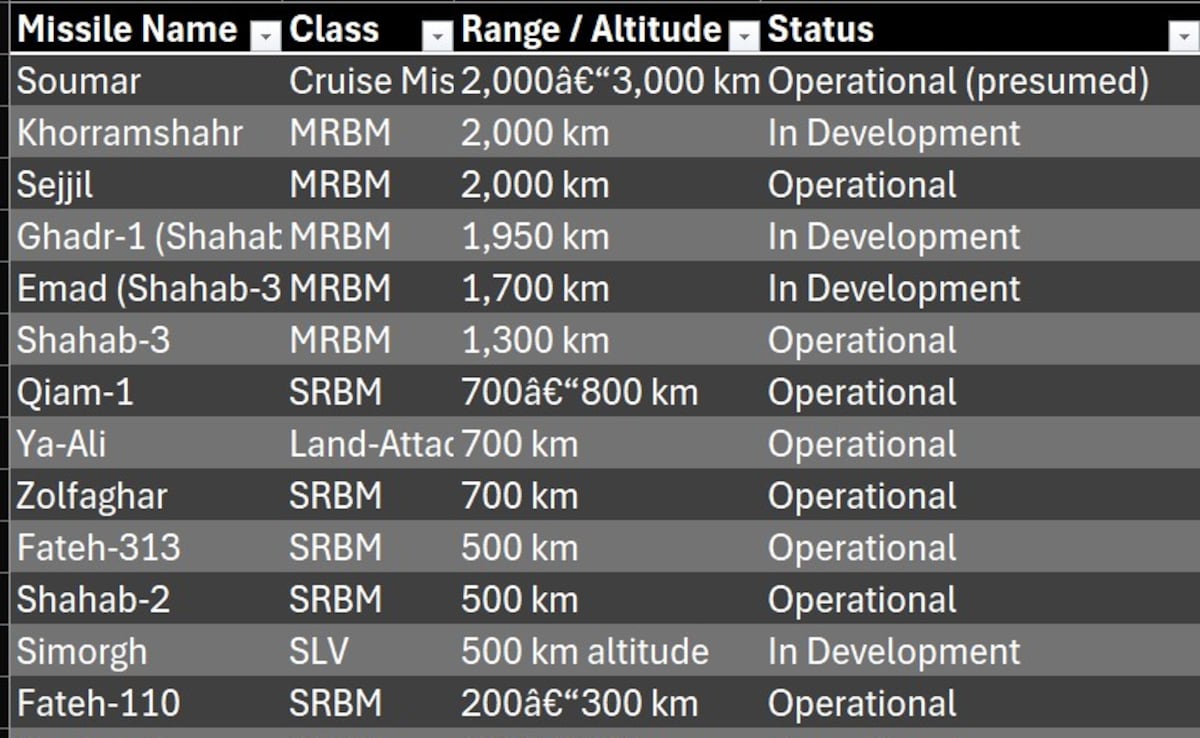
Iran's missile arsenal. Source: Missile Defense Project, Center for Strategic and International Studies
A third option is the Khorramshahr MRBM, likely derived from North Korea's Hwasong-10 and which is believed to have range of 2,000-3,000km. It can carry payloads up to 1,800kg.
A fourth is the Kheibar Shekan, though its payload is below that now vowed by Mousavi.
Iran's 'force them to run out of missiles' test
Iran's much-discussed earlier strategy was to draw US, Israeli air defences into a 'war of attrition', i.e., saturate them, and those of Gulf nations dragged into this war, by firing barrages of low-cost missiles and Shahed-131 and Shahed-136 drones.
In essence, the idea was to make interception a costly proposition; conventional military doctrine recommends firing two-three interceptors to block an incoming missile/drone threat. And it was; the US-made PATRIOT air defence system, for example, has been largely successful in neutralising Iranian attacks; UAE-operated battalions reported a 96 per cent interception rate.
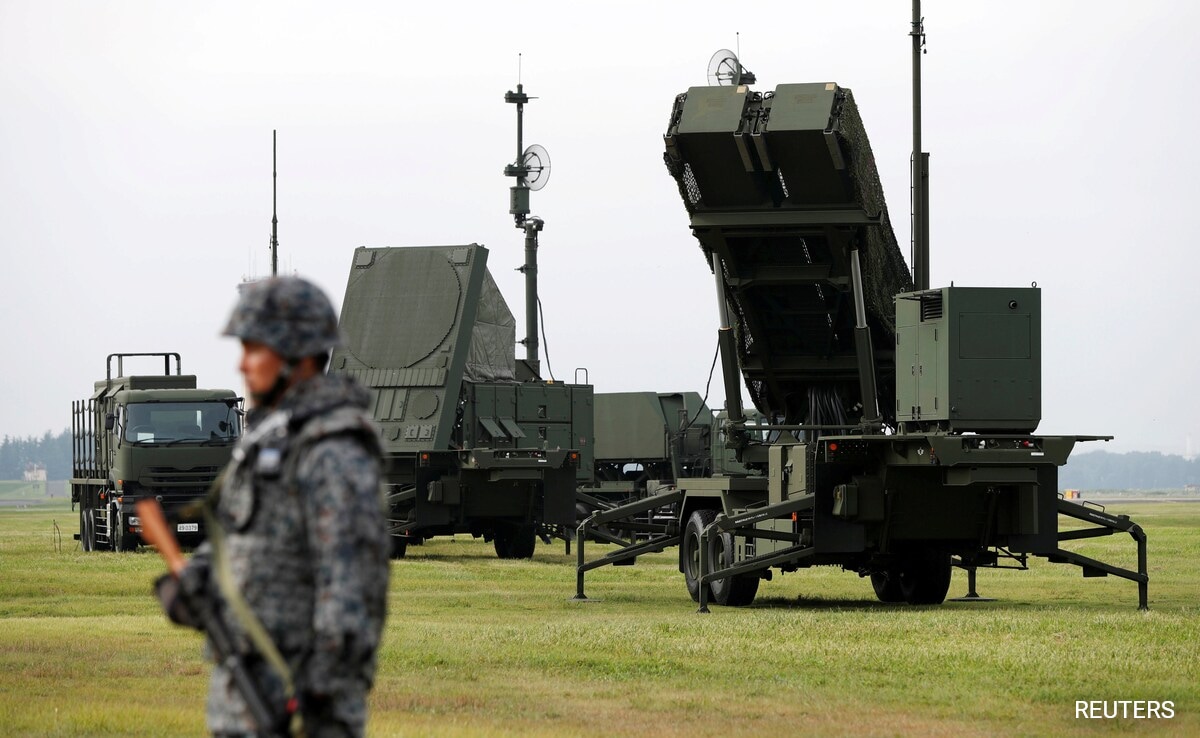
US-made PATRIOT air defence systems (File).
But a PATRIOT missile costs US$4 million and a THAAD interceptor around US$12 million, and an Israeli Arrow-3 missile approximately US$3 million. A Shahed drone caps out at US$50,000.
RECAP | Iran's Missile Math: $20,000 Drones Take On $4 Million US Patriots
Multuple analysts have pointed out the math just isn't in the US' favour, particularly since that does not mean Washington could stand down firing of interceptors; the real cost of missile interception is not monetary as much as it is potential loss, i.e., how much damage will be done if an enemy missile hits a target as opposed to how much money is spent on intercepting it.
That question almost always has only one answer – intercept every enemy missile possible.
Iran's 'heavy' missile shift
Iran has fired nearly three dozen rounds of projectiles, including the Shahed-136 'kamikaze' drones, since the war began February 28. The 33rd attack – spread over Sunday and Monday –included solid-fuelled Kheibar Shekan missiles with a 1,450km range and 550kg payloads. But Iran also fired the much heavier Khorramshahr missile.
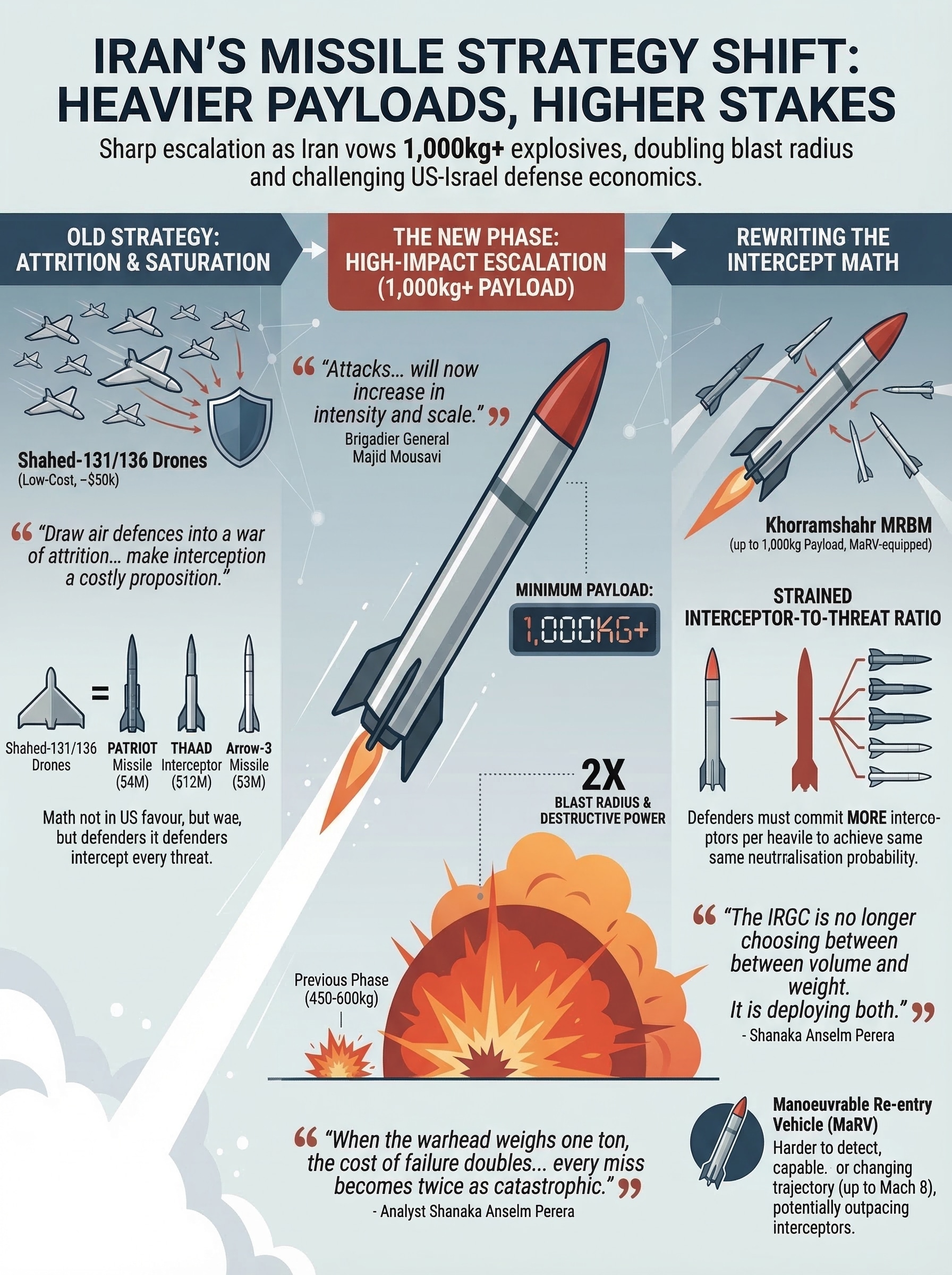
Apart from being larger, both also have manoeuvrable re-entry vehicles, i.e., they are capable of changing trajectory, at speeds up to Mach 8, Iran claims, which make them harder to intercept.
The Khorramshahr, for example, has a manoeuvrable re-entry vehicle, or MaRV, that the IRGC claims can outpace/outfox Israeli Arrow-3 exo-atmospheric interceptors.
This (read with Mousavi's warning about firing 1,000kg+ payloads only) indicates a key shift in the way the Tehran's decentralised battlefield command is managing this conflict.
In a post on X, the commander of the Aerospace Force of the !/R/G//C, Brigadier General Majid Mousavi, confirmed that every missile launched from now on will weigh no less than one ton.
— Al Mayadeen English (@MayadeenEnglish) March 10, 2026
Mousavi added that the intensity of missile salvos and the scale of attack waves will… pic.twitter.com/Ap78Vt9xpj
Using larger warheads now doesn't affect the interception math; US, Israeli, and Gulf nations' forces must still try and stop every Iranian missile or drone they can.
But "when the warhead weighs one ton, the cost of failure doubles because the destructive radius on impact doubles… every miss becomes twice as catastrophic", Perera explained.
"The defender must now commit more interceptors per incoming missile to achieve the same probability of neutralisation. The interceptor-to-threat ratio – already strained at 190 to 1 on the drone front (thanks to the Shahed) – now deteriorates on the ballistic missile front as well."
"The IRGC is no longer choosing between volume and weight. It is deploying both…" he warned, outlining also how the inclusion of heavier missiles changes the intercept math.
Previously reported interception rates, he argued, were based on Iran missiles carrying warheads between 450 and 600kg.
The question now, he said, is "whether the same architecture holds when every incoming warhead is twice the mass (and) destructive radius".
-
Opinion | Why A 'Bangladesh' Proposal By Turkish Media Should Worry India

A recent article in Turkish media illustrates how Ankara is turning into a strategic threat for India and its neighbourhood
-
Opinion | 4,800 Indians Removed, 51,000 ICE Arrests: What's Happening In Trump's America?
According to Stop AAPI Hate, Indians are now one of the most targeted groups by ICE, with the highest number of arrests, detentions, and deportations out of all Asian and Pacific Islanders.
-
Opinion | Noakhali To Parliament, What Gandhi, Nehru, Jinnah And Faiz Were Doing On Aug 15, 1947
What was Gandhi doing while Nehru was making his famous midnight speech, and why was Jinnah hosting a lunch as a new nation began fasting? August 15, 1947, looked very different depending on where you stood.
-
Opinion | 79 Years On, India's Enduring Answer To Those Who Had Predicted Its Collapse
Seventy-nine years in the lifespan of an ancient civilisation is a mere heartbeat; yet, in the annals of modern nation-building, it's an audacious triumph.
-
The Coast Pays, Delhi Collects: What The Centre's Mineral Bill Takes From States
India's mineral wealth may lie with the states, but the power to tax it is increasingly travelling north.
-
Opinion | Nanded Attack: Sukhbir Badal And The Past That Still Haunts Him, 11 Years Later
Badal has now faced two serious physical attacks at Sikh religious places in less than two years. Is religious atonement enough for political forgiveness?
-
How Parents Walk Tightrope Of Sending Child To Daycare And Ensuring Safety
As dual-income households rise in India and nuclear families become the norm, daycare support is no more a want, but a need.
-
Opinion | Indian Parliament And The Perils Of Empty 'Swagger'
Indian MPs - on all sides - have found a dangerous new way to game the Parliament. And so far, they all are winning
-
Al-Assad Faces Death, But Sleeps Safely In Russia. What Syrians Think
A court in Damascus sentenced Syria's ousted president Bashar al-Assad and his brother, Maher al-Assad, in absentia for murder, torture and crimes against humanity committed before and during Syria's 14-year civil war that left about half a million people dead.
-
One Company, 40-Year Career: The N Chandrasekaran Story
N Chandrasekaran, a former chief executive of Tata Consulting Services (TCS), took over as chairman of Tata Sons in 2017 following a bitter boardroom battle that led to the ouster of Cyrus Mistry.