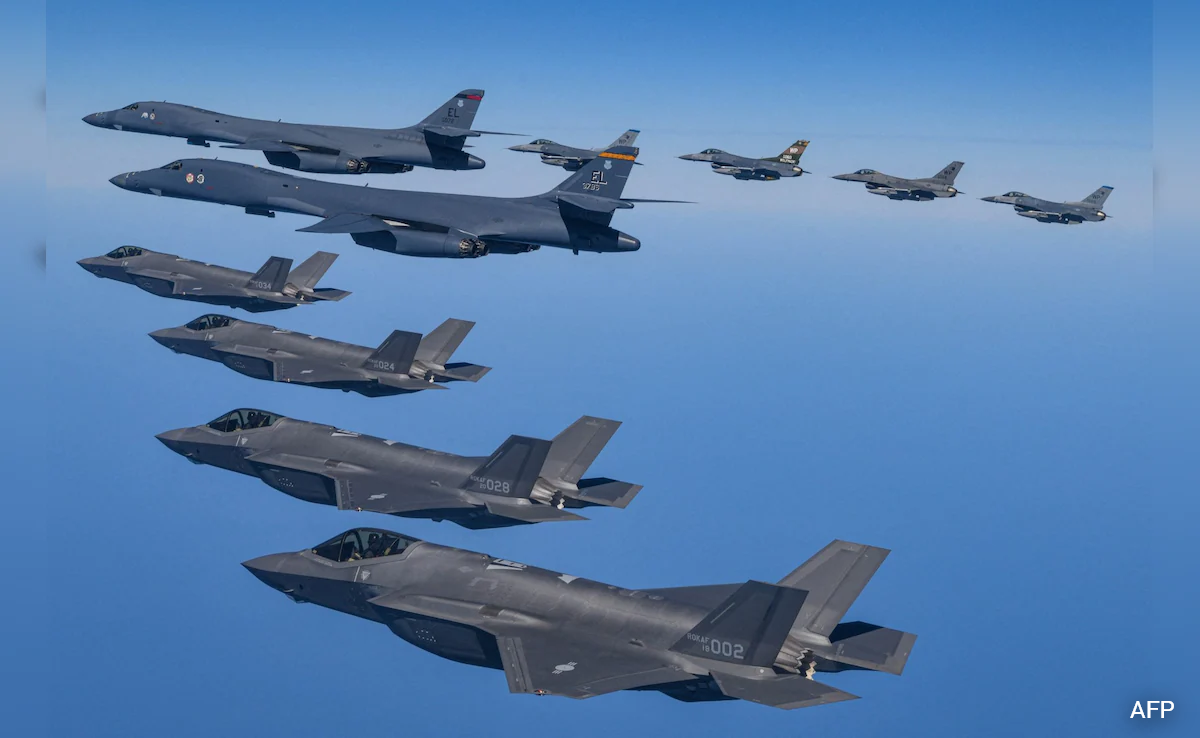
About a dozen B-1B bombers have been deployed to RAF Fairford in the United Kingdom for airstrikes on Iran. This accounts for more than half of the US Air Force's mission-capable B-1 Lancer fleet.
US Central Command said Monday that B-1B Lancers, capable of carrying a payload of up to 34,000 kg have been operating over the Gulf in support of Operation Epic Fury, the joint US-Israeli war on Iran.
“Nicknamed the BONE, B-1Bs hold world records for speed, payload and range,” the CENTCOM said.
B-1B Lancers – capable of carrying a payload of 75,000 pounds – have operated over the Middle East in support of Operation Epic Fury. Nicknamed the BONE, B-1Bs hold world records for speed, payload and range. pic.twitter.com/pwYq7n1BMO
— U.S. Central Command (@CENTCOM) March 15, 2026
The B-1 holds 61 world records recognised by the Federation Aeronautique Internationale for speed, payload, distance and time to climb across different aircraft weight categories.
Follow LIVE Updates
The buildup at the Gloucestershire air base began on March 6, when the UK Ministry of Defence allowed the US to use its bases to attack Iran. Three B-52 Stratofortress aircraft have also been deployed.
About The B-1B Lancer
The B-1B Lancer is a long-range heavy bomber used by the US Air Force. It is designed to carry large quantities of conventional weapons and strike targets anywhere in the world.
Because of its speed, range and heavy payload, the aircraft is considered the backbone of the US long-range bomber fleet.
The bomber is commonly nicknamed “BONE”, derived from the pronunciation of B-One.
What makes it powerful?
The B-1B can carry one of the largest conventional weapon loads of any aircraft in the US Air Force. It can deliver both precision-guided and unguided bombs.
The B-1B first saw combat in 1998 in Iraq. It was later used in major conflicts, including NATO's Operation Allied Force in 1999, the war in Afghanistan after 2001, and the Iraq War.
The aircraft was originally designed to carry nuclear weapons, but the US removed its nuclear role in 1994. It was fully converted to carry only conventional weapons by 2011 under international arms control agreements.
Features
- Can carry about 34,000 kg of weapons, allowing strikes on multiple targets in a single mission.
- Equipped with advanced radar and navigation systems for accurate targeting, even without ground-based navigation aids.
- Features variable-sweep wings that move forward during take-off and landing, and sweep back during high-speed flight.
- The design improves speed, stability and manoeuvrability.
- Capable of flying at over 1,450 kmph and operating above 9,000 metres.
- Has intercontinental range, enabling long-distance strike missions.
- Can remain airborne for long periods for patrol and target monitoring.
- Fitted with electronic warfare systems that detect and jam enemy radar.
- Uses chaff, flares and decoys to evade incoming missiles.
Track Latest News Live on NDTV.com and get news updates from India and around the world


