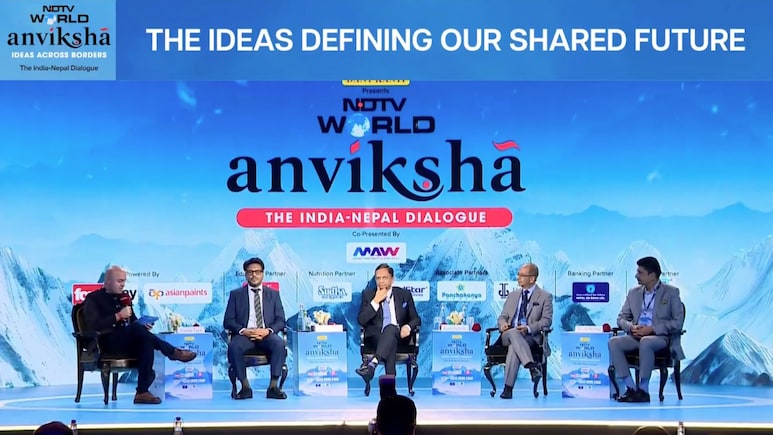
India and Nepal need to move beyond traditional trade and physical connectivity to build a broader economic partnership focused on manufacturing, energy, tourism, technology and entrepreneurship, industry leaders said during a panel discussion at NDTV Anviksha.
NDTV World on Thursday launched its new dialogue series, "NDTV Anviksha: Ideas Across Borders".
The panel on "Nepal-India Industry Partnership: Building the Next Growth Corridor" brought together stalwarts such as Gaurav Tayal, Birendra Raj Pandey, Shishir Priyadarshi and Vishnu Agarwal.
#NDTVWorldAnviksha | Nepal-India Industry Partnership: Building the Next Growth Corridor
— NDTV (@ndtv) August 27, 2026
On the panel with @AdityaRajKaul: Gaurav Tayal, Birendra Raj Pandey, @priyadarshi_crf, and Vishnu Agarwal#NDTVAnviksha #IdeasAcrossBorders #IndiaNepalDialogue pic.twitter.com/R6IXfRjWG6
The speakers highlighted Nepal's hydropower potential, young population and strategic location. They also stressed the need for better infrastructure, connectivity, policy consistency and a more investor-friendly environment.
India-Nepal Partnership Beyond Physical Connectivity
Priyadarshi, President of Chintan Research Foundation, said Nepal and India must balance economic development with environmental sustainability. He suggested identifying fragile ecological regions where development needs to be carefully managed, while simultaneously developing economic growth corridors.
According to him, future growth corridors should not be limited to transporting goods. They should also enable the movement of people, energy, talent, technology and emergency aid.
He also said Nepal could benefit from India's experience by "leapfrogging" some stages of development rather than repeating the same process. "I think for Nepal, it's extremely important to balance out what we call the sustainability of development and the sustainability of the environment," he added.
Infrastructure Needs To Be More Resilient
Birendra Raj Pandey, President, Confederation of Nepalese Industries, said Nepal's geography makes it particularly vulnerable to natural disasters and called for greater focus on climate-resilient infrastructure.
"Our very young mountains, steep terrain and a lot of vulnerabilities like golf and others and infrastructure is so important and CNI has been raising this point the last decade or so that we need to build infrastructure more sustainably. Resilience is very important," he said.
Pandey said infrastructure planning should take into account Nepal's steep terrain and ecological vulnerabilities, while also improving early-warning systems. He stressed that Nepal and its neighbouring countries need to work together to build infrastructure that can withstand disasters and protect lives and property.
Tourism, Education And Hydropower Offer Opportunities
Gaurav Tayal, Vice President of the Nepal-India Chamber of Commerce and Industry and Managing Director of Surya Nepal, said India-Nepal ties need to go beyond physical connectivity, highlighting education, tourism and energy as key areas of opportunity. He suggested exploring the possibility of bringing institutions such as IITs and IIMs into Nepal to provide world-class education and improve talent mobility between the two countries.
Tourism, he said, could also become a major growth area, particularly premium tourism and destination weddings. Better air connectivity between Indian cities and destinations such as Kathmandu, Pokhara and Chitwan could help unlock this potential.
Tayal also highlighted Nepal's hydropower potential and suggested that Indian companies could invest in the sector.
Greater Policy Certainty For Investors
Vishnu Agarwal, Managing Director, MAW Group of Companies, said several Indian investments made in Nepal during the 1990s had performed well, but policy uncertainty and frequent changes in government later affected investor confidence.
He said Nepal needs to change the narrative around its investment environment and provide greater policy consistency to attract Indian and other foreign investors. Agarwal also pointed to energy, industrial parks and manufacturing as major opportunities.
Youth and entrepreneurship at the centre of future growth
Priyadarshi called for a shift from creating jobs for youth to helping them become job creators through skills, technology, capital and market access.
Agarwal stressed that Nepal should look beyond its population of around 30 million and consider the much larger market available across the Indian states bordering the country.
From Commodities To Premium Brands
Tayal said Nepal could also focus on adding value to products such as large cardamom, coffee, tea and honey rather than competing purely on scale.
He pointed to the success of premium products such as Manuka honey and said Nepal could develop strong brands around its own natural resources.
"And if you see India as a partner, India can bring in a lot of great management practices, can bring technology, and they can always bring a large market to them. I think both of these things, if they happen, I have no doubt that in the coming five to ten years, we will be seeing one of the most vibrant growth corridors developing in South Asia," he added.
Track Latest News Live on NDTV.com and get news updates from India and around the world


