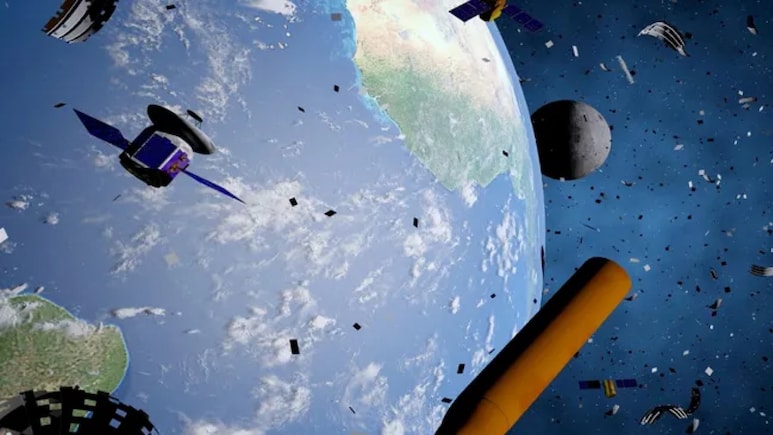
The amount of space junk falling back to Earth is increasing as more rockets and satellites are launched into orbit. While most debris burns up in the atmosphere or falls into the ocean, large objects weighing around a metric ton now re-enter Earth's atmosphere about once a week, reported The New York Times.
According to Mariusz Slonina, who heads space situational awareness operations for the Polish Space Agency, around one metric ton of space debris re-enters Earth's atmosphere every week.
“The re-entries happen each and every day,” he said. The US Space Force issued alerts for nearly 820 objects re-entering the atmosphere in 2025, compared to 110 alerts a decade earlier, reflecting the rapid increase in space activity.
One such incident occurred near Mukuku village in Kenya, where a large metal ring from a rocket crashed into farmland. The object, which was supposed to burn up during re-entry, landed intact and was later identified as part of a rocket that had remained in orbit for more than 16 years.
Why It Is Happening
The rise in rocket launches and satellite deployments has increased the amount of debris returning to Earth. More than 300 rockets were launched last year, while thousands of satellites currently orbit the planet. Many of these satellites eventually re-enter the atmosphere after completing their missions.
Recent incidents include debris from the International Space Station landing on a home in Florida, parts of a SpaceX rocket falling in Poland, and a defunct Chinese satellite breaking apart over Spain's Canary Islands. Pieces of space debris have also been found in Australia and the Philippines.
Growing Risks
Although people are still more likely to be struck by lightning than by falling space debris, experts say the risk is rising as the number of objects in orbit continues to grow. A study for the US Federal Aviation Administration (FAA) estimated that, by 2035, debris from SpaceX satellites alone could cause an injury or fatality once every two years.
Experts have urged governments and companies to use materials that fully disintegrate during re-entry. However, no such regulation currently exists.
Regulations Lag Behind
The report noted that UN treaties governing liability for space debris were framed during the Cold War and have limited scope. It also said the UN issued guidelines on space debris in 2007, but those guidelines are nonbinding.
According to The New York Times report, even the best rocket scientists cannot accurately predict where uncontrolled space debris will land. Even a one-minute error in estimating re-entry can change the landing zone by nearly 300 miles.
Who Pays If Space Debris Causes Damage?
If space debris belongs to a company or agency from your own country, any compensation or legal claims are generally handled under the country's laws. However, if the debris comes from another country, governments usually rely on United Nations treaties to seek compensation.
Track Latest News Live on NDTV.com and get news updates from India and around the world


