






The year was 1993. On July 21, in the heart of Kolkata, police opened fire on a crowd of demonstrators. Thirteen people were killed. The march had been led by Mamata Banerjee, then a Young Congress leader, towards the Writers' Building as part of the "Writers' Chalo" movement. The incident shook Bengal politics to its core and would go on to become one of the most enduring emotional symbols of Mamata Banerjee's political movement.
Since then, every year, Mamata has observed July 21 as Shahid Dibas - Martyrs' Day. Even after the formation of the Trinamool Congress, the event continued to grow in scale and significance. Over the years, it became one of the biggest annual political gatherings in Bengal.
18 Years Later
The story of Suvendu Adhikari - one of Bengal's most consequential political figures of recent times - begins 18 years later, in 2011. That year, a huge event was organised at Brigade Parade Ground and Dharmatala under Mamata Banerjee's leadership. The crowd was enormous. The atmosphere was charged. By then, Mamata had already emerged as the undisputed force against the Left Front government, and the momentum for change in Bengal was building to a fever pitch.
Suvendu Adhikari was, at that time, the Youth Trinamool Congress president - an important organisational figure who had played a major role in strengthening the party at the grassroots level, especially in East Midnapore and adjoining regions. He was on stage that day. But something felt wrong.
The event management, stage announcements, and overall coordination were almost entirely in the hands of Kunal Ghosh, who was then extraordinarily prominent within the party and closely aligned with Mamata Banerjee. Kunal was making the announcements, directing the flow of the event, energising the crowd, and effectively conducting the entire gathering. Suvendu, despite his organisational stature, remained largely silent and inactive on stage - present, but peripheral. To many observers, it appeared as though he had been placed there simply to be seen, not heard.
The First Slight
For someone as politically ambitious and organisationally driven as Suvendu Adhikari, that was not a trivial insult.
Outwardly, nothing happened. But the first seeds of distance had been planted. Suvendu reportedly felt that Kunal Ghosh had displaced him in the leadership hierarchy, and that Mamata Banerjee herself had quietly approved this arrangement. From that moment, a slow-burning sense of wounded pride began to take root.
The answer to why he felt so isolated - despite being surrounded by Mamata, the party leadership, and the very movement he had helped build - lies partly in the nature of Mamata Banerjee's politics itself. Mamata had emerged from street movements, agitation politics, and direct mass mobilisation. She valued absolute loyalty and exercised tight central control over the movement's emotional narrative. In such a political universe, space around the leader is carefully rationed. Younger leaders with strong independent mass bases inevitably began competing - consciously or unconsciously - for visibility and influence. Suvendu was among such young leaders then. But, stubborn and self-respecting, he was also not the type to let things go. That incident at Brigade and Dharmatala stayed with him.
Soon came another blow. Rajib Banerjee had reportedly been assured the post of Youth Trinamool Congress president, and was even asked to postpone a planned trip to Australia in anticipation. But at the last minute, Soumitra Khan was brought in instead, and Suvendu was effectively edged out of that organisational space entirely. For Suvendu, this was yet another betrayal.
The Mukul Roy Era
Around the same period, Mukul Roy's star was rapidly rising as one of the most powerful figures inside the Trinamool Congress. He and his son, Subhranshu Roy, grew increasingly influential in youth and organisational politics. In fact, people would openly say that though Mamata Banerjee was the Chief Ministerial face, Mukul Roy was the TMC's organisational backbone.
Abhishek Banerjee had not yet emerged as a dominant force in the party in those days. Yet, he was slowly rising through the youth leadership structure. Inside the party, a quiet but unmistakable conversation had begun taking shape about who would eventually emerge as Mamata Banerjee's political heir, Roy or Banerjee. A silent power struggle was already on its way.
Suvendu, watching all of this patiently, began to understand his own position more clearly. The number-two role he had perhaps aspired to get, was already slipping away from him. Roy or Banerjee, Adhikari found himself slowly sidelined - close to Mamata, and yet far from power.
Eventually, though, Mukul Roy left for the Bharatiya Janata Party (BJP). That would further clear the way for Abhishek Banerjee. The trajectory was becoming clear. And its implication wasn't lost on Suvendu.
As these developments unfolded, Suvendu slowly began to reckon with the possibility that he, too, might eventually have to leave the Trinamool. BJP leaders had already begun establishing contact with him. But it wasn't that straightforward. His father, Sisir Adhikari, an old Congressman and seasoned politician, was firmly opposed to the idea. Mamata Banerjee herself reportedly made repeated efforts to stop Suvendu from leaving. She even sought Sisir Adhikari's help to bridge the growing distance. Sisir tried to defuse the tensions. But by then, the real conflict perhaps was no longer between Suvendu and Mamata directly - it was Abhishek Banerjee's growing influence over the party machinery that didn't sit right with Suvendu.
Suvendu Was No Mukul Roy
Mukul Roy's drift towards the BJP had been driven by some sticky factors. For one, he faced multiple allegations as a Rajya Sabha MP. By the time he had made the move, his significance within the Trinamool was also fading. His flight to the BJP, thus, was only natural.
Suvendu's case was different - and the BJP knew it. He was seen not merely as another defector but as a potential alternative for anti-Mamata politics in Bengal. BJP strategists saw in Suvendu something of what leaders like LK Advani had once identified in Mamata decades earlier - a regional force capable of channelling widespread popular discontent against an entrenched establishment.
The Final Nail In The Coffin
Before Suvendu's final goodbye, there was one last telling episode. The Trinamool Congress had organised a massive state conference in Digha - deep in the Adhikari family's home turf of East Midnapore. Suvendu was one of its principal organisers and naturally expected recognition for the scale and effort. Instead, the conference seemed to dissolve into what many described as a celebratory fan gathering rather than any serious organisational exercise. Despite the enormous effort he had put in, Suvendu felt, once again, that he had not received the importance he deserved.
That was the last straw.
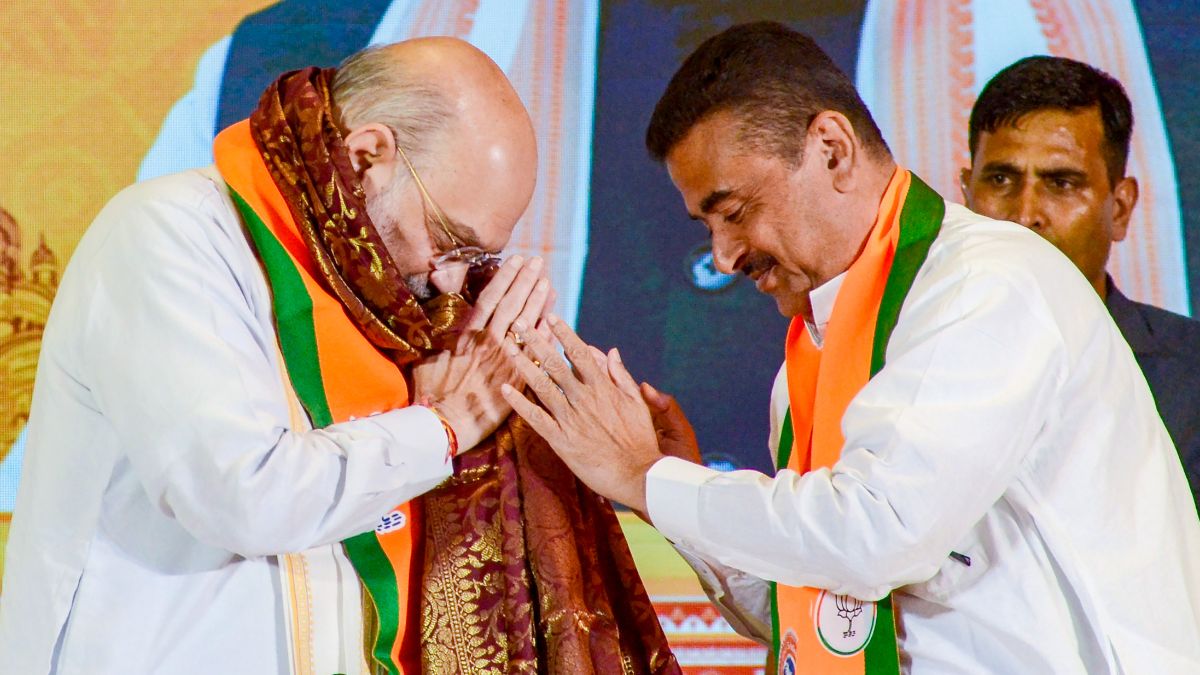
On December 19, 2020, Suvendu Adhikari officially joined the BJP in the presence of Amit Shah. By the 2021 assembly election, he had defeated Mamata Banerjee in Nandigram, her own chosen battlefield. Suvendu Adhikari had now well and truly emerged from the Trinamool and Mamata's shadow to cement his place in Bengal's public memory.
Now the Leader of Opposition in the assembly, it was time for Suvendu to challenge his former political family head-on - and take no prisoners as he did that.
Suvendu Rises
After joining the BJP, Suvendu moved steadily and visibly closer to the RSS ecosystem. One of the most discussed moments came when he attended a major RSS gathering wearing the traditional RSS uniform, or a 'ganvesh'. Appearances at events of that level are rarely extended to leaders unless they have a deep organisational grounding in the Sangh. That made his presence there symbolically significant. In July 2023, he attended another major RSS event associated with Mohan Bhagwat, which many observers interpreted as confirmation that the RSS had formally accepted him as being part of the broader Sangh Parivar.
Over time, Suvendu Adhikari became one of the most prominent Hindutva voices in West Bengal. Today, he speaks openly about issues such as polarisation, citizenship, infiltration, and Bangladesh - positions that closely reflect how deeply he is steeped in the ideological preferences of the BJP-RSS leadership.
Yet, the story of Suvendu Adhikari is not simply about the rough and tumble of politics. In his personal life, he remains an admirer of Swami Vivekananda. People close to him know him also as a generous and warm host - even during his years as a minister in Delhi, seafood brought in straight from Kolkata would be a permanent offering at his residence. He never married. Among BJP leaders in Bengal, he remains one of the very few with actual administrative experience at both the state and central levels.
In hindsight, the soon-to-be Bengal Chief Minister's journey from that stage at Brigade Parade Ground in 2011, where he sat in silence while someone else controlled the microphone, to Bengal's top job today is, in its own way, a remarkable arc. But the central question that Bengal politics keeps returning to remains unanswered: how far will Hindutva politics ultimately be accepted within Bengal's pluralist, culturally heterogeneous social fabric? It is an experiment - a debate that continues, and one that only time can answer.
(The author is Contributing Editor, NDTV)
Disclaimer: These are the personal opinions of the author


