Opinion | NEET Paper Leak: When Incompetence Becomes The System
India had been here before, exactly two years ago. The language was the same. The apology was the same. The promise was the same. Only the year had changed.
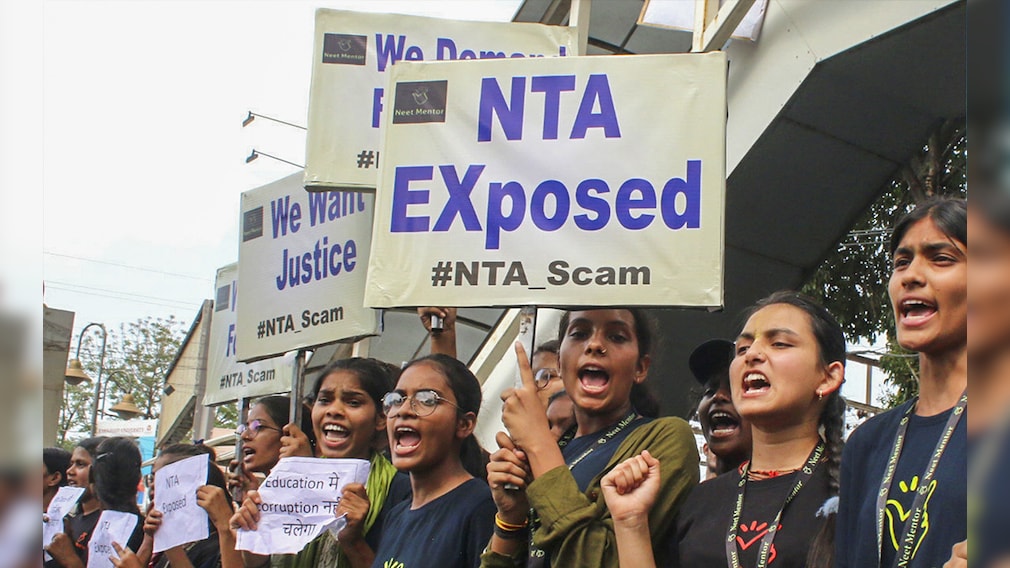
On May 3 this year, 23 lakh students appeared for NEET-UG - the single gateway to a doctor's profession in India. Within days, the National Testing Agency (NTA) cancelled the examination, referred the matter to the Central Bureau of Investigation (CBI), and issued its now-familiar statement about "transparency" and "trust". India had been here before, exactly two years ago. The language was the same. The apology was the same. The promise was the same. Only the year had changed.
This is not incompetence. Repeated incompetence, left uncorrected, becomes a system. India's examination governance has become a system that often faces major disruptions, absorbs outrage, and then resets.
What Happened in 2024
On May 5, 2024, NEET-UG faced allegations of a question paper leak. In Patna, Bihar, police arrested 13 people - including four examinees - who had allegedly paid Rs 30-50 lakh to obtain the question paper before the examination.
The scale of the irregularity went beyond paper leaks. A total of 67 students achieved a perfect score - a significantly higher number than in previous examinations - which created immediate controversy. Several examinees received scores of 718 or 719, which students argued was mathematically impossible under the exam's marking scheme.
On June 22, 2024, the government dismissed NTA Director General Subodh Kumar Singh from his position and handed the NEET-UG irregularities case to the CBI. This was framed as decisive action. To be more precise, it was the first move in a long game of institutional delay.
The CBI investigation revealed the mechanics of the breach with uncomfortable precision. The centre superintendent of Oasis Public School in Hazaribagh had left the back door of the strong room - where exam papers were stored - open. At 8:02 am, the accused entered the room with a toolkit, opened the locker, removed the seal from a question paper, and photographed it. No satellite hacking. No sophisticated encryption bypass. A toolkit, an open back door, and a complicit superintendent. The India of 2024 was losing its medical entrance examination to a screwdriver.
The CBI ultimately arrested 36 persons in relation to the NEET paper leak case. On July 23, 2024, the Supreme Court established that while a paper leak had undeniably occurred - where 155 students directly benefited - there was no indication it was widespread enough to affect the exam as a whole. On this narrow ground, the examination was not cancelled. Counselling proceeded. The crisis was declared managed.
The CBI Inquiry: Where Does It Stand?
The CBI inquiry of June 2024 produced arrests. By July 18, 2024, the Bureau had carried out various arrests, including four MBBS students from AIIMS Patna and a civil engineering student from NIT Jamshedpur in connection with the paper leak and the solving of the leaked paper. Total arrests reached 36.
But arrests are not convictions. Investigations are not reforms. As of today, there is no publicly reported conviction in the NEET 2024 case.
The syndicate model - which operates through layers of brokers, centre superintendents, and local fixers - remains structurally intact. The individuals arrested were the hands of a machine whose mind continues to function.
The 2025 cycle saw the CBI bust a ₹87.5 lakh NEET scam, demonstrating that the syndicate had merely recalibrated. Now, 2026 has produced the same outcome: cancellation, CBI referral, promises of cooperation. The wheel turns. Nothing underneath it changes.
The Act That Was Supposed to End All of This
The Public Examinations (Prevention of Unfair Means) Act, 2024, was passed by Parliament on February 9 and received Presidential assent on February 12, 2024. It was, in theory, exactly what India needed.
The Act prohibits collusion or conspiracy to facilitate indulgence in unfair means, including unauthorised access or leakage of question papers or answer keys. Persons committing an organised crime face imprisonment between five and ten years and a fine of at least Rs 1 crore. If an institution is held guilty of an organised crime, its property will be attached and forfeited.
On paper, this is formidable legislation. In practice, it arrived too late, too slowly, and without the institutional machinery to enforce it.
On June 21, 2024, the very day after the NEET crisis exploded nationally, the Union Government announced the enforcement of the Act, raising serious questions about the inexplicable delay in its implementation despite having been passed four months earlier. In effect, the Act came into force to manage an ongoing crisis, not to prevent the next one.
It also came with structural loopholes: there are no fixed timelines for agencies like the CBI to probe malpractices, no interim measures during investigations, and students are exempt from accountability under the law - meaning even a student found engaging in irregularities faces no penalty under this legislation.
Two years after this Act came into force, NEET 2026 has been cancelled due to a paper leak. The legislation exists. The enforcement does not.
The Anatomy of NTA's Systemic Failure
The NTA was established in 2017 to be India's premier, independent examination body - a professional, technology-driven alternative to the fragmented system that preceded it. Instead, it has become a centralised risk-amplifier. The following structural failures explain why.
NTA conducts NEET, JEE, CUET, UGC-NET, and dozens of other examinations. Over 20 lakh students appear for NEET alone. Centralising all high-stakes examinations in one agency - without independent audit, without genuine oversight, without term-limited leadership - creates a single point of systemic failure. When the system fails, it fails catastrophically, for millions simultaneously.
In 2026, NEET continues to be conducted as a pen-and-paper-based test across thousands of physical centres. Every physical centre is a potential vulnerability: a complicit invigilator, an unlocked strong room, a loose seal on a question paper envelope. Computer-based testing, despite its technical complexity, overlooks the entire possibility of physical paper theft. The NTA has not transitioned, and the reason it has not is a combination of institutional inertia, vendor interests, and the genuine infrastructure challenge of reaching aspirants in Tier-3 cities.
None of these reasons justify the price being paid by 23 lakh students every time the system fails.
NTA depends heavily on private examination centre operators and logistics service providers. These are not employees of the government. They are contractors with their own incentives. The 2024 Hazaribagh breach was facilitated by a centre superintendent - a person employed not by NTA but by a private institution contracted to conduct the exam. Across India, at least 48 instances of paper leaks in recruitment exams across 16 states over five years disrupted government hiring processes and affected at least 1.51 crore applicants for approximately 1.2 lakh posts. The private contractor model is the leak. India has not fixed the pipe; it has repeatedly mopped the floor.
NTA's Director General was removed on June 22, 2024 - after the crisis, not before it. Leadership in high-stakes examination administration must be accountable before failures, not after them. The removal of a functionary without structural reform is political theatre.
World-class examination systems use encrypted, distributed delivery of question papers, tamper-evident seals with electronic verification, biometric authentication of candidates, real-time CCTV surveillance with central monitoring, and blockchain-based chain of custody for question paper logistics. NTA has implemented fragments of these - but without integration, without full coverage of all centres, and without enforcement of minimum technology standards for empanelled examination centres.
Why We Keep Repeating This
The honest answer is structural, not incidental.
First, the demand-supply gap in medical education is catastrophic. India has approximately 1.1 lakh MBBS seats for 23 lakh aspirants - a ratio of roughly 20:1. This creates an examination with enormous economic stakes for families willing to pay lakhs for leaked papers, and for syndicates willing to supply them. As long as this ratio persists, the market for question paper leaks will remain robust, regardless of legislation.
Second, the examination industry - coaching centres, examination centre operators, question paper logistics vendors - has deep economic interests in maintaining a system that can be gamed. Clean examinations are bad for the economy of examination corruption. This ecosystem extends into political networks in states like Bihar, Jharkhand, and Gujarat where the 2024 breaches were most acute.
Third, there is no structural consequence for NTA or the Ministry of Education when examinations fail. The DG is removed, a CBI enquiry is announced, the examination is re-conducted, and life goes on. No Ministry official has been prosecuted. No examination centre has had its licence permanently cancelled following a breach. No systemic reform has been publicly tracked against timelines. In the absence of consequence, there is no incentive for systemic change.
Fourth - and this is the most damning failure - the High-Level Committee constituted under former ISRO Chairman K. Radhakrishnan in 2024 to recommend NTA reforms submitted its report. Those recommendations have not been made public in their entirety, nor has there been a transparent audit of which recommendations were implemented before NEET 2026 was conducted.
What Must Change
The solutions are known. What is absent is the political will to implement them against the resistance of entrenched interests.
Full Computer-Based Testing (CBT) for NEET within three years, with a state-subsidised infrastructure rollout for aspirants in rural and tier-3 areas. The argument that CBT is not feasible for 23 lakh students is contradicted by the fact that JEE Mains has been conducted in CBT mode since 2018 - for a similarly large and geographically distributed population.
Break NTA's monopoly. Create a federal examination consortium - an autonomous National Examination Authority with a Board constituted by representatives from IITs, IIMs, ISRO, and state governments - with rotating external auditors and a mandatory annual report to Parliament. Remove the examination from the Ministry of Education's operational control.
Amend the Public Examinations Act to fix mandatory timelines for CBI investigations - no longer than 90 days for a preliminary report - and create a mandatory public disclosure mechanism for examination security audits. Extend accountability to examination centre operators through criminal liability for their leadership, not just fines.
India needs to double its MBBS seat capacity within a decade. The examination crisis is, at its root, a supply crisis. Every seat created in a government medical college reduces the per-seat premium that drives corruption. No amount of examination reform can fully substitute for expanding the system that makes those seats available.
The Trust Deficit Is the Real Catastrophe
NTA's statement on May 12, 2026, spoke of "maintaining transparency and preserving trust in the national examination system". But trust is not preserved by statements. It is earned through demonstrated, consistent, transparent action over time.
Twenty-three lakh students will study again. They will book hotels in unfamiliar cities again. Their parents will take more unpaid leave. They will sit again in examination halls with the quiet terror that the student next to them paid for what they have spent three years earning.
That terror is the real cost of this failure - not the inconvenience, but the erosion of the belief that merit matters. When the system that is supposed to certify merit is itself corrupt, India does not merely lose an examination. It loses the foundational promise of its republic: that hard work and ability are sufficient.
Two years, two CBI enquiries, one legislation, one committee report, zero systemic convictions, one cancelled examination, 23 lakh students - and counting.
The question is not whether the system has failed. The question is how many more repetitions it will take before the failure is treated as a crisis requiring structural surgery, rather than a scandal requiring political management.
(The writer is an author and a noted educationist)
Disclaimer: These are the personal opinions of the author
-
Opinion | Edappadi Palaniswami, And The End Of His 'I, Me, Myself' Politics

Thirty of Palaniswami's colleagues in the AIADMK Legislature party, led by SP Velumani and CV Shanmugam, have refused to propose his name as leader.
-
Opinion | Trump-Xi Talks: When One Is Playing Chess, And Other Is Flipping The Board
Xi seeks cumulative advantage. Trump? Short-term spectacle. This distinction will decide what comes of the talks between the two leaders this week.
-
Opinion | 'Hellish Difficulty': Why India Should Be Keeping An Eye On China's New 'Shipborne' Drone
The GJ-21, which has a reported combat attack radius of up to 1,500 kilometres, when combined with a land-attack long-range precision-strike system, can have the ability to strike deep within a territory's mainland.
-
China Is Mining The Iran War For Lessons On US Military Power
China is studying two wars at once: Op Sindoor for lessons on Indian air defence and Beijing-backed Pakistani systems, and in Iran for US strike doctrine, AI targeting and air-defence saturation - with Taiwan as a likely endgame.
-
Opinion | What's Behind Araghchi's Visit To China Right Before Trump-Xi Meeting?
Beijing remains indispensable to Tehran as an economic backer and diplomatic shield, but it is not prepared to become its war ally.
-
Opinion | KC Venugopal, And The Paradox Of Being The Man Rahul Can't Do Without
If KCV, Rahul's most trusted lieutenant in Delhi, ends up becoming Kerala Chief Minister, the Congress will have put its own credibility on the line in the state. But does the party care?
-
How 'Smiling Buddha' In Pokhran Permanently Altered India's Place In Global Politics
On May 18, 1974, coinciding with Buddha Purnima, India conducted what it officially described as a 'Peaceful Nuclear Explosion', code named 'Smiling Buddha'.
-
AI Courses Are India's New Craze. But Are They Helping Students Land Jobs?
National Technology Day: From campuses to workplaces, Indians are racing to learn AI for jobs, fuelling a nationwide surge in practical AI courses.
-
Blog | Suvendu Adhikari: The Man Who Never Forgot How He Was Denied A Stage In 2011
The story of Suvendu Adhikari begins in 2011 - from a stage in Dharmatala that made him invisible and denied him the limelight he thought should've been his.