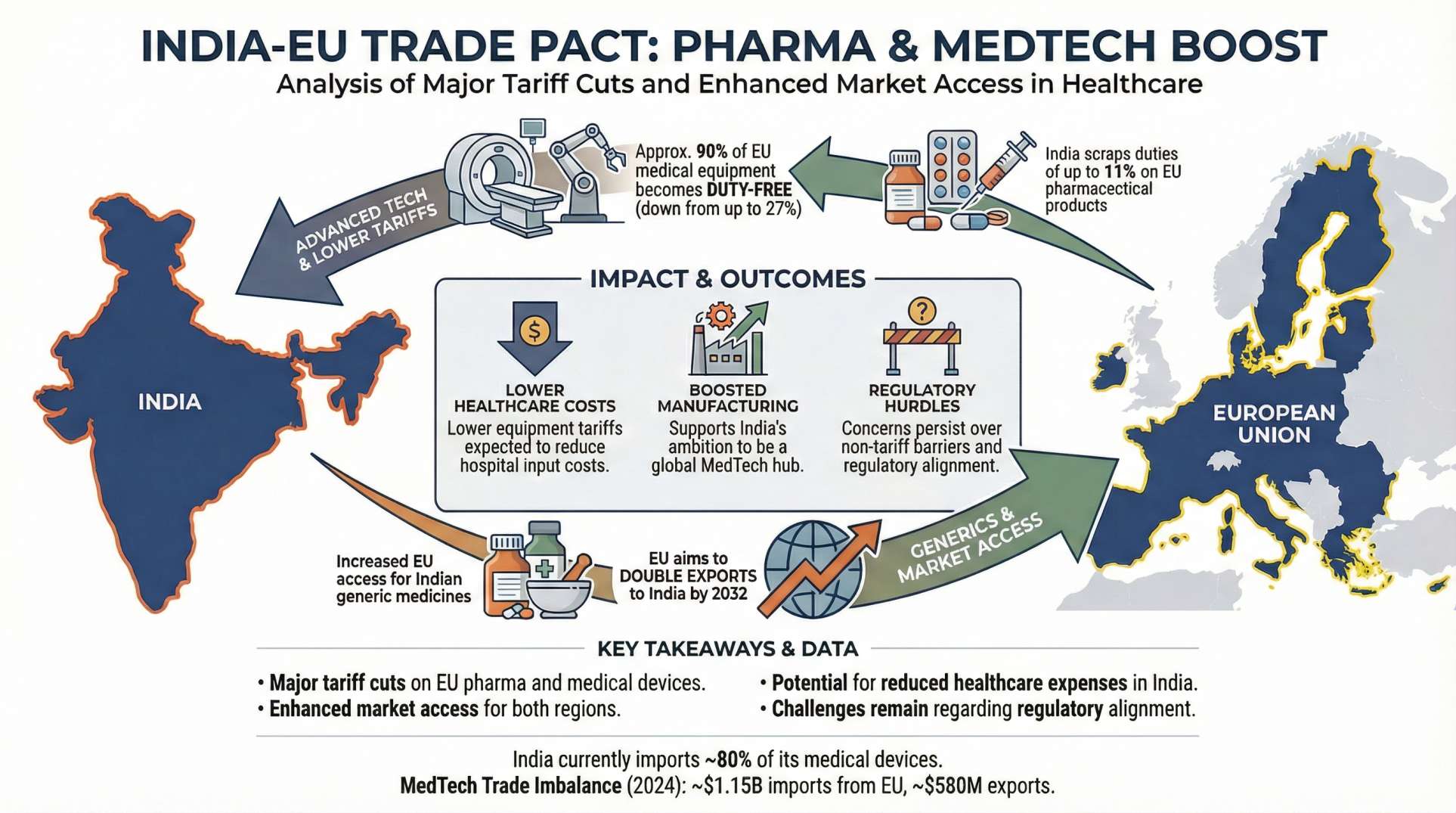
India's pharmaceutical and medical devices sector is poised for a major growth push following the finalisation of the Free Trade Agreement (FTA) between India and the European Union (EU). The agreement unlocks access to the EU's $572.3 billion pharmaceuticals and medical technology market, one of the largest and most regulated healthcare markets in the world, according to the Ministry of Chemicals and Fertilizers. Government officials say the FTA will strengthen India's position as a global healthcare manufacturing hub, expand employment opportunities, and deepen integration into international supply chains. The move is being seen as a significant step in reinforcing India's image as the "pharmacy of the world," particularly at a time when global demand for affordable, high-quality medicines and medical devices continues to rise.
Beyond exports, the agreement is expected to drive domestic capacity expansion, encourage MSME participation, and support industrial clusters across key manufacturing states. While the deal brings new market access and tariff liberalisation, experts caution that success will depend on India's ability to meet Europe's stringent quality, regulatory and compliance standards. Together, these developments mark a crucial moment for India's healthcare manufacturing ecosystem.
What The India-EU FTA Means For India's Pharma Sector
According to the Ministry of Chemicals and Fertilizers, the India-EU FTA is expected to enable pharmaceutical companies to scale operations, generate skilled employment, and reinforce India's role as a reliable partner in the global healthcare supply chain.
The ministry noted that the agreement will support:
- Expansion of skilled and industrial employment
- Stronger participation of MSMEs
- Deeper global supply chain integration
- Capacity expansion across pharmaceuticals, medical devices and allied sectors
Union Minister for Chemicals and Fertilisers JP Nadda highlighted the significance of the deal for high-value healthcare manufacturing.
"Access to the $572.3 billion Pharma and MedTech market in EU and liberalised tariffs for Indian medical devices will accelerate growth in this high-value sector," said Nadda. He added that the agreement aligns with India's broader healthcare manufacturing ambitions.
"Under the visionary leadership of PM Narendra Modi, India continues to expand its presence as a reliable global partner in healthcare and manufacturing," the minister said.
Also Read: Historic India-EU Trade Deal Could Impact Prices Of Weight Loss And Lifesaving Drugs, Here's How
A Strategic Partnership With Long-Term Impact
The India-EU FTA is being described as a major milestone in one of India's most strategic economic partnerships. Designed as a modern, rules-based trade framework, the agreement aims to address current global challenges while enabling deeper market integration between the world's fourth-largest and second-largest economies.
Officials say the deal will provide preferential market access to drive growth in high-value segments and liberalise tariffs for key "Made in India" medical devices. Beyond pharmaceuticals, the agreement also covers inorganic and organic chemicals, fertilisers, cosmetics, soaps and detergents.
The ministry said the FTA would support:
- MSME cluster development
- Industrial capacity expansion
- Export-led growth in processing-intensive sectors
Major manufacturing hubs in Gujarat, Maharashtra, Karnataka and Andhra Pradesh are expected to benefit significantly, particularly coastal export hubs that can scale up production and logistics to meet EU demand.
Opportunities Come With Higher Quality Expectations
Industry experts say that while the agreement opens enormous opportunities, it also raises expectations for Indian manufacturers.
Parag Bhatia, Director at Laborate Pharmaceuticals, said Indian companies must be prepared for Europe's strict regulatory environment. "The India-EU Free Trade Agreement is a strategic opportunity for Indian pharmaceutical companies, but it also raises the bar on execution. While improved market access and tariff rationalisation are positive, the real impact will be felt in how well Indian manufacturers align with Europe's stringent regulatory, quality and documentation standards. The EU market places a strong emphasis on consistency, traceability and pharmacovigilance, not just during inspections but across the entire product lifecycle. For Indian pharma exporters, this agreement reinforces the need to strengthen manufacturing discipline, invest in quality systems and adopt a long-term compliance mindset. Those who treat quality as a core capability rather than a regulatory obligation will be best positioned to build credibility and scale sustainably in the European market."
Also Read: Opinion | The India-EU Deal Isn't Really About Tariffs
Need To Strengthen India's Quality Infrastructure
Echoing similar concerns, Dr Saurabh Arora, MD of Auriga Research, said the FTA could act as a powerful economic catalyst but would require major investments in quality systems.
"Signing of the India-EU Free Trade Agreement is a tremendous achievement and will work like rocket fuel to grow India's economy. It will provide us access to one of the largest and richest blocs of countries. But at the same time, the EU has got very strict quality norms which are very well defined. Be it food products, pharmaceuticals, automotive parts, leather goods, clothing, whatever we talk about. Everything in the EU has very stringent well-defined quality parameters."
Dr Arora stressed the need for government support in compliance and testing. "To be able to access that market India will have to scale up its quality infrastructure and the government really needs to focus on creating capabilities and capacities for testing and compliance and also helping the exporters understand the quality requirements. Laboratories like us are well-equipped and have been working for the European market for two decades now supporting the food industry. This is going to be a huge opportunity but like I said we need to really improve our quality infrastructure and the government needs to take proactive steps. It will be right from education on quality, training the manpower, up-skilling to deliver quality products and also creating quality testing and R&D infrastructure."
The India-EU Free Trade Agreement represents a significant opportunity for India's pharmaceutical and medical devices sector, opening doors to a $572.3 billion market while reinforcing India's global healthcare leadership. However, the deal also places a clear spotlight on quality, compliance and long-term capability building. As India seeks to scale exports and deepen its presence in Europe, sustained investment in regulatory standards, testing infrastructure and skilled manpower will be critical. If executed effectively, the FTA could drive inclusive growth, strengthen MSMEs and position India as a trusted healthcare partner for Europe and beyond.
(With inputs from IANS)
Disclaimer: This content, including advice, provides generic information only. It is in no way a substitute for a qualified medical opinion. Always consult a specialist or your own doctor for more information. NDTV does not claim responsibility for this information.