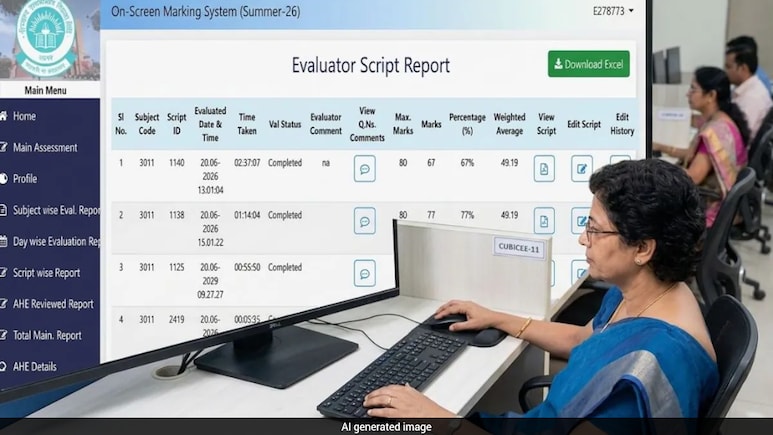
From result-day portal crashes and payment failures to blurred answer sheets, mismatched copies and now allegations of vulnerabilities in its new digital evaluation system, the Central Board of Secondary Education (CBSE) is facing one of its most turbulent examination cycles in recent years, exposing deeper questions over whether India's largest school board was prepared for a rapid digital overhaul.
The controversy began soon after CBSE declared Class 12 board results on May 13, when students across the country started reporting unexpectedly low marks, discrepancies in evaluation and technical problems while applying for photocopies and re-evaluation of answer sheets.
The concerns snowballed into a larger crisis around the board's newly introduced On-Screen Marking (OSM) system. Despite suggestions from members of its own governing body that the mechanism should first undergo pilot testing across regional offices, according to minutes of a June 2025 meeting.
The minutes of a governing body meeting held in June 2025 show that members had suggested the OSM system "may be implemented in all subjects only after completion of pilot projects in some subjects across various regional offices of the board". The governing body had "taken note of the suggestion", the minutes recorded.
However, no such pilot exercises were conducted before the nationwide rollout this year across CBSE's 22 regional offices. CBSE had formally announced the implementation of OSM on February 9, just days before Class 12 examinations began on February 17. Actual evaluation work under the system started on March 7, officials said.
The board conducted a nationwide webinar on February 13 and opened an online training portal on February 15 to allow evaluators to practise using previous years' answer books. At a press conference on May 17, CBSE said nearly three lakh teachers had logged into the portal for training, while around 77,000 eventually participated in the evaluation process.
Under the new system, evaluators checked scanned copies of answer sheets digitally instead of physically handling paper scripts. But as lakhs of students sought photocopies of their answer books after results, social media was flooded with complaints of blurred scans, missing pages, unmarked answers, and mismatched answer sheets. Several Science stream students who had qualified examinations like JEE Main claimed they had either barely passed or failed subjects such as Physics and Mathematics in board exams, raising suspicions over the new evaluation system.
One of the biggest flashpoints came after a Delhi student, Vedant Shrivastava, alleged that the Physics answer sheet uploaded under his roll number did not belong to him. CBSE later acknowledged the error and provided the correct answer script, intensifying scrutiny over the system's reliability.
CBSE has acknowledged technical issues linked to the rollout. Officials said at the May 17 press conference that the system had faced login problems, server overload, and scanning deficiencies during the evaluation process.
According to data shared by the board, of the 98.66 lakh answer books evaluated this year, 68,018 had to be rescanned due to poor image quality, while another 13,583 answer books were manually checked after repeated scanning attempts failed to produce readable copies.
The scale of concern has also been reflected in post-result numbers. As of May 26, CBSE had received 4,04,319 applications seeking scanned copies of 11,31,961 Class 12 answer books-an increase of over 208 per cent in applications and more than 301 per cent in answer-book requests compared to last year.
CBSE attributed the surge partly to its decision to reduce the fee for obtaining scanned copies from Rs 700 to Rs 100 per subject.
However, the spike also coincided with anxiety over evaluation quality after the overall Class 12 pass percentage dropped by 3.19 percentage points to 85.20 per cent-the lowest since 2019.
The controversy took another turn this week after a 19-year-old teen cybersecurity researcher claimed to have found vulnerabilities in CBSE's OSM portal that could potentially allow unauthorized access and manipulation of marks. The allegations spread rapidly online, reigniting fears over the security of the system.
CBSE rejected the claims, saying the allegedly compromised portal was merely a testing platform containing dummy data and not the live evaluation system used for board assessments. The board said no security breach had been detected in the actual evaluation infrastructure.
The crisis has triggered intervention from the Union Education Ministry, forced emergency reviews involving IIT experts and public sector banks. Education minister, Dharmendra Pradhan has sought a detailed report from CBSE on the technical failures and directed officials to ensure that students did not suffer because of system glitches.
"Students should not face technical glitches or payment failures in future," Pradhan said during a review meeting with officials and banking representatives.
As criticism mounted, CBSE defended the OSM system. CBSE Chairperson Rahul Singh said only the "medium" of evaluation had changed and not the marking scheme itself. "The marking scheme remains exactly the same," he said, adding that nearly three lakh teachers had been trained for the process.
The board also maintained that every genuine grievance raised by students would be examined carefully and said the digital system was intended to improve consistency in marking rather than compromise it.
CBSE had earlier experimented with OSM in 2014 through limited pilots involving select Class 10 subjects across regions and two Class 12 subjects in Delhi, but the initiative was later scaled back because of scanning and connectivity limitations at the time.
Despite the present controversy, officials indicated at the May 17 press conference that the OSM system would continue for next year's board examinations as well.
The scale of the challenge facing CBSE is enormous. The board oversees more than 27,000 affiliated schools in India and abroad and evaluates nearly one crore answer sheets annually. This year alone, officials said over 98 lakh answer sheets were processed through the digital evaluation ecosystem.
Education experts say the controversy reflects a deeper structural issue within India's examination ecosystem. Over the past few years, exam bodies have been under growing pressure to become faster, more transparent and more technology-driven amid rising student numbers and increasing demands for access to answer sheets and re-evaluation.
But the shift has also exposed institutional vulnerabilities.
For lakhs of students waiting for college admissions and scholarship cut-offs, the glitches have translated into anxiety over whether marks-often decisive in determining academic futures-can still be trusted unquestioningly.
