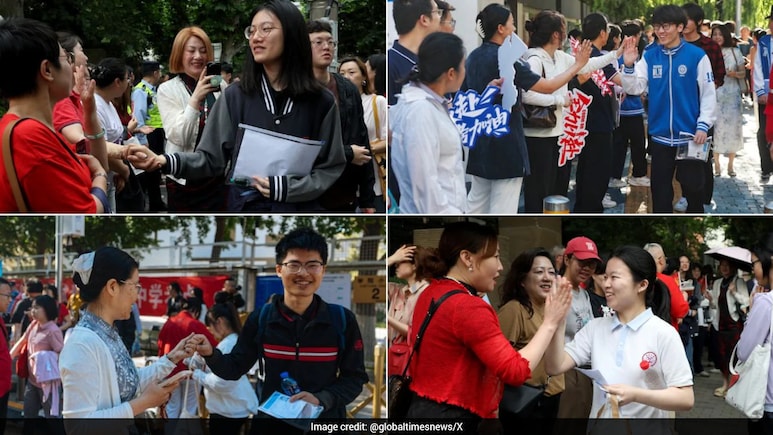
China's National College Entrance Examination, known as the Gaokao, has once again drawn attention in India after Chinese Embassy spokesperson Yu Jing highlighted the scale and conduct of the examination.
Sharing a video on June 10, Yu Jing said that the world's largest examination was conducted smoothly for nearly 13 million (1.3 crore) students over two days. "Factories paused. Roads quieted. The entire nation rallied for its students," she wrote.
The remarks have attracted attention in India at a time when the country's examination system is under intense scrutiny following the cancellation of the National Eligibility cum Entrance Test Undergraduate (NEET UG) 2026.
China's Gaokao — the world's largest exam & India's equivalent of JEE/NEET rolled into one — was conducted smoothly for 1.3 crore students in just 2 days 🎓
— Yu Jing (@ChinaSpox_India) June 10, 2026
Factories paused. Roads quieted. The entire nation rallied for its students.
चीन की गाओकाओ — दुनिया की सबसे बड़ी परीक्षा,… pic.twitter.com/aSbpL05suN
The medical entrance examination, originally conducted on May 3 for admission to undergraduate medical programmes, was cancelled after allegations of a question paper leak surfaced. The decision affected more than 22 lakh candidates who had appeared for the examination.
The National Testing Agency (NTA) has scheduled a re-examination on June 21. Investigations into the alleged leak are underway, with the Central Bureau of Investigation (CBI) probing the matter and multiple arrests already made.
Union Education Minister Dharmendra Pradhan has assured candidates and parents that the re-examination will be conducted in a fair and secure manner. The government has also announced additional security measures, including the involvement of the Indian Air Force in transporting question papers. Reports have indicated that central armed police forces may also be deployed as part of the examination security arrangements.
Gaokao And The Debate Over Exam Security
Following the cancellation of NEET UG, discussions comparing India's examination system with those of other countries gained traction on social media, television debates and public forums.
Many people pointed to China's Gaokao, which sees participation from around 13 million students annually, and questioned whether similar security measures could help prevent examination irregularities in India.
The Gaokao is widely regarded as one of the most competitive examinations in the world and is conducted under extensive security arrangements. Measures reportedly include strict control over question paper printing and transportation, deployment of security personnel at examination centres, facial recognition systems, surveillance technologies and monitoring of online platforms for cheating-related activities.
Cheating Cases Have Also Been Reported In China
While Gaokao is often cited as an example of a tightly controlled examination system, China has also dealt with instances of examination malpractice.
According to a report published by China Daily in June 2024, data released by China's Supreme People's Court showed that more than 11,000 individuals were penalised between November 2015 and April 2024 for offences such as organising cheating operations, selling examination answers and impersonating candidates.
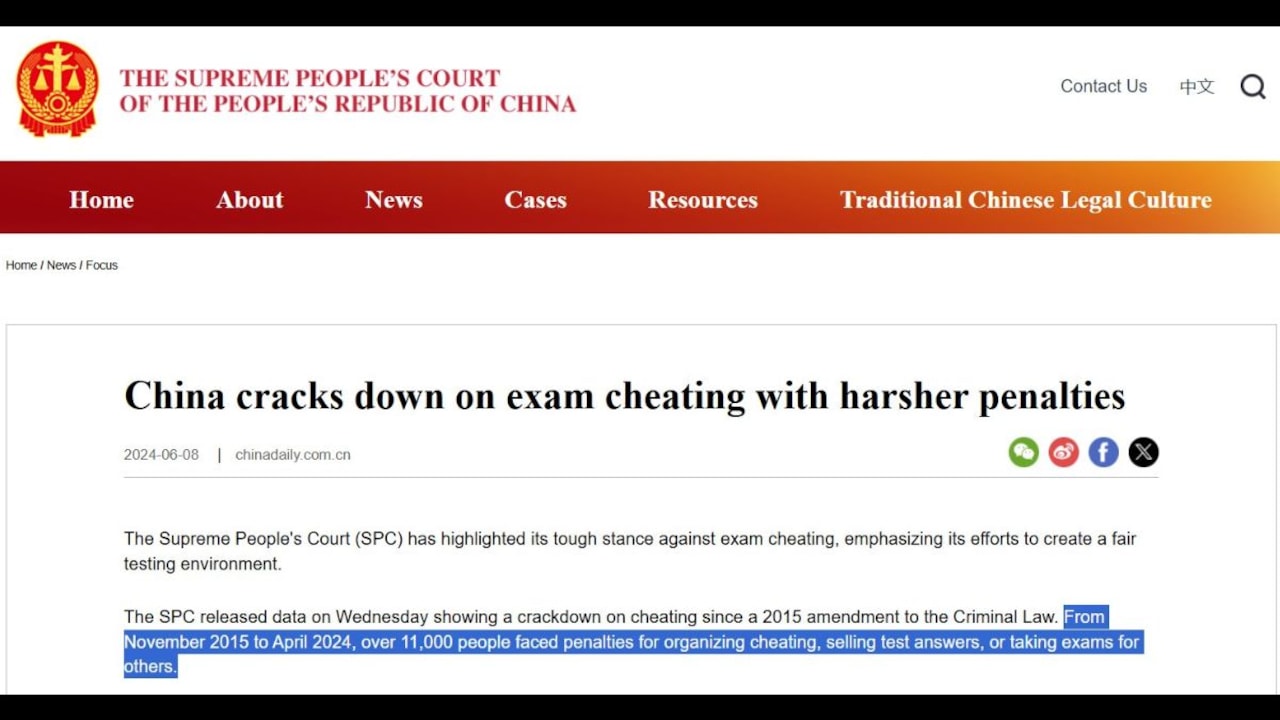
The court also disclosed several cases involving criminal punishment for cheating-related offences. One of the cases involved a teacher who was sentenced to four years in prison for organising a cheating network during the 2020 Gaokao examination.
"The gaokao is a crucial exam for talent selection," the court had said. "Cheating is a serious threat to educational fairness and social integrity, and it will be severely punished."
Chinese law provides for prison terms ranging from three to seven years for serious examination-related offences, including organised cheating and the leakage of examination questions and answers. Candidates found guilty of violations may also face bans from future state examinations and other administrative penalties.
Challenges Before India
The NEET controversy has renewed calls for stronger safeguards in India's examination system. Education experts and students have highlighted the need for tighter controls at every stage of the examination process, including question setting, printing, transportation, storage and distribution.
The Public Examinations (Prevention of Unfair Means) Act, 2024, was enacted to address organised cheating and paper leaks. However, concerns continue to be raised about the effectiveness of enforcement and prosecution in examination-related cases.
The ongoing investigation into the alleged NEET UG 2026 paper leak is expected to shape future reforms aimed at strengthening the integrity of large-scale public examinations in India.
