TVS Succession Battle Explained: What Lakshmi Venu Wants From Family Empire
The TVS family dispute is no longer just a disagreement over division of businesses. It has become a legal question about ownership and inheritance.
TVS Family Feud: The succession dispute within one of India's best-known business families has moved from private discussions to the courtroom.
Lakshmi Venu, daughter of TVS patriarch Venu Srinivasan, has approached the Madras High Court seeking a formal partition of the joint family assets belonging to her father's branch of the TVS family. She has also sought access to financial records and documents relating to these assets, alleging that repeated requests for information have not been met.
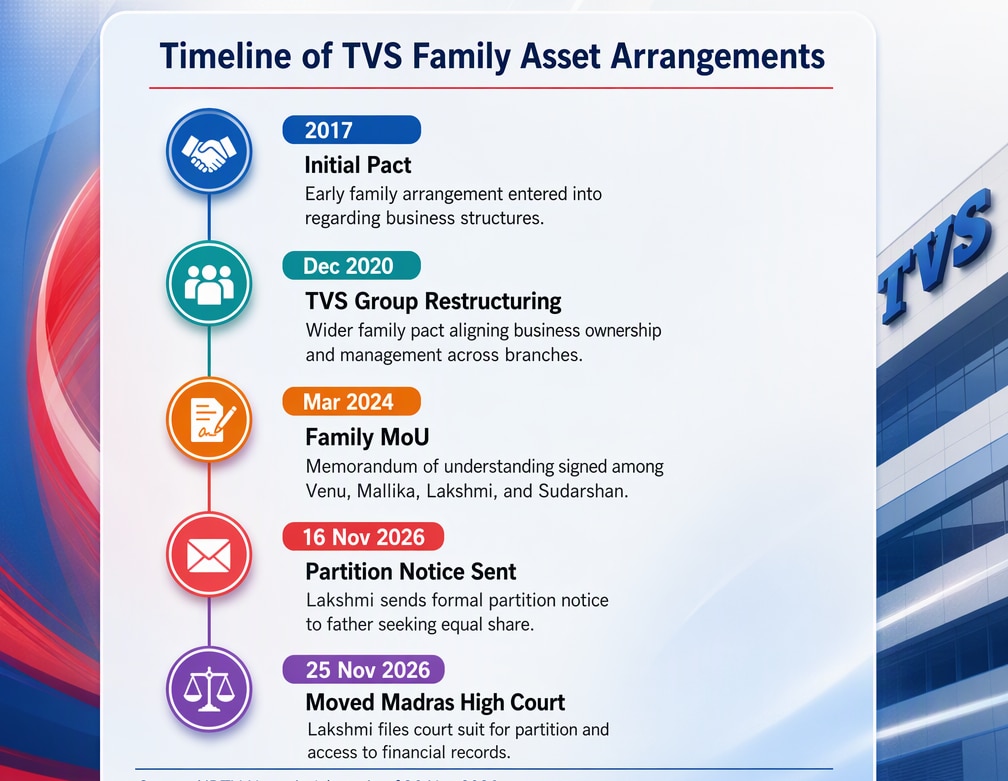
The legal action follows a formal partition notice sent to her father on November 16. According to a statement issued on her behalf, his response did not recognise her claims or lead to any progress towards an amicable settlement. "Having exhausted every effort at an amicable dialogue, she has been left with no choice but to approach the Hon'ble Court. The legacies of her great-grandfather and her grandfather, she maintains, are as much hers as her brothers," as per a statement.
The dispute is not about the day-to-day running of TVS Motor Company or other businesses. It is about who owns the underlying family wealth, how that wealth was divided and whether the arrangements made over the years settled the economic interests of Venu Srinivasan's immediate family.
At the heart of the disagreement is a series of family arrangements dating back to 2017, followed by the wider TVS family restructuring in 2020 and another memorandum of understanding in 2024.
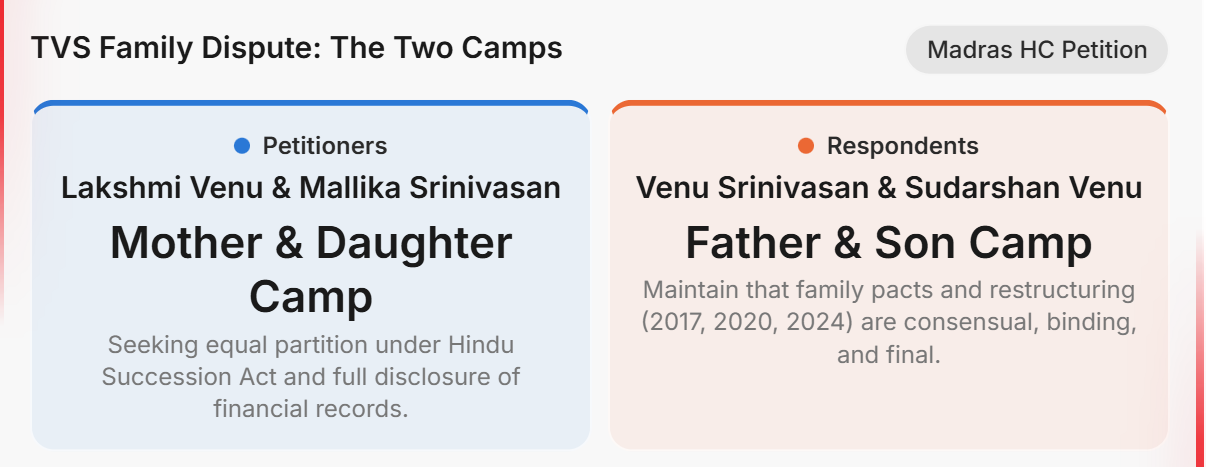
Lakshmi and her mother, Mallika Srinivasan, argue that these arrangements did not result in a transparent and legally valid division of the joint family assets within their immediate family.
Venu Srinivasan and his son, Sudarshan Venu, have a different position. They maintain that the family reached a series of consensual and binding agreements and that the division cannot now be reopened.
What Has Lakshmi Venu Asked The Madras High Court For?
Lakshmi has approached the court seeking partition of the joint family assets belonging to the Venu Srinivasan branch of the TVS family and allotment of her claimed share.
She has also sought the court's intervention to obtain documents and information concerning the family's assets. Her side has alleged that details about the holdings and their ownership structures have consistently been withheld despite multiple requests.
The assets under consideration include interests held through VS Trust and other holding entities in businesses such as TVS Holdings, TVS Motor Company, TVS Credit Services and Sundaram-Clayton.
These were among the businesses and interests allotted to the Venu Srinivasan branch under the wider TVS family arrangement of 2020.
In her November 16 notice, Lakshmi had called upon her father, as head of the family, to discharge his fiduciary responsibilities and ensure a fair and lawful partition.
Her legal team has maintained that the allocation of management responsibilities between siblings cannot automatically be treated as a settlement of ownership rights.
The suit also makes an important distinction. It concerns ownership and partition of family assets, not the operations of the companies themselves.
Lakshmi has said she has an interest in the continued strength of the businesses and believes any division can be implemented in an orderly manner and in accordance with the law.
The suit was filed on November 25. The Madras High Court is yet to hear the matter.
Why Is The 2024 Family Agreement Being Questioned?
The disagreement goes back several years. In 2020, members of the wider TVS family reached a settlement to reorganise the group's businesses and interests among different family branches. The arrangement was based on a memorandum of family agreement dated December 10, 2020, and took effect from February 4, 2022.
However, Lakshmi and Mallika maintain that this was a division among the larger TVS family groups. It did not settle the economic interests within Venu Srinivasan's immediate family.
The wider restructuring allocated business interests to different branches of the TVS family. But Lakshmi's argument is that the assets allotted to her father's branch still needed to be divided within that branch.
The next important development came in March 2024. Venu Srinivasan, Mallika, Lakshmi and Sudarshan signed a memorandum of understanding on March 20, with its execution completed on March 21.
Venu disclosed the agreement to TVS Holdings through a letter dated March 22, 2024. The company disclosure described the MoU as an additional understanding among the family members, including arrangements concerning the use of TVS brands and restrictions on competing business activities.
Under the agreement, Sudarshan agreed not to use certain TVS trademarks in specified businesses, including aluminium and magnesium die-castings and machined castings.
Mallika and Lakshmi, on the other hand, agreed to restrictions involving specified businesses such as two-wheelers, three-wheelers and financial services.
The agreement also contained non-compete provisions. The crucial point, however, is that the publicly disclosed terms of the 2024 MoU did not set out a comprehensive division of the family's underlying economic ownership interests.
This is where the two sides differ. Lakshmi and Mallika argue that the agreement dealt with business responsibilities, brand usage and restrictions. It did not amount to a final partition of the joint family assets.
Venu's side maintains that the 2024 MoU was part of a series of agreements through which the family reorganised its holdings and settled its differences.
The 2017 Settlement: Why It's Relevant
The disagreement is not limited to the 2020 and 2024 arrangements. Venu Srinivasan's lawyer, senior advocate Abhishek Manu Singhvi, has pointed to an earlier written family settlement signed by all four members in 2017.
According to Singhvi, this agreement dealt with the division of ancestral assets and the dissolution of the Hindu Undivided Family (HUF). His argument is that the family had already settled the relevant issues and that there is no undivided family property left to partition.
Singhvi has also argued that the subsequent agreements in 2020 and 2024 were deliberate steps taken with the consent of all family members. He has questioned why the arrangements should be reopened now, particularly because the businesses have grown in value since the agreements were signed.
According to his account, the broad understanding was that the tractor business associated with Mallika's entrepreneurial efforts would eventually go to her or her family, while the automobile business would be handed over to Sudarshan.
He has also pointed to the VS Trust and argued that Lakshmi's son has been named as a beneficiary. Another important part of Venu's defence concerns the financial burden of acquiring the family's automobile business interests.
Singhvi has said Venu wanted to consolidate control over the automobile business and had to acquire shares held by his brothers for just under Rs 2,000 crore. According to him, Venu had expected Mallika and Lakshmi to contribute towards the acquisition. They declined, although Singhvi said the family agreement did not make such a contribution compulsory.
Venu subsequently raised the money through borrowings, with the resulting debt remaining with his side of the family, Singhvi has argued. His position is that the earlier arrangements cannot be disregarded simply because the value of the businesses has changed or one party is now unhappy with the outcome.
What Does The Hindu Succession Act Say About A Daughter's Rights?
A significant part of the dispute revolves around the Hindu Succession Act, 1956, particularly the amendments introduced in 2005.
The amendment to Section 6 gave daughters the same rights and liabilities as sons in a Mitakshara Hindu Undivided Family. Daughters became coparceners by birth, in the same manner as sons.
This means a daughter can claim an equal interest in ancestral coparcenary property.
However, the legal position is not as simple as saying that every daughter automatically has an equal claim over every asset owned by her father.
A person generally has the right to decide how to distribute his or her self-acquired assets, subject to applicable laws and other legal obligations. Coparcenary property, on the other hand, carries specific rights for eligible family members.
Lakshmi's side argues that the assets in question include joint family property and that her rights cannot be taken away through unilateral decisions or the allocation of business management responsibilities.
Venu's side disputes the premise, arguing that the HUF was dissolved through the 2017 settlement and that the subsequent arrangements were final.
The court will therefore have to examine the nature and ownership of the assets, the legal effect of the earlier settlements and whether any coparcenary rights continue to exist.
It is important to note that the 2005 amendment does not automatically reopen every partition completed before its commencement. The legal effect of an earlier partition, including whether it was legally recognised and documented, can become a crucial question.
Why Has Mallika Srinivasan Backed Her Daughter?
The dispute has also brought Mallika Srinivasan, chairperson and managing director of Tractors and Farm Equipment Limited (TAFE), into the centre of the controversy.
Mallika has publicly supported Lakshmi's demand for a fair division of the family assets. In a statement, she said: "As a mother, to me, a son and daughter are equal in every respect. I do believe that Lakshmi has a legitimate share of the family assets, not unequal to that of Sudarshan's."
She also said it was unfortunate that Venu's response to Lakshmi's notice had not recognised her lawful rights and that no progress had been made towards an amicable resolution. Mallika maintained that her daughter had been compelled to approach the court to protect her interests.
There is another distinction worth noting here. Mallika has clarified that TAFE belongs to the Amalgamations Group, a separate family business group in which she is a shareholder. Its ownership should not be confused with the economic settlement being sought within the Venu Srinivasan branch of the TVS family.
Lakshmi's legal action is focused on the latter.
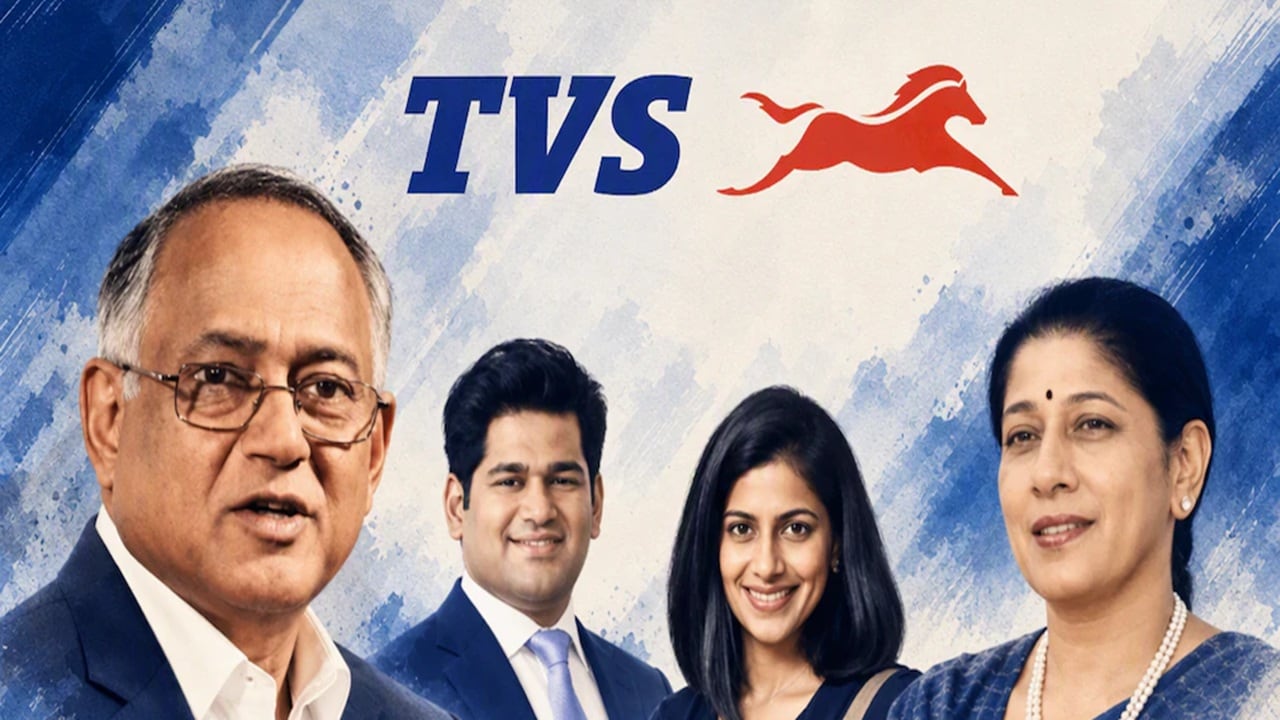
Left to right: Venu Srinivasan, Sudarshan Venu, Lakshmi Venu, and Mallika Srinivasan
Why The Dispute Matters For The TVS Business Empire
The case has drawn attention because of the size and significance of the businesses involved. The assets under discussion include interests in TVS Holdings, TVS Motor Company, TVS Credit Services and Sundaram-Clayton.
TVS Motor is one of India's largest two-wheeler manufacturers, while TVS Holdings has interests across multiple businesses. The dispute also highlights the complicated ownership structures that can exist within large family-run business groups.
Shares and beneficial interests may be held through trusts and other holding entities. Management control, legal ownership and beneficial ownership are not necessarily the same thing. This is why access to documents and financial disclosures has become an important part of Lakshmi's case.
She has argued that she cannot properly establish or protect her rights without clarity on the assets, their valuation and the way beneficial interests have been distributed. Her lawyer has also indicated that the legal team intends to seek interim relief from the High Court to prevent the creation of fresh beneficial interests in the assets under dispute while the case is pending.
That request is separate from the main prayer for partition and will have to be considered by the court. The family members had also filed caveats in Chennai courts earlier, indicating that they were preparing for possible legal proceedings.
TVS Family Dispute: What Happens Next?
The dispute has now entered the judicial process, but several questions remain unresolved. The Madras High Court will have to examine whether the assets being claimed are joint family properties or self-acquired assets, what legal effect the 2017 settlement had, and whether the subsequent arrangements in 2020 and 2024 settled the economic interests of the immediate family.
The court will also have to consider Lakshmi's request for access to financial documents and her claim that her rights as a daughter and coparcener have not been recognised. Neither side's arguments have been judicially established at this stage.
The outcome could have implications beyond the immediate family. Succession and ownership disputes are a recurring challenge for India's family-run business groups, particularly when business restructuring, management succession and inheritance planning overlap.
Ronesh Puri, Managing Director of Executive Access, a leading executive search and leadership advisory firm, told NDTV that the dispute illustrates how difficult it can be to achieve consensus on family succession.
"This case is classic example that family succession and asset division are rarely as straightforward as they appear. A settlement was reached in 2024, but that doesn't necessarily mean both sides were on the same page. It is now up to the courts to decide whether the fresh claims hold merit.
"Even the best-intentioned decisions can leave one or more family members feeling aggrieved. What one person considers fair may not necessarily be seen the same way by another... We are seeing more such disputes surface publicly today. It reinforces a larger lesson. Succession is not just about dividing assets; it is about managing expectations, ensuring transparency and building consensus. These conversations need to happen well before differences turn into disputes," added Puri.
-
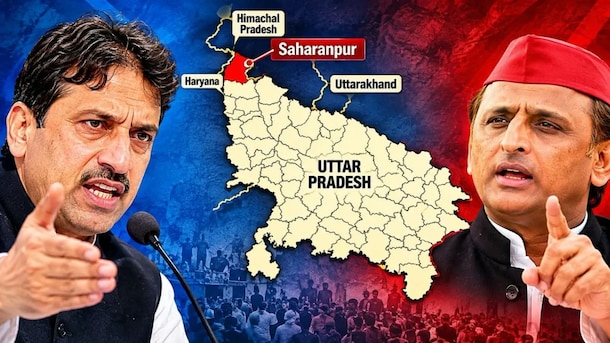
Personal And Political Collide In Samajwadi-Congress War In Saharanpur

Saharanpur is more than just another constituency in the Congress-SP seat-sharing dispute. It is a district where geography, electoral arithmetic, community identities and family legacies intersect.
-
Opinion | Indian Firms Are Making Record Profits. Why Are Foreign Investors Still Leaving?
In the July to September quarter of 2026-27, the 50 companies in the Nifty 50 increased profit after tax by 27% over the same quarter of the previous year - the highest growth in 17 quarters.
-
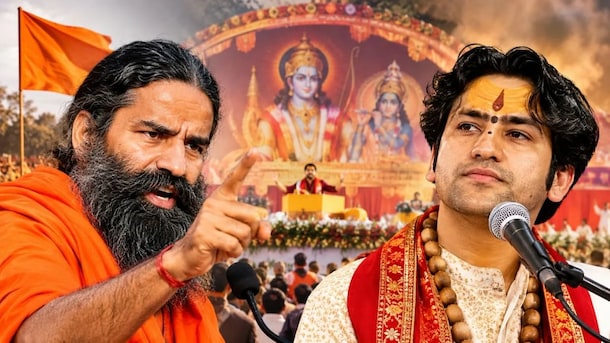
Battle Of Two Babas: What's Behind Ramdev Versus Dhirendra Shastri?
Why Ramdev chose to publicly criticise Shastri soon after attending his much-publicised and well-attended Ram Katha in Uttar Pradesh for an earlier comment remains an interesting question.
-
Opinion | There Are 5 Reasons Iran Won't Drop A Dirty Bomb On The US - And One Reason It Might
Iran is entirely capable of building a dirty bomb - as are other modern states with access to industrial radioactive materials. But how far will it really go?
-
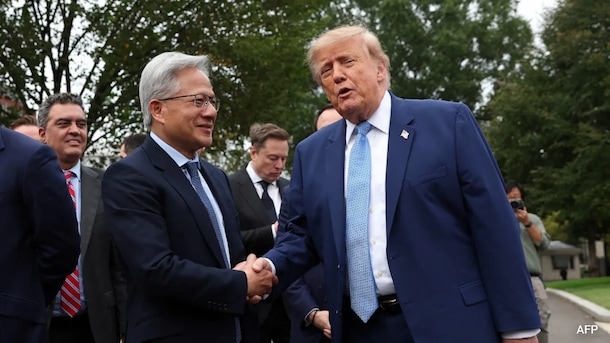
Opinion | Too Big To Fail, Too Connected To Fall: Why Trump Needed Jensen Huang
Rumours are that Trump's own business stakes in Nvidia have helped him rake in millions of dollars as the company's shares zoomed back up after the plunge that followed Huang's exit. But that's just one part of the story.
-
BJP's UP Seat-Sharing Test: Four Allies, Many Ambitions And A 50-Seat Puzzle
This time, the BJP has to accommodate all four partners, each with its own electoral ambitions and areas of influence across western and eastern Uttar Pradesh.
-
From 'Spy Affair' To 'Nothing Wrong' In 11 Days: What Brought Jensen Huang Back As Nvidia Boss
Nvidia's Jensen Huang admitted to an extramarital affair with Alice Huang, a woman who worked at his company's Hong Kong-based customer firm and is alleged to be a Chinese spy. That brought with it many investigations. But he seems to have weathered most of it for now, within days.
-
Between Nehru And Netanyahu, Rahul Gandhi Faces An Uncomfortable Question
The divergence has come to the fore after Rahul Gandhi endorsed maintaining strong ties with Israel, citing India's defence requirements and national interests.
-
Kunda's King And His Thakur Court: Raja Bhaiya's Big Power Play Before UP Polls
UP Elections 2027: The Ram Katha may have been about Lord Ram, but the political story unfolding in Kunda was about Raja Bhaiya.