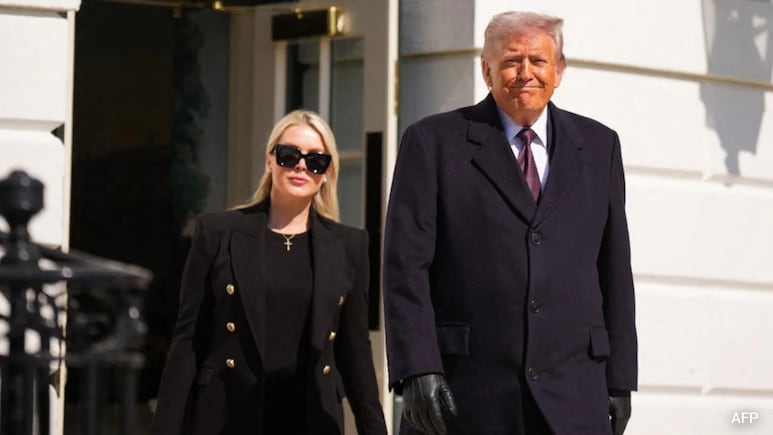
- Karoline Leavitt, youngest White House Press Secretary, to leave Trump administration soon
- Leavitt will remain senior advisor and influential voice in Republican Party post-departure
- She delayed maternity leave after alleged assassination attempt on Trump at White House event
White House Press Secretary Karoline Leavitt, the youngest person to hold the role, is set to leave the Donald Trump administration at the end of the month. The 28-year-old, who earned a reputation for acid putdowns of journalists, will leave her role to spend more time with her young family, President Donald Trump has announced, adding that she would remain a senior advisor.
"Karoline will now be one of my top outside advisors and an influential voice within the Republican Party," Trump said on social media.
The president called Leavitt a "real leader" and one of his "most trusted aides," saying she would remain an influential voice within the Republican Party ahead of the midterm elections. He said he "totally" understands her decision and respects it.
Leavitt gave birth to her second child -- a girl named Viviana -- in May, just days after delaying her maternity leave following an alleged assassination attempt on Trump when a gunman tried to storm the White House correspondents' dinner.
Her departure, just weeks after returning to the job, comes as Trump faces steadily sinking poll numbers and the Republican Party risks defeat in the November midterm congressional elections.
Leavitt was not a policymaker. But the Trump veteran who served in his press office during his first term, emerged as one of the administration's most visible public messengers during Trump's second term at the White House on all issues, including those that mattered directly to India and Indians, including tariffs, Russian oil, immigration, and the India-Pakistan conflict.
On US Tariffs
In February 2026, after the Trump administration reduced its tariff on Indian goods from 25 per cent to 18 per cent as part of a new trade arrangement, Leavitt applauded the move, saying New Delhi has committed to "no longer" purchasing Russian oil, with Prime Minister Narendra Modi also agreeing on investments of $500 billion across key American sectors and energy, transportation and agriculture.
She claimed that India has committed to ending its purchases of Russian oil and will instead source crude oil from the United States, potentially from Venezuela under the newly announced trade agreement between the two countries.
"The President struck another great trade deal with India. He spoke with Prime Minister Modi directly. They share a very good relationship. India is committed to not only no longer purchasing Russian oil, but buying oil from the United States, also perhaps from Venezuela too, which we know will now have a direct benefit on the United States and the American people," she told reporters at the time.
On India-Pak Conflict and Op Sindoor
Leavitt also emerged as one of the most vocal voices peddling the United States' claim that Trump brokered a peace deal between India and Pakistan during the May 2025 conflict. In July 2025, she said that Trump should be awarded the "Nobel peace prize" for ending several conflicts, including between New Delhi and Islamabad, ever since he came to power.
Since May 10, Trump, as well as his administration, has repeated the claim several times on various occasions that the U.S. President "helped settle" the tensions between India and Pakistan and that he told the nuclear-armed South Asian neighbours that America will do a "lot of trade" with them if they stop the conflict.
New Delhi, however, has maintained that it was clearly conveyed to Washington that Islamabad wanted the ceasefire and emphasised that no mediation would be tolerated. The US claim contradicts India's narrative on the ceasefire agreement.
Track Latest News Live on NDTV.com and get news updates from India and around the world


