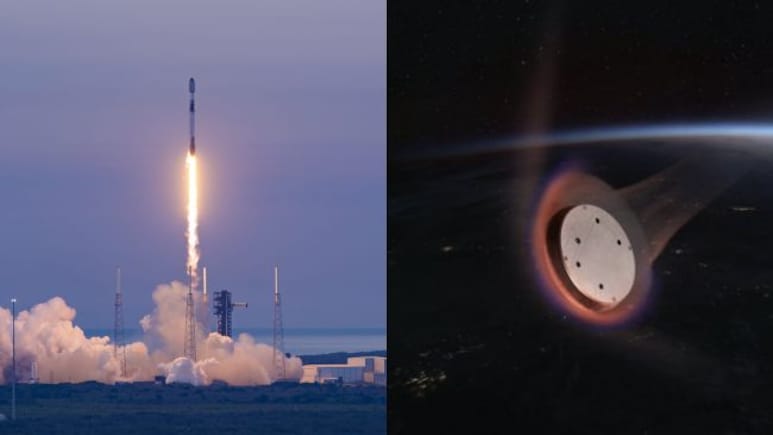
SpaceX on Tuesday launched the new Starfall capsule on its first test flight from Cape Canaveral, Florida, aboard a Falcon 9 rocket. The rocket lifted off around 4:30 pm IST and SpaceX confirmed the successful deployment of the capsule around 7:30 pm IST.
According to filings with the US Federal Aviation Administration (FAA), Starfall is designed to support manufacturing experiments in the microgravity environment of space. The company said the capsule could help businesses develop and manufacture products in space.
During the mission, SpaceX will test the spacecraft's ability to fly in a controlled manner and carry out its planned operations. SpaceX wants to test bringing the Starfall capsule back to Earth by landing it in the Pacific Ocean.
"Today's mission includes a demo of a new vehicle that will enable affordable, routine access to the microgravity environment for scientific research and in-space manufacturing," SpaceX wrote on X. "After demonstrating controlled flight, the spacecraft will splash down in the Pacific Ocean," it added.
Today's mission includes a demo of a new vehicle that will enable affordable, routine access to the microgravity environment for scientific research and in-space manufacturing. After demonstrating controlled flight, the spacecraft will splash down in the Pacific Ocean pic.twitter.com/NLwhigtSWC
— SpaceX (@SpaceX) June 23, 2026
After the spacecraft splashes down in the ocean, SpaceX teams will recover the capsule and its major parts for inspection and analysis.
Starfall is a small, disk-shaped spacecraft. It is about 2.5 feet tall and 10 feet wide. It weighs about 2,100 kilograms and can carry up to 1,000 kilograms of cargo or scientific equipment. Unlike SpaceX's Dragon spacecraft, Starfall is not designed to carry astronauts. It is built only for transporting cargo, research equipment, and manufacturing experiments.
The spacecraft has two main parts. The first is an aluminium top plate weighing about 1,400 kilograms and the second is a carbon-fibre heat shield. The cargo is stored inside a payload bay that is 8.2 feet long, 4.9 feet wide, and 1.6 feet tall.
The FAA says Starfall cannot bring itself back from orbit because it does not have a propulsion system powerful enough to perform a de-orbit burn. Instead, the capsule follows a pre-planned flight path set before the mission.
"Capsules do not have the ability to de-orbit themselves and can only control their attitude. Individual capsules would reenter Earth's atmosphere on a pre-planned trajectory and splash down with the assistance of parachutes," the FAA's assessment reads.
Track Latest News Live on NDTV.com and get news updates from India and around the world


