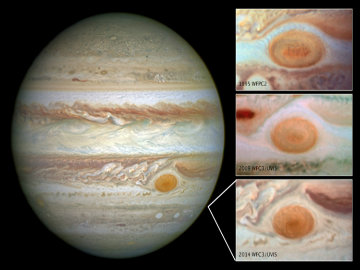
This undated image provided by NASA, taken by the Hubble Space Telescope, shows the planet Jupiter and the The Great Red Spot in 2014, (left); in 1995, (top); 2009, (center); and 2014, (bottom). Jupiter's signature Great Red Spot is on a cosmic diet, shri
Photo Courtesy: Associated Press
Washington:
Jupiter's Great Red Spot seems to be on a cosmic diet, shrinking rapidly before our eyes.
Astronomers using the Hubble Space Telescope calculate that the spot, a giant long-lasting storm, is narrowing by about 580 miles a year, much faster than before.
In the late 1800s the red spot was an oval 25,500 miles (41,000 kilometers) wide. Now it's a circle that's 10,250 miles (16,500 kilometers) across.
Michael Wong, a scientist at the University of California, Berkeley, said the spot is a mystery. Astronomers don't know why it's red or shrinking, or what will happen next. If this pace continues, in 17 years the spot could be gone. Or it could stop at a smaller size.
Wong said one theory is the spot eats smaller storms, and that it is consuming fewer of them.
Astronomers using the Hubble Space Telescope calculate that the spot, a giant long-lasting storm, is narrowing by about 580 miles a year, much faster than before.
In the late 1800s the red spot was an oval 25,500 miles (41,000 kilometers) wide. Now it's a circle that's 10,250 miles (16,500 kilometers) across.
Michael Wong, a scientist at the University of California, Berkeley, said the spot is a mystery. Astronomers don't know why it's red or shrinking, or what will happen next. If this pace continues, in 17 years the spot could be gone. Or it could stop at a smaller size.
Wong said one theory is the spot eats smaller storms, and that it is consuming fewer of them.
How may i help you today
Show full article
Track Latest News Live on NDTV.com and get news updates from India and around the world


