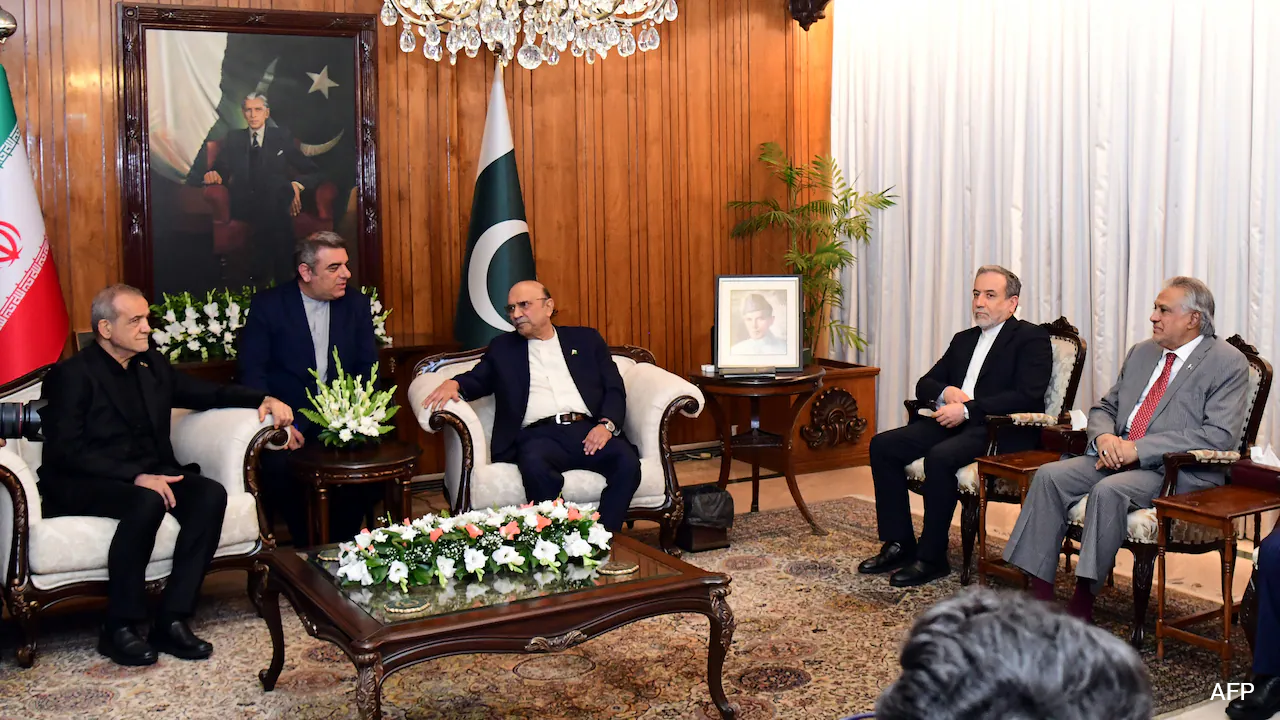
Iranian President Masoud Pezeshkian on Tuesday met with Pakistan's top civilian and military leadership and discussed regional developments and peace initiatives involving the US.
Pezeshkian, who arrived in Pakistan on a day-long visit, held separate talks with President Asif Ali Zardari, Prime Minister Shehbaz Sharif and Army chief Field Marshal Asim Munir.
"The peace deal between the US and Iran would bring a new era in the region," Prime Minister Sharif said during a joint press conference with President Pezeshkian following their delegation-level talks.
His visit comes days after Iran held talks with the US in Switzerland, where the two sides agreed on a roadmap to seal a final deal in 60 days.
The high-level talks at the Lake Lucerne Summit in Switzerland, held on Sunday and Monday, took place under the framework of the Islamabad Memorandum of Understanding (MoU) signed by the US and Iran to advance negotiations on regional security and other contentious issues.
The US and Iran signed the Islamabad MoU on Thursday to restore peace in West Asia, advance negotiations on regional security and other contentious issues.
Sharif praised the Iranian nation for showing unity and dignity during the entire crisis.
Recalling the Islamabad MoU, he said it is "a matter of great happiness that this war has come to an end, which could have engulfed the entire region and beyond".
He hailed the "sagacious" leadership of Pezeshkian and his colleagues, and highlighted Pakistan's role as an "honest and sincere mediator" in the US-Iran peace process.
Referring to the US-Iran technical talks held in Switzerland, he said, "God-willing, this arrangement will usher in a new era of peace, stability and prosperity for this entire region." Responding to a question about Iran's nuclear and missile technology, Sharif said that Iran's ballistic missile programme was not a subject of discussion between the US and Iran. "It is not possible that others have missiles and Iran does not have them," he added.
He thanked Iran for placing its trust in Pakistan to initiate and mediate the peace process. "We have done it with full honesty of purpose and sincerity," he said.
Sharif also announced that he will visit Iran next month to attend the funeral of assassinated Supreme Leader Ali Khamenei.
On his part, Pezeshkian said that relations between Pakistan and Iran are based on trust and mutual respect, and the recent events have given a new direction to these ties.
Iran believes that peace in the region is possible through dialogue and mutual respect, he said. He also called for new security arrangements in the region for lasting peace.
"We are here to appreciate the role of Pakistan and the support of the people of Pakistan since the start of the war," he said. "If it were not the effort of Pakistan, we would not be here." The premier asked Pezeshkian to convey his warm regards to Supreme Leader Ayatollah Mojtaba Khamenei for his "sagacious leadership that Iran has been able to achieve this MoU and as a result, a ceasefire with dignity and honour".
According to the Prime Minister's Office, Chief of Defence Forces and Chief of Army Staff Field Marshal Asim Munir and Deputy Prime Minister and Foreign Minister Ishaq Dar were also present in the meeting, which was also attended by Iran's Foreign Minister Abbas Araghchi.
During his meeting with Zardari, Pezeshkian lauded Pakistan's "constructive contribution" to Iran-US dialogue and reaffirmed Tehran's commitment to strengthening bilateral ties and regional peace.
Zardari welcomed Pezeshkian on his first state visit to Pakistan after the recent conflict with the US and said that his visit reflects the longstanding brotherly relations between the two countries.
According to a statement issued by the President's Office, the two leaders discussed bilateral relations, mainly regional peace and security, bilateral and regional connectivity, economic cooperation and other issues of mutual interest.
Zardari reaffirmed Pakistan's principled support for Iran's peace, stability, national unity, sovereignty and territorial integrity.
Pezeshkian said Iran attaches great importance to its relations with Pakistan and looks forward to further expanding cooperation in political, economic, security and regional matters.
In his meeting with Field Marshal Munir, Pezeshkian "appreciated Pakistan's constructive and responsible role in promoting dialogue, de-escalation, and regional stability".
"He acknowledged Pakistan's consistent efforts to encourage peaceful resolution of disputes and foster understanding among regional stakeholders at a time of heightened geopolitical challenges," the army said in a statement.
Field Marshal Munir reiterated Pakistan's unwavering commitment to peace and stability in the region.
"Both sides reaffirmed their commitment to further strengthening Pakistan-Iran relations and maintaining close consultations on issues of mutual interest, with the shared objective of advancing peace, prosperity and stability across the region," the army said.
Earlier, the Iranian leader landed at Nur Khan airbase, where he was received by President Zardari, PM Sharif and other high officials.
Pakistan's JF-17 Thunder jets escorted the plane of President Pezeshkian when it entered the country's airspace.
Ahead of his departure from Tehran, the Iranian president said his visit "aims to secure full implementation of the memorandum under international law". He added that the agreement would help strengthen stability and security in West Asia, Iran's state-run Press TV reported.
In a post on X, Pezeshkian cautioned that "the effectiveness of the talks depends on full commitment to the agreed obligations and their precise implementation." "Progress on this path will be measured by practical adherence to accepted responsibilities. Statements outside the agreed text do not help advance the negotiations," he added.
Security was on high alert in Islamabad due to the visit of the Iranian leader. The government closed bus terminals in the capital to restrict the movement of people coming to the city.
(Except for the headline, this story has not been edited by NDTV staff and is published from a syndicated feed.)
Track Latest News Live on NDTV.com and get news updates from India and around the world


