The Iran-Contra Affair: How A Secret Deal With Tehran Shook Washington's Core
On November 25 In 1986, addressing a packed White House press conference, President Ronald Reagan acknowledged something that would soon become the most serious political scandal since Watergate.
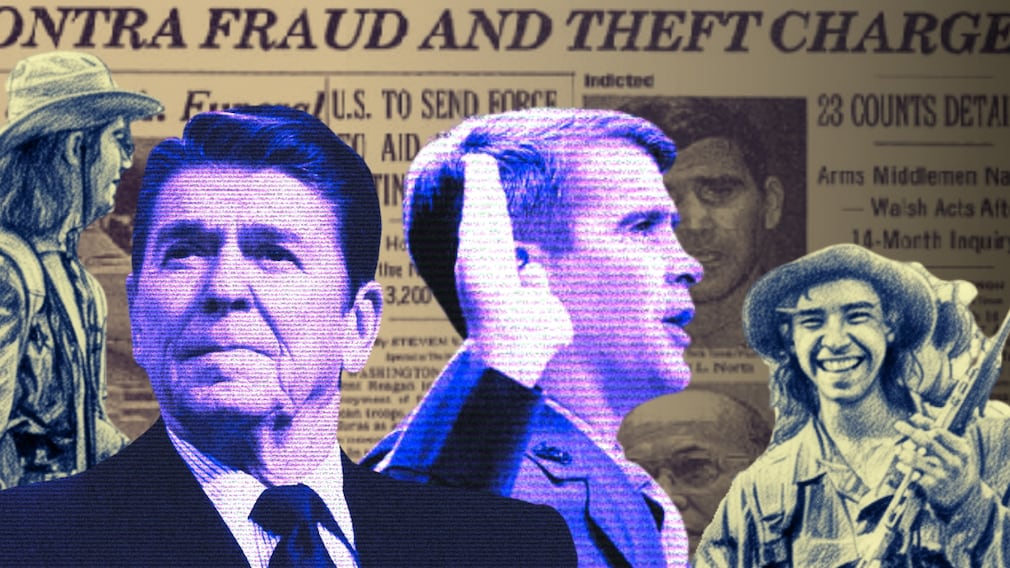
In 1986, Washington was already uneasy after reports had begun to surface that something unusual had taken place deep within the United States government machinery. But few anticipated the scale of what would follow.
On November 25, addressing a packed White House press conference, President Ronald Reagan acknowledged something that would soon become the most serious political scandal since Watergate. He confirmed that funds generated from covert arms sales to Iran had been secretly diverted to finance anti-communist Contra rebels in the central American country of Nicaragua.
Policy Built On Contradictions
Publicly, the Reagan government maintained a strong stance that the US will not negotiate with terrorists. The policy had been repeated consistently, including by Reagan himself. Yet, behind closed doors, a move had been set in motion that involved selling weapons to Iran, a country officially designated as hostile, in the hope of securing the release of American hostages held in Lebanon.
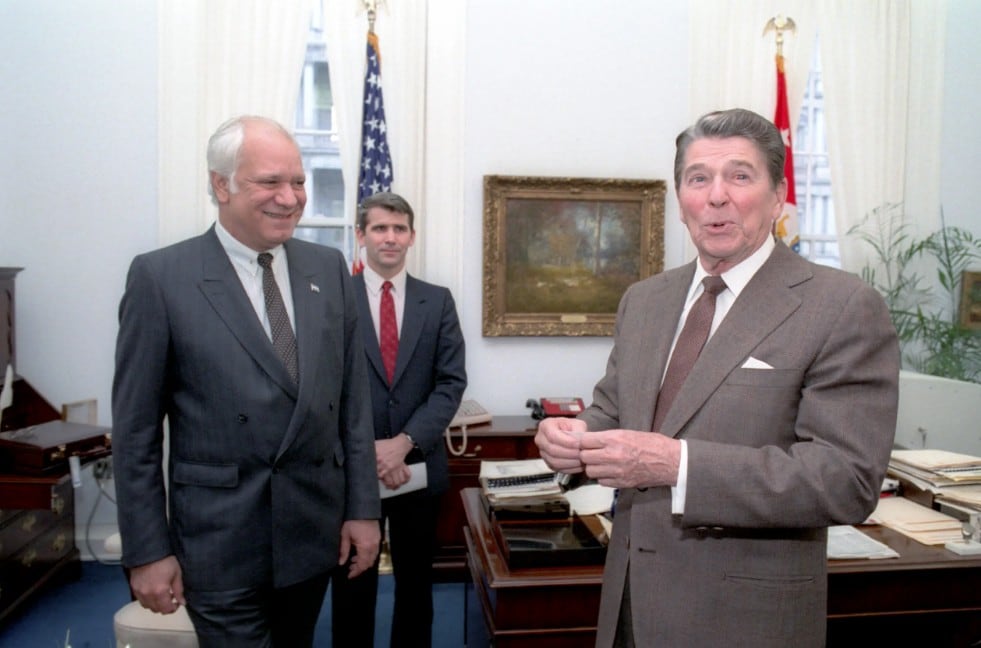
President Reagan in Robert McFarlane's office with Adolfo Calero (Nicaraguan Democratic Resistance (Contra) leader) and Oliver North, Apr 4, 1985
Photo Credit: US Government
Thousands of missiles were transferred, including more than 2,000 TOW anti-tank missiles and 18 HAWK anti-aircraft systems. These shipments took place despite restrictions tied to the Iran-Iraq war and longstanding American policy against arming Tehran.
The operation was managed not through conventional diplomatic or military channels, but through a small network within the National Security Council. Among the central figures were National Security Advisors Robert McFarlane and John Poindexter, alongside a relatively lesser-known Marine officer on the NSC staff called Lieutenant Colonel Oliver North.
The arms sales were intended to open communication channels with elements inside Iran and to secure the release of hostages.
The Contra War
In Nicaragua, the US had backed the Contras, a rebel force opposing the leftist Sandinista government led by Daniel Ortega. Reagan viewed the Contras as essential to countering Soviet influence in the Western Hemisphere. He would later describe them as fighters who must be kept together "body and soul."
But the US Congress had imposed strict limits on American involvement. Through a series of measures known collectively as the Boland Amendment, American lawmakers restricted funding and prohibited direct military assistance aimed at overthrowing the Nicaragua government.
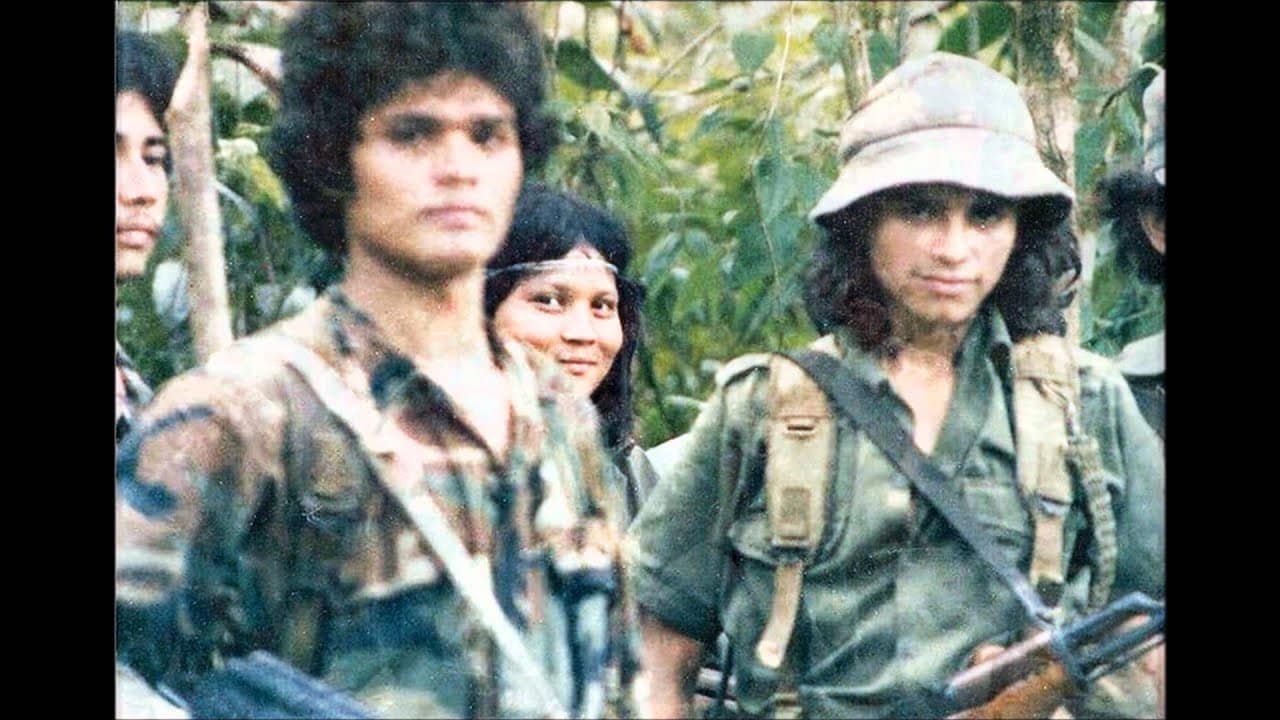
Photo Credit: Pulitzer Centre
These constraints forced the administration to consider alternatives.
Saudi Arabia, for example, contributed financial support. Honduras played a key role, hosting Contra bases and facilitating operations, in part in exchange for US military assistance.
The "Enterprise"
Profits from the arms sales to Iran were redirected to support the Contras, bypassing restrictions. This diversion was orchestrated largely by Oliver North, who oversaw what became known as "the Enterprise", a network of operatives, intermediaries, and private resources that handled everything from weapons procurement to cash transfers.
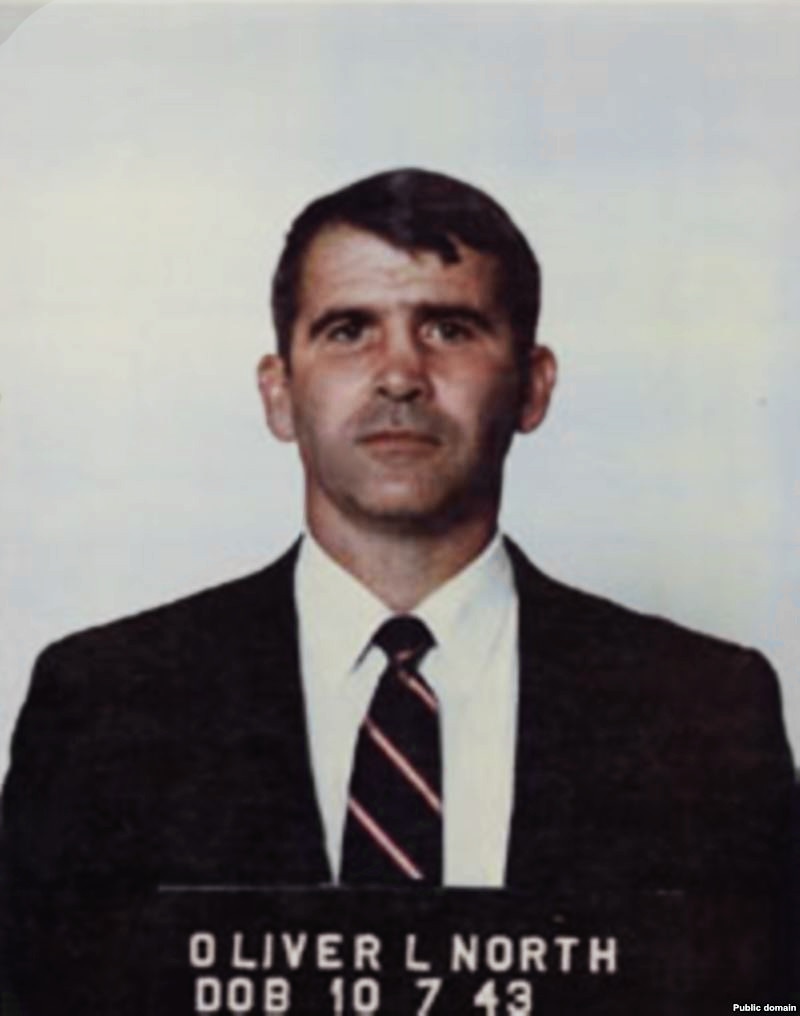
Photo Credit: US Government
Memoranda, cables, and electronic messages describe efforts to secure funding from countries such as Brunei, where an emissary, using an alias, arranged for a $10 million contribution to be transferred into an account controlled by North. The funds were ultimately lost due to an incorrect account number.
At the same time, there were indications that senior officials were aware of, or at least exposed to, aspects of these activities.
The President's Role
There is evidence that Reagan personally authorised key elements of both operations. He signed findings approving covert action in Nicaragua and supported continued assistance to the Contras despite congressional opposition. He also approved the initiative to engage Iran in arms-for-hostage negotiations.
The extent of his knowledge regarding the diversion of funds remains contested.
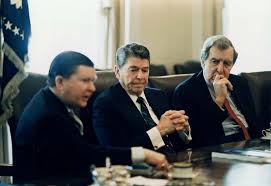
Reagan himself maintained that he had not been aware of the diversion. Yet his public statements created further complications.
Photo Credit: US Government
John Poindexter, who served as national security advisor, later stated that he had not informed Reagan about the diversion. He added that he believed the president would have approved it if he had been told.
Reagan himself maintained that he had not been aware of the diversion. Yet his public statements created further complications.
On November 13, 1986, in a televised address, he declared: "We did not - repeat - did not trade weapons or anything else for hostages."
The statement would later be contradicted by the administration's own findings. As more details emerged, Reagan's leadership style came under scrutiny. The Tower Commission, established to investigate the affair, concluded that he had been disengaged from the operational details of policy, allowing subordinates autonomy without appropriate oversight.
The Unraveling
The operation began to unravel in late 1986, as a key moment came when a transport plane supplying the Contras was shot down over Nicaragua. Documents recovered from the wreckage pointed to connections with US operations, raising immediate suspicions.
At the same time, investigations exposed elements of the Iran arms deals. Under growing pressure, the administration initiated an internal review led by Attorney General Edwin Meese. The inquiry confirmed that funds from the arms sales had been diverted to the Contras.
Poindexter resigned. North was dismissed. Efforts were made to manage the political fallout.
Public Reaction
Reagan's approval ratings dropped sharply, falling from 67 per cent to 46 per cent within a month. Public trust was shaken, with polls indicating widespread scepticism about his claims of limited knowledge.
Congressional hearings in 1987 brought the scandal into full public view. Televised testimony, particularly from Oliver North, drew significant attention. North, appearing in his Marine uniform, defended his actions and portrayed the operation as a necessary response to geopolitical challenges.
Some people viewed him as a patriot acting in the national interest. Others saw a clear violation of law.
Legal proceedings followed. Several officials were indicted or convicted on charges ranging from obstruction of justice to providing false testimony. However, many convictions were later overturned on appeal.
Despite the scale of the scandal, Reagan avoided the most severe political consequences. He was not impeached.
-
Opinion | India Has A 'Lobbying' Problem In Washington, And It Has Come Back To Haunt It

While the EU, Japan, the UK and South Korea secured quick deals, India's efforts were getting drained in prolonged negotiations and the wrong kind of lobbying.
-
Opinion | The AI Boom Has Run Into A Big 'Debt' Trap Problem. Inside The 5% Danger Line
For most of the AI buildout's first two years, hyperscalers funded it the easy way: out of operating cash flow. That era is over.
-
Opinion | Iran To Saudi, Pakistan Is Now Fast Running Out Of Sides To Play
Pakistan's long history of playing all parties to its own benefit may have reached the end of its road.
-
Gyanesh Kumar Has An Immunity Pin. Why A Petition Says He Can't Use It
The Opposition wants the Chief Election Commissioner prosecuted for alleged manipulation of voter rolls, but a 2023 law stands in the way. A petition in the Supreme Court now says the law has a gap.
-
Opinion | Is The World Staring At A Big Stock Market Crash - And Recession? 5 Uneasy Signs
On Wednesday, the US bond market recorded its worst day since Trump's "Liberation Day" tariffs rattled markets in April 2025. The 30-year US Treasury yield topped 5.43%, putting it on track for its highest close since 2004.
-
Form 6 For New Voters: When A Small Change Triggered A Big Row
In July 2026, the online version of Form 6 on the ECI's ECINet portal was modified to include a new declaration.
-
Opinion | Saudi Arabia's China Turn Has Begun - After Learning Much The Hard Way
Leaning on China just makes sense for the Saudis right now. The question is, can its other great 'ally' stomach it?
-
Opinion | Bihar Assault, Hisar Marriage Ban: Who'll Stop The Guardians Of Indian 'Culture'?
Why exactly does the sight of a young couple seeking a bit of alone time somewhere tend to particularly provoke a certain kind of Indian men?
-
Opinion | The Trump-Xi Summit, And India's Many Worries Of Its Own
Washington and Beijing may have chosen coexistence over confrontation. For India, that could be both a relief and a warning.