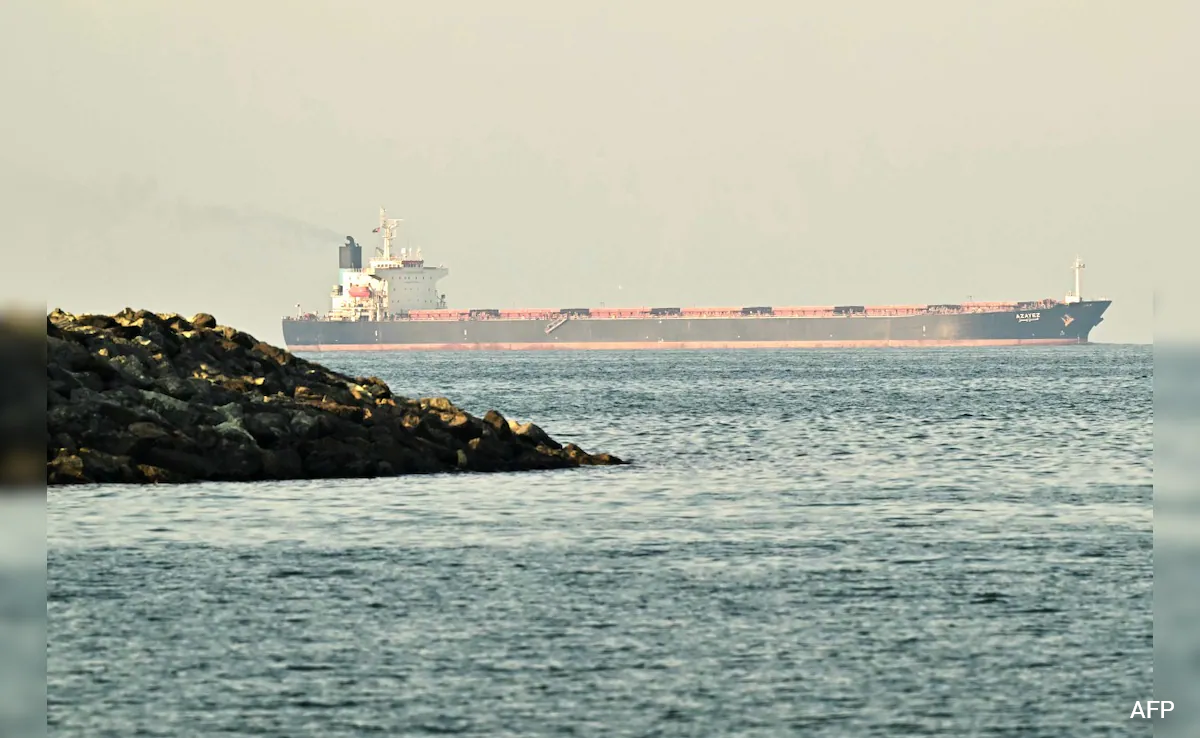
Iran has reportedly begun laying sea mines in the Strait of Hormuz, one of the world's most critical energy routes. A few dozen mines have been placed so far in the waterway, CNN reported, citing sources.
Iran still retains around 80-90 per cent of its small boats and mine-laying vessels, which means it has the capability to deploy hundreds of mines if the situation escalates, the report stated. Iran's Islamic Revolutionary Guard Corps, along with the country's navy, could use small craft, explosive-laden boats and shore-based missiles to target ships moving through the area.
Reacting to the reports, US President Donald Trump said on Truth Social, “If Iran has put out any mines in the Hormuz Strait, and we have no reports of them doing so, we want them removed, IMMEDIATELY!”
What Are Sea Mines?
Sea mines are explosive devices placed underwater to damage or destroy ships and submarines. According to the Strauss Centre at the University of Texas, these weapons are often used in naval warfare to block enemy vessels from entering certain areas or to force them into specific routes.
The concept of sea mines dates back centuries. The first successful sea mine was invented in 1776 by David Bushnell. His design consisted of a wooden keg filled with gunpowder and fitted with a basic contact fuse.
Types Of Sea Mines
Mines are generally classified based on how they are deployed, how they are triggered and where they are positioned in the water.
How Mines Are Placed In The Sea
Large surface vessels such as warships and patrol boats are commonly used for mine-laying operations. But smaller boats, including fishing vessels, can also be used in some situations.
Aircraft can also release mines into the sea. Both helicopters and fixed-wing planes are capable of dropping mines from the air. Submarines are another platform used for this purpose. They often deploy mines through their torpedo tubes.
Method Of Detonation
The simplest type of mine is a contact mine. These mines explode when a ship physically touches them or comes very close.
More advanced systems are known as influence mines. According to the Strauss Centre, these mines do not require direct contact. Instead, they rely on sensors that detect certain characteristics of ships, often referred to as “signatures.”
These sensors can identify magnetic signals, acoustic noise, pressure changes, vibrations or underwater electrical activity created by a passing vessel.
Another specialised type is the rising mine. Once activated, these mines fire a projectile warhead upward toward the target ship. Rising mines are typically used in deeper water.
Both contact and influence mines can also be controlled remotely.
Position Of Mines In The Water
Sea mines can also be classified based on where they are placed in the water.
Drifting mines float freely on the surface and move with ocean currents or wind. Although drifting mines have been banned under international law for more than eighty years, both Iran and Iraq have reportedly used them in conflicts since 1980. They are versatile due to their deployment which can be done by small boats, including trawlers and speedboats, warships or aircraft. They can detonate via contact or via remote-control.
Bottom mines rest directly on the seabed or may be buried in the ocean floor. Because they sit on the bottom, they can carry larger explosive charges. Many bottom mines rely on sensors to detect ships passing above them and are generally used in relatively shallow water. They can also detonate through contact or remote-control.
Moored mines float below the surface but are attached to the seabed with a cable. The depth can be adjusted according to the water level. These mines contain smaller charges than bottom mines.
How Do Sea Mines Work
The damage to ships through sea mines mainly occurs due to two forces: a growing gas bubble and a shockwave.
The explosion creates a pressure difference in the water that causes a gas bubble, which rises quickly towards the surface. The bubble can strike the bottom of the vessel with powerful force.
Shockwaves are also created through explosions, which can disrupt sensitive equipment and mechanical systems onboard. These waves are more likely to disrupt a ship's hull rather than the full vessel as compared to an explosion.
The amount of damage also depends on several factors such as the size of the explosive charge, the depth of the mine and the strength and size of the vessel.
Countermeasures Against Sea Mines
Navies use countermeasures that can be both passive or active to deal with sea mines.
Passive measures focus on changing the “signatures” which reduce the chance of triggering a mine. Ships can be built using materials such as fiberglass or wood instead of steel in order to reduce magnetic signals.
Another method, known as degaussing, alters a ship's magnetic field to make it harder for mines to detect it. But this won't be possible in the case of VLCC (Very Large Crude Carrier).
Active countermeasures involve locating and removing mines. Special ships and helicopters known as minesweepers are used to detect and destroy mines or clear safe routes through mined waters.
But mine warfare technology continues to evolve. New systems, such as Target Detection Devices, can turn older mines into more advanced influence mines. These technological developments allow “more fine-tuned control of a mine's actuation behaviour to increase the likelihood of success.”
Track Latest News Live on NDTV.com and get news updates from India and around the world


