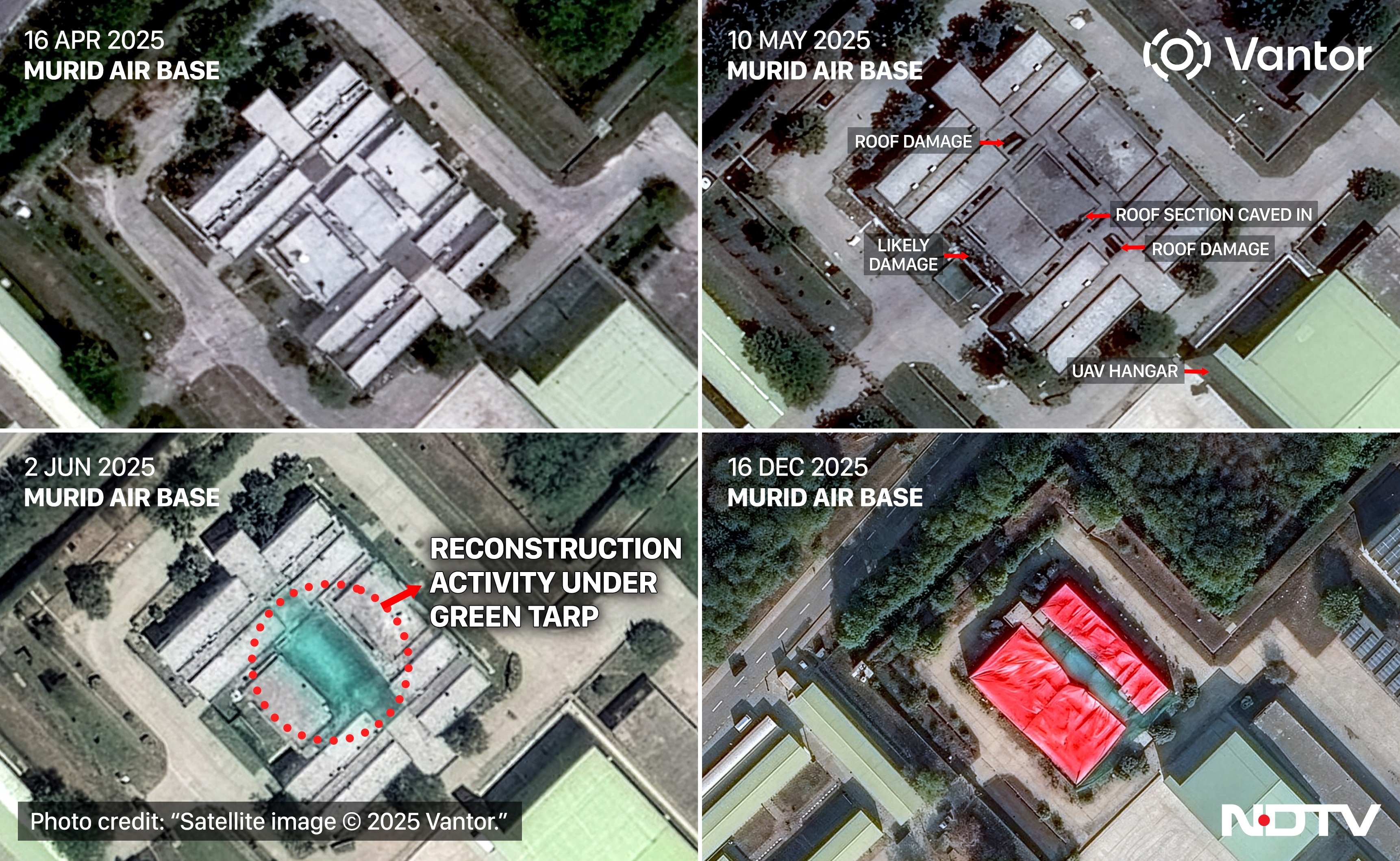
New high-resolution satellite imagery available to NDTV shows extensive re-construction activity at a key command and control building at Pakistan's Murid Airbase which was struck by the Indian Air Force during Operation Sindoor in the early hours of May 10.
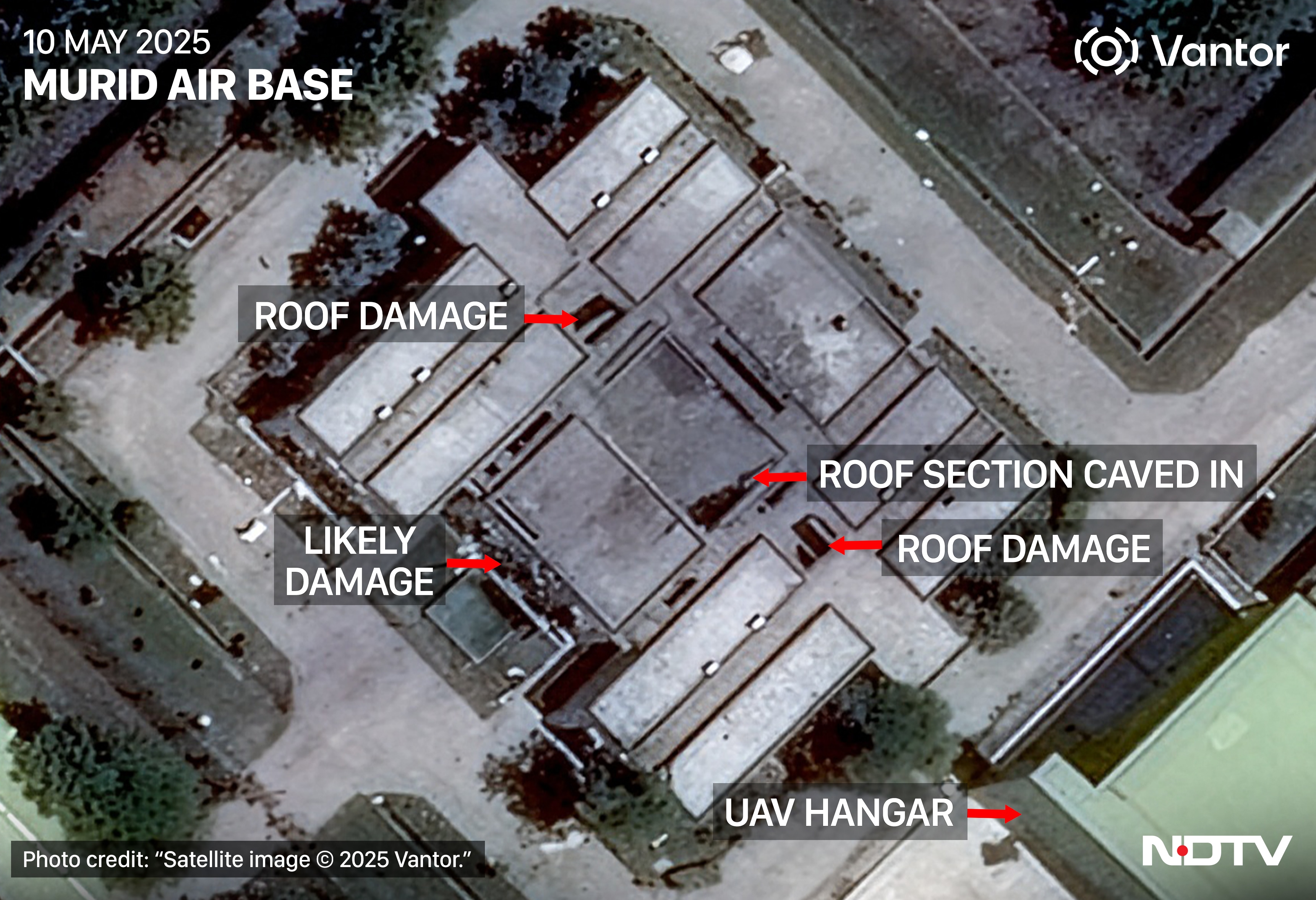
The Vantor sourced image produced in this report is dated December 16 and shows a large red tarpaulin covering the building located adjacent to a large complex where Pakistan operates Unmanned Aerial Vehicles (UAVs). Damage from the Indian Air Force strike is believed to have caused parts of the roof to collapse, extensive structural damage, and likely internal destruction of the building.
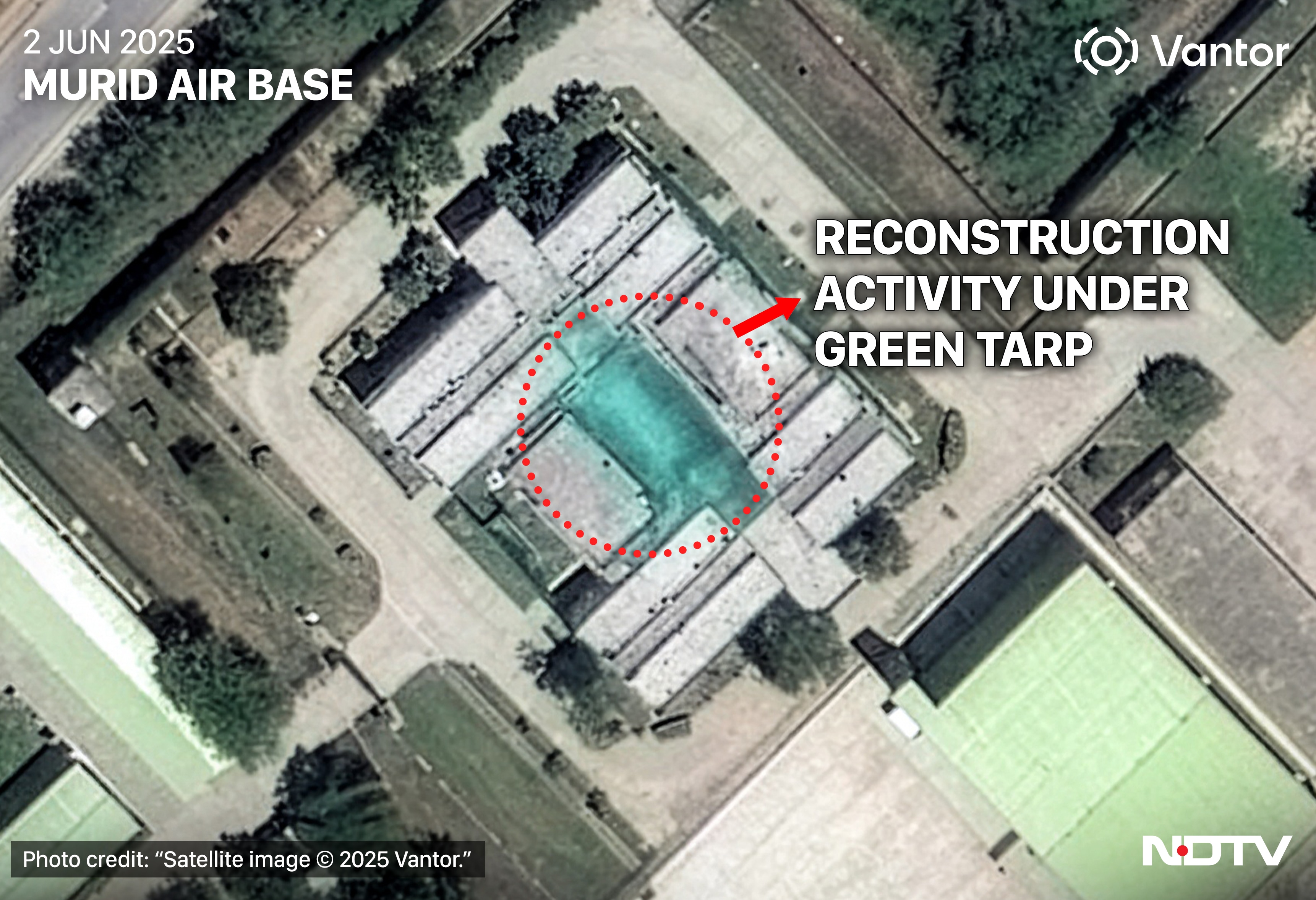
Post-strike images of the attack from June this year show a smaller green tarpaulin covering a part of the building at that time. The entire structure now appears to be under repair or re-construction under a larger tarp. Heavy-duty tarps are commonly used by militaries to hide repair work, debris clearance, or sensitive damage from satellite reconnaissance.
Evidence first emerged of reconstruction activity in satellite images from June. High-res image here
Initial images of the impact of the Indian Air Force strike on Murid had shown specific parts of the roof having caved in. While the IAF has never revealed the specific weapons that it used to target individual targets, post-strike imagery of Murid indicates the possible use of missiles with roof-penetrating warheads, such as a precision-guided missile carrying a delayed-fuse penetrator.
Penetrator weapons typically strike the roof of a hardened or semi-hardened structure at high speed, punching through concrete or metal roofing with its kinetic energy and hardened casing before detonating a high-explosive payload after penetrating inside the building. This maximises internal damage within the structure.
"India had targeted this building during its conflict with Pakistan in May 2025, satellite imagery showed significant damage to its roof at the time. Pakistan had initially placed tarpaulin only over the affected sections possible as structural and damage evaluations were underway," says satellite imagery expert Damien Symon. "Now with the building fully enclosed in new tarpaulin and construction mesh it is likely reconstruction efforts are finally underway. The scale of containment around the building also suggests that there likely was more internal damage to site than perceived earlier."
PAF Base Murid, located in the Chakwal District of Punjab, Pakistan is a key Pakistan Air Force facility primarily serving as a hub for unmanned aerial vehicles (UAVs) and unmanned combat aerial vehicles (UCAVs), including models like the Shahpar series, Burraq, Bayraktar TB2/Akinci, and Wing Loong II.
On May 10, hours before Pakistan's Director General of Military Operations Major General Kashif Abdullah reached out to his Indian counterpart Lieutenant General Rajiv Ghai with an offer of a ceasefire, the Indian Air Force had stepped up its attacks on Pak airbases. This was the biggest military escalation of the 88-hour war.
Satellite imagery indicate significant damage on the roof of the PAF facility. High-res image here
The IAF was responding to the widespread incursion of Pakistani drones which were detected at more than 26 locations a day earlier. During this period, Pakistan launched concentrated attacks on IAF Integrated Air Command and Control System (IACCS) nodes, airbases and S-400 surface-to-air missile units. This resulted in limited damage to IAF bases and personnel in Udhampur, Pathankot, Adampur and Bhuj.
There was a second strike on Murid on May 10. Images of that attack, reported first by NDTV showed a three-metre-wide crater just 30 metres from an underground facility of the Pakistan Air Force. According to experts, earth-protected entrances to this underground site indicate that it served as a storage facility for special equipment or perhaps as a hardedend operational shelter capable of sustaining heaving bombardment.
Sequence of pre-strike, post-strike and reconstruction of the PAF facility struck in Murid. High-res image here
Pakistan has begun extensive reconstruction activity at sites within its airbases which were struck by the Indian Air Force in May.
Runways at Mushaf Airbase (Sargodha) and Rahim Yar Khan (southern Punjab) were cratered preventing the operation of fighter jets. These have now been repaired.
Hangars were destroyed at Jacobabad, Bholari and Sukkur in IAF strikes during Operation Sindoor. The Indian Air Force believes several PAF F-16 fighter aircraft were destroyed on the ground in Jacobabad while an Airborne Early Warning and Control Aircraft was destroyed in the strike on a hangar in Bholari. In Sukkur, Pakistan has levelled a hangar which are believed to have housed Unmanned Aerial Vehicles. Meanwhile, new structures have appeared at the site of a complex destroyed by the IAF in strikes on the Nur Khan airbase in Chaklala near Islamabad.