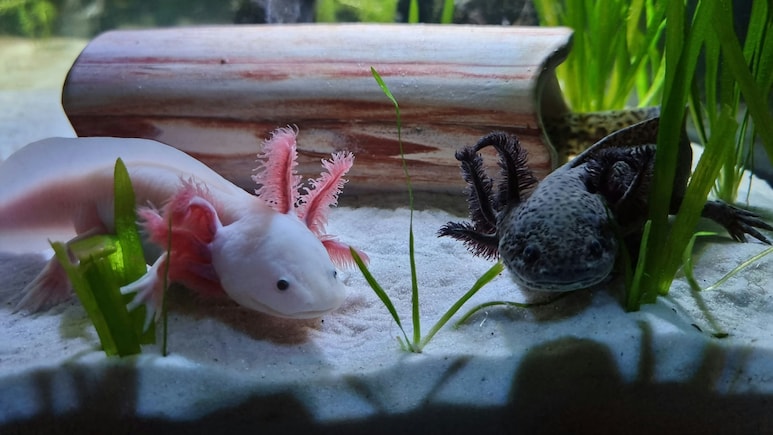
Axolotls, the frilly-headed salamanders that stay in their ‘tadpole' form forever, have the ability to completely regrow their thymus, according to recent research.
In most vertebrates, the thymus is a complex organ that is instrumental to the immune system, according to Scientific American.
-

-
 World-Class Chefs, Food And Music: The Fun Side Of NDTV World Summit 2026
 -
 AI, Consciousness And Dharma: Why Ancient Indian Wisdom Matters Now
 -
 NDTV World Summit: What To Expect From PM Modi's Keynote Address
 -
 NDTV World Summit 2026: What To Watch Out For | PM Modi, Jaishankar, AI And Global Power Shifts
 -
 A World Between Orders: What To Expect At NDTV World Summit 2026
 -
 Who Is Rajiv Mehta? Lilavati Hospital Trustee To Speak At NDTV World Summit 2026
 -
 Alain Ebobisse, Africa50 CEO, To Attend NDTV World Summit 2026. All About Him
 -
 Kriti Sanon At NDTV World Summit: A Look At Her Career And Business Ventures
 -
 Ex-CIA Director To Decode 'War In Times Of AI' At NDTV World Summit
 -
 Who Is Vikram Rai, CEO, South Asia GE Aerospace, Set To Attend The NDTV World Summit 2026
In the research paper, published in Science Immunology, the co-authors have highlighted how axolotls can rebuild the thymus completely from scratch, compared to earlier works that suggested how some animals were able to partially regrow the intricately structured organ.
What is an axolotl?
According to the Natural History Museum, axolotl, or 'Ambystoma mexicanum,' is a type of salamander which does not go through metamorphosis - a process under which salamanders go on to become adults, like a tadpole transforming into a frog.
Whole starting off in the water, salamanders later go on to mostly live on land. During metamorphosis, they witness multiple changes to adapt to their new habitat.
However, axolotls do not make this transition and rather keep their frilly external gills and other juvenile features. They go on to live in the water for their entire life.
Axolotls' Extraordinary Biological Feat
Maximina H Yun, a biologist at the Chinese Institutes for Medical Research in Beijing and co-author of the latest study, has termed axolotls as "legendary for regenerating limbs and parts of the central nervous system”.
"The realisation that these animals can regrow their full thymus from scratch is a breakthrough moment," Scientific American quoted Yun as saying.
The thymus produces the T cells in the body that target and destroy invading pathogens.
Turan Demircan, a biologist and regeneration expert at Mugla Sıtkı Kocman University in Turkey, said it is famous for being one of the first organs to degenerate in humans and several other vertebrates.
"Until now, it was believed that once this tissue is gone or removed, it cannot be fully rebuilt," Demircan added.
As part of their study, Yun and others decided to remove the thymus from several juvenile axolotls. They were surprised to find out that these were able to build new thymuses after seven days, while 60% of them fully regenerated the organ in 35 days.
“I was genuinely surprised. A full, functional regeneration of a complex immune organ wasn't something I expected," said René Maehr, a biologist at the University of Massachusetts Chan Medical School.
Later on, the researchers tested the function of the regenerated thymuses after transplanting them into other axolotls.
Demircan highlighted that the "transplanted organs integrated perfectly".
A further analysis pointed towards two features that were essential to the regeneration process: the Foxn1 gene and a signalling molecule called midkine.
Scientists already knew aboutthe Foxn1 gene's involvement in thymus development.
The results indicate that there could be a biological pathway involving these components, which might be useful in treating thymus-related conditions in humans.
Track Latest News Live on NDTV.com and get news updates from India and around the world


