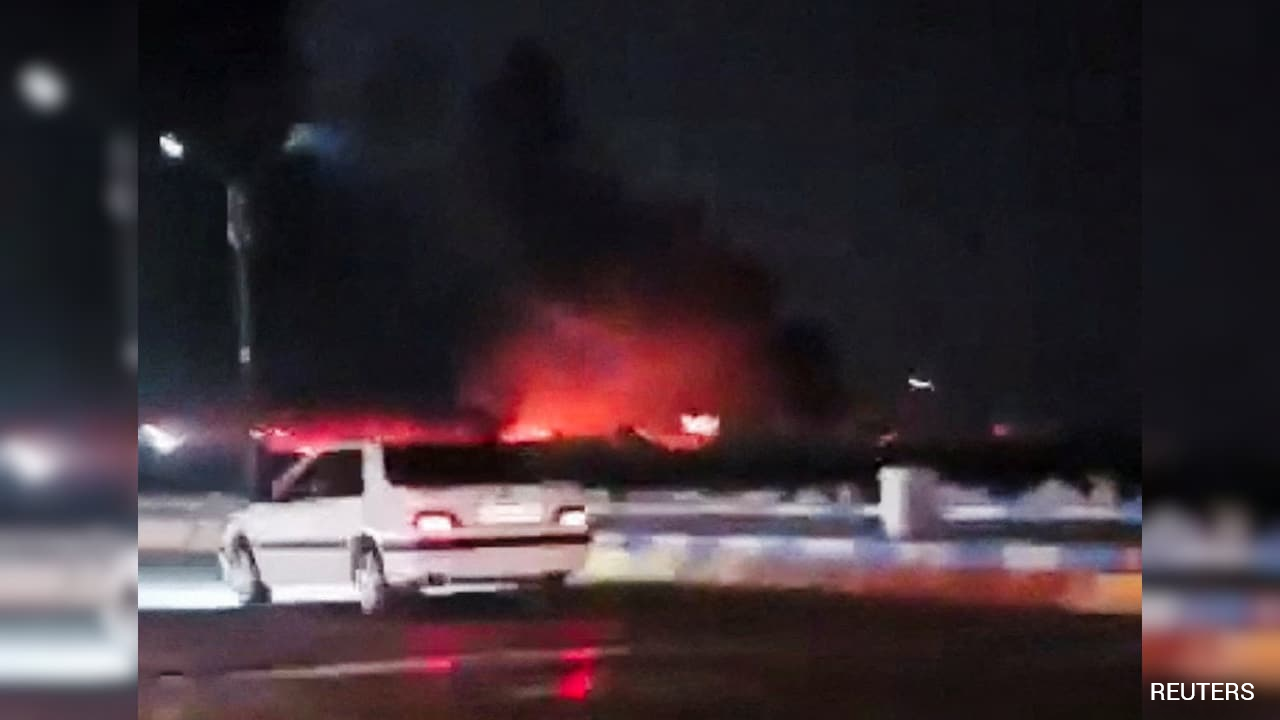
- New US airstrikes on Iranian targets are four to five times larger than prior attacks
- Strikes targeted Iranian air defenses, missile sites, ports, and drone launch areas
- US revoked temporary sanctions waiver on Iranian oil after tanker attacks near Oman
The new US airstrikes against Iranian military targets in the area of the Strait of Hormuz have been "four or five times bigger in scope and power" than any previous attacks carried out ten days ago, according to an Axios report. A US official told the publication that the operation, launched in retaliation for renewed Iranian attacks on commercial ships, could continue for several more hours, even as millions of Iranians are on streets for the mega funeral of former Supreme Leader Ali Khamenei.
The United States has already revoked a temporary sanctions waiver for Iranian oil after three tankers were struck in the strategically crucial commercial shipping route, raising pressure on Tehran as it negotiates with Washington over ending the Middle East war.
Officials said the strikes were the most intense US attacks on Iran since the April ceasefire and risk plunging Tehran and Washington into a new cycle of retaliation, threatening the fragile memorandum of understanding signed between the two nations less than three weeks ago.
According to the Axios report, the Iranian air-defense systems, surface-to-air missiles, coastal surveillance systems, anti-ship cruise missile sites, port facilities, and drone launch sites were targeted in the strikes, with Iranian media reporting that explosions were heard in the port cities of Bandar Abbas and Sirik, as well as on Qeshm Island.
At least six rounds of explosions have been heard on the island of Qeshm, between seven and nine in Sirik and 10 in Bandar Abbas, an Al Jazeera report said, quoting officials.
More Targets On US Aim
A US official told the Associated Press that attacks intended to hit around eight times more targets than the previous round of retaliatory strikes that were conducted at the end of June. The official said that Iran hasn't been listening, so the US is "turning up the volume."
Another official told CNN that strikes were “punishment” for Iran for attacks on commercial ships near the contested waterway.
The US Central Command (CENTCOM) said they completed a new round of offensive strikes against Iran, hitting over 80 targets with precision munitions as an immediate response to Iran's latest attacks on commercial vessels transiting the Strait of Hormuz.
— U.S. Central Command (@CENTCOM) July 8, 2026
"US forces struck Iranian air defense systems, command and control networks, coastal radar sites, anti-ship missile capabilities, and more than 60 Islamic Revolutionary Guard Corps small boats in and near the strait to degrade Iran's ability to continue attacking international commerce flowing through the international trade corridor," the agency said in a post.
A US official told Axios that US President Donald Trump approved the new Iranian strike plan and ordered it while in Turkey for this week's NATO summit.
"This response is a direct result of the acts of international terrorism that have been perpetrated by Iran on innocent ships transiting the Straight of Hormuz. The Iranians know the consequences to their ridiculous actions, yet they still chose to carry out these attacks," the official said.
Meanwhile, talks between Iran and the US appeared to be on hold until after the burial of Khamenei, who was killed in US-Iranian strikes on February 28.
Iran's Reaction
The Khatam-al-Anbiya Central Headquarters has strongly condemned the US strikes in southern Iran, labeling them a “blatant act of aggression” that took place while the body of the late supreme leader was being hosted for funeral processions in Iraq.
In a statement, the Iranian military warned that its armed forces will deliver a “crushing response” to the US actions. The military said Iran will not allow any outside interference in the management of the Strait of Hormuz.
“It is reiterated that the only safe passage for commercial ships and oil tankers through the Strait of Hormuz is the route designated by the Islamic Republic of Iran,” the military added.
Parliament speaker and chief negotiator with the US, Mohammad Bagher Ghalibaf, also condemned the recent strikes, claiming Iran won't fold.
"Major MOU Violations by the US: Violating Iranian adjustments in the Strait. Persistent threats of further strikes. Reinstating oil sanctions. Attacks on southern Iran. Continued Zionist aggression on Lebanon. The era of bullying and extortion is over. It leads nowhere. We don't fold," he wrote in a post on X.
Iran's deputy foreign minister Kazem Gharibabad said the US strikes are being considered a violation of the MoU. Condemning that US move, the Iranian Foreign Ministry said in a statement that "the US government bears responsibility for the consequences of this breach of commitment."
Tehran also replied to reports and statements about the Iranian attacks on ships, calling them questionable accusations.
One tanker was travelling off the coast of Oman when it was hit and caught fire, the United Kingdom Maritime Trade Operations centre said. Iranian state television said the liquefied natural gas tanker came under attack after ignoring warnings but did not directly claim the assault.
The other two ships sustained some damage, but no one was injured, and both continued on their way, the UK maritime agency said.
Tehran, which has repeatedly declared that only its approved route through the strait is safe, is suspected of attacking other ships that have used a route close to the Omani shore. Location details provided by the U.K. agency showed that all three attacks occurred off the coast of Oman or the neighbouring United Arab Emirates, making it likely that the ships were using the route near Oman.
In peacetime, a fifth of all traded oil and natural gas passed through the channel.
Iranian President Rushes Home
Meanwhile, Iranian President Masoud Pezeshkian, who was in the Iraqi city of Najaf to attend funeral rites for former Supreme Leader Ali Khamenei, is returning to Tehran following the US's latest strikes, according to the state broadcaster IRIB.
According to Press TV, Pezeshkian had also planned to hold high-level talks with Iraqi government officials.
The coffins of Khamenei and his three family members have been taken to Najaf, from where they'll be taken to Iraq's Karbala before being returned to the Iranian city of Mashhad for burial on July 9.
Khamenei's son, Iran's new Supreme Leader Ayatollah Mojtaba Khamenei, has yet to make an appearance at the ceremonies, which began Saturday in Tehran. He is believed to be in hiding after reportedly being wounded in the airstrike that killed his father.
Track Latest News Live on NDTV.com and get news updates from India and around the world


