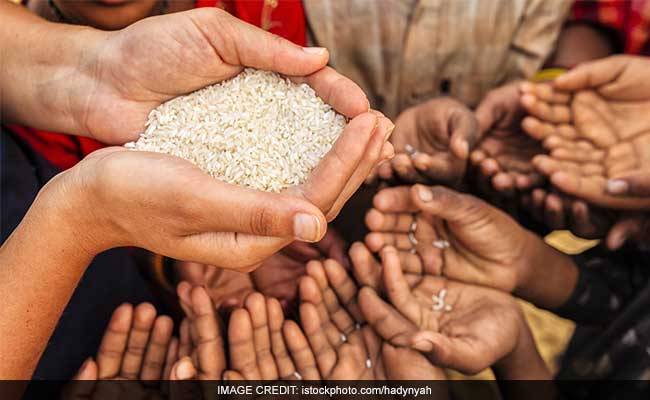
More than 821 million people suffered from hunger, food insecurity and malnutrition worldwide last year, the United Nations reported Monday -- the third year in a row that the number has risen.
After decades of decline, food insecurity began to increase in 2015 and reversing the trend is one of the 2030 targets of the UN's Sustainable Development Goals.
-

-
 Is AI Bubble Waiting To Burst? Nikhil Kamath Warns Of Tougher Months Ahead
-
 "We Don't Have 5 Years": Celebrated American General Sounds Alarm On War
-
 "There Will Be Issues Between Big Countries": S Jaishankar On India-China
-
 Neha Goyal Makes Stunning Asian Games Gold Revelation At NDTV World Summit 2026
-
 Big NDTV Summit Impact: RBI Governor's Tata Sons Listing Remark Makes Top Newspaper Headlines
-
 "Certainty Is A Problem": Nikhil Kamath On Marriage, Children And Future
-
 "High Inflation Is Like Tax On Everyone": RBI Governor At NDTV World Summit
-
 RBI Governor Sanjay Malhotra's Big Hint On Tata Sons Listing Row At NDTV World Summit
-
 The Mystery Of A Bare Nail In Ashwini Vaishnaw's Office
-
 To PM Modi's "Failed Product" Jab At Rahul Gandhi, A Shashi Tharoor Counter
But getting to a world where no one is suffering from hunger by then remains an "immense challenge," the report said.
"The State of Food Security and Nutrition in the World" was produced by the UN Food and Agriculture Organization (FAO) and other UN agencies including the World Health Organization.
"To safeguard food security and nutrition, it is critical to already have in place economic and social policies to counteract the effects of adverse economic cycles when they arrive, while avoiding cuts in essential services, such as health care and education, at all costs," it said.
The authors said a "structural transformation" was needed to include the poorest people in the world, a move they said would require "integrating food security and nutrition concerns into poverty reduction efforts" while tackling gender inequality and the exclusion of certain social groups.
Malnutrition remains widespread in Africa, where around 20 percent of the population is affected, and in Asia where more than 12 of people experience it. In Latin America and the Caribbean, seven percent of people are affected.
Adding the number of people suffering from famine to those hit by food insecurity gives a total of more than two billion.
The FAO said current efforts were insufficient to meet the goal of halving the number of children whose growth is stunted by malnutrition by 2030.
Around 149 million children currently suffer from hunger-related growth delays.
At the same time, the report notes that obesity and excess weight are both on the rise in all regions, with school-age children and adults particularly affected.
(Except for the headline, this story has not been edited by NDTV staff and is published from a syndicated feed.)Track Latest News Live on NDTV.com and get news updates from India and around the world


