Redshift
- All
- News
- Web Stories
-
James Webb Telescope Finds Galaxies Nearly as Old as the Early Universe
- Wednesday February 11, 2026
- Written by Gadgets 360 Staff
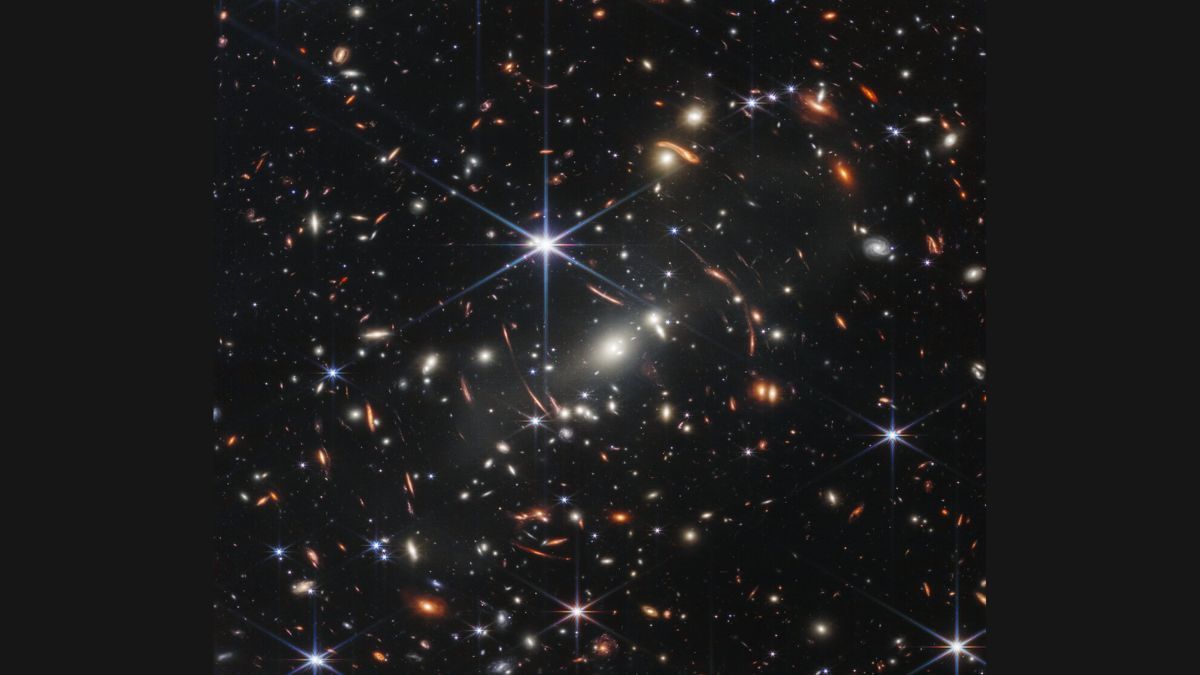
NASA’s James Webb Space Telescope has revealed early galaxies that appear almost as old as the universe itself. By analyzing 31 galaxies at high redshift, researchers estimated stellar ages of around 600 million years—close to the universe’s age at that epoch. One galaxy may even seem older than the universe, posing a potential challenge to t...
-
www.gadgets360.com
-
NASA's Roman Telescope Set To Map Cosmic Voids, Reveal Universe's Dark Energy Secrets
- Tuesday December 16, 2025
- Science | Edited by Astitva Raj
The Roman telescope promises to provide a clearer picture of the large-scale structure of the universe and the forces shaping it, bringing scientists closer to understanding the cosmic puzzles of dark matter.
-
www.ndtv.com
-
JWST Detects Oldest Supernova Ever Seen, Linked to GRB 250314A
- Friday December 12, 2025
- Written by Gadgets 360 Staff
Astronomers using the James Webb Space Telescope have detected the oldest supernova ever recorded, tied to gamma-ray burst GRB 250314A. Occurring when the universe was only 730 million years old, the explosion provides a rare glimpse into the first generations of stars and early galaxy growth, highlighting Webb’s unmatched ability to study the di...
-
www.gadgets360.com
-
How Hot Was the Universe 7 Billion Years Ago? Scientists Now Have an Answer
- Wednesday November 5, 2025
- Written by Gadgets 360 Staff
Japanese astronomers using ALMA data have found the universe was about twice as hot 7 billion years ago, with a temperature of 5.13 K compared to today’s 2.7 K. The finding aligns perfectly with Big Bang predictions that the Universe cools as it expands, providing the most precise mid-epoch measurement yet and reinforcing confidence in standard c...
-
www.gadgets360.com
-
James Webb Space Telescope Reimagines Hubble’s Deep Field, Unveils Ancient Galaxies
- Tuesday August 5, 2025
- Written by Gadgets 360 Staff
The James Webb Space Telescope has re-imaged part of Hubble’s Ultra Deep Field, revealing over 2,500 galaxies in stunning infrared detail. Using its NIRCam and MIRI instruments, Webb observed faint galaxies dating back to just a few hundred million years after the Big Bang. This is part of the JADES survey, which includes the deepest mid-infrared...
-
www.gadgets360.com
-
Is Earth In A Giant Cosmic Void? Why New Research Could Change Everything
- Wednesday July 9, 2025
- Science | Edited by Nikhil Pandey
New research suggests Earth may lie inside a massive, billion-light-year-wide cosmic void, offering a possible solution to the Hubble Tension and changing our understanding of the universes expansion.
-
www.ndtv.com
-
Russian Researchers Discover 11 New Active Galactic Nuclei In Spektr-RG X-ray Survey
- Saturday May 17, 2025
- Written by Gadgets 360 Staff
In a significant step for extragalactic astronomy, researchers from the Russian Academy of Sciences have identified 11 new active galactic nuclei (AGNs) through the ART-XC telescope aboard the Spektr-RG space observatory. These AGNs, classified as Seyfert galaxies, span redshifts from 0.028 to 0.258 and display X-ray luminosities typical for the pr...
-
www.gadgets360.com
-
NASA James Webb Space Telescope Discovers Farthest Spiral Galaxy, Reveals Clues About Galactic Evolution
- Saturday April 19, 2025
- Written by Gadgets 360 Staff
JWST discovers Zhúlóng, the earliest Milky Way-like galaxy, 800 million years after the Big Bang explosion occurred.
-
www.gadgets360.com
-
Astronomers Discover 19 New Quasars Using DESI Legacy Surveys Data
- Wednesday January 29, 2025
- Written by Gadgets 360 Staff
Using data from the DESI Legacy Surveys photometry catalog, 19 new quasars were identified, including strongly-lensed, dual, and projected types. Observations were carried out on October 15–16, 2023, at California's Palomar Observatory using the P200/DBSP instrument. Among the findings are two lensed quasars, J0746+1344 and J2121-0826, which exhi...
-
www.gadgets360.com
-
Astronomers Discover A Massive Distant Spiral Galaxy from the Early Universe
- Tuesday December 31, 2024
- Written by Gadgets 360 Staff
Astronomers, using the James Webb Space Telescope (JWST), have identified Zhúlóng, a massive spiral galaxy with a redshift of 5.2. This discovery places the galaxy in a time when the universe was under a billion years old, providing critical insights into early galactic formation. Zhúlóng, named after a mythical Chinese dragon, spans 62,000 lig...
-
www.gadgets360.com
-
James Webb Telescope Finds Galaxies Nearly as Old as the Early Universe
- Wednesday February 11, 2026
- Written by Gadgets 360 Staff
NASA’s James Webb Space Telescope has revealed early galaxies that appear almost as old as the universe itself. By analyzing 31 galaxies at high redshift, researchers estimated stellar ages of around 600 million years—close to the universe’s age at that epoch. One galaxy may even seem older than the universe, posing a potential challenge to t...
-
www.gadgets360.com
-
NASA's Roman Telescope Set To Map Cosmic Voids, Reveal Universe's Dark Energy Secrets
- Tuesday December 16, 2025
- Science | Edited by Astitva Raj
The Roman telescope promises to provide a clearer picture of the large-scale structure of the universe and the forces shaping it, bringing scientists closer to understanding the cosmic puzzles of dark matter.
-
www.ndtv.com
-
JWST Detects Oldest Supernova Ever Seen, Linked to GRB 250314A
- Friday December 12, 2025
- Written by Gadgets 360 Staff
Astronomers using the James Webb Space Telescope have detected the oldest supernova ever recorded, tied to gamma-ray burst GRB 250314A. Occurring when the universe was only 730 million years old, the explosion provides a rare glimpse into the first generations of stars and early galaxy growth, highlighting Webb’s unmatched ability to study the di...
-
www.gadgets360.com
-
How Hot Was the Universe 7 Billion Years Ago? Scientists Now Have an Answer
- Wednesday November 5, 2025
- Written by Gadgets 360 Staff
Japanese astronomers using ALMA data have found the universe was about twice as hot 7 billion years ago, with a temperature of 5.13 K compared to today’s 2.7 K. The finding aligns perfectly with Big Bang predictions that the Universe cools as it expands, providing the most precise mid-epoch measurement yet and reinforcing confidence in standard c...
-
www.gadgets360.com
-
James Webb Space Telescope Reimagines Hubble’s Deep Field, Unveils Ancient Galaxies
- Tuesday August 5, 2025
- Written by Gadgets 360 Staff
The James Webb Space Telescope has re-imaged part of Hubble’s Ultra Deep Field, revealing over 2,500 galaxies in stunning infrared detail. Using its NIRCam and MIRI instruments, Webb observed faint galaxies dating back to just a few hundred million years after the Big Bang. This is part of the JADES survey, which includes the deepest mid-infrared...
-
www.gadgets360.com
-
Is Earth In A Giant Cosmic Void? Why New Research Could Change Everything
- Wednesday July 9, 2025
- Science | Edited by Nikhil Pandey
New research suggests Earth may lie inside a massive, billion-light-year-wide cosmic void, offering a possible solution to the Hubble Tension and changing our understanding of the universes expansion.
-
www.ndtv.com
-
Russian Researchers Discover 11 New Active Galactic Nuclei In Spektr-RG X-ray Survey
- Saturday May 17, 2025
- Written by Gadgets 360 Staff
In a significant step for extragalactic astronomy, researchers from the Russian Academy of Sciences have identified 11 new active galactic nuclei (AGNs) through the ART-XC telescope aboard the Spektr-RG space observatory. These AGNs, classified as Seyfert galaxies, span redshifts from 0.028 to 0.258 and display X-ray luminosities typical for the pr...
-
www.gadgets360.com
-
NASA James Webb Space Telescope Discovers Farthest Spiral Galaxy, Reveals Clues About Galactic Evolution
- Saturday April 19, 2025
- Written by Gadgets 360 Staff
JWST discovers Zhúlóng, the earliest Milky Way-like galaxy, 800 million years after the Big Bang explosion occurred.
-
www.gadgets360.com
-
Astronomers Discover 19 New Quasars Using DESI Legacy Surveys Data
- Wednesday January 29, 2025
- Written by Gadgets 360 Staff
Using data from the DESI Legacy Surveys photometry catalog, 19 new quasars were identified, including strongly-lensed, dual, and projected types. Observations were carried out on October 15–16, 2023, at California's Palomar Observatory using the P200/DBSP instrument. Among the findings are two lensed quasars, J0746+1344 and J2121-0826, which exhi...
-
www.gadgets360.com
-
Astronomers Discover A Massive Distant Spiral Galaxy from the Early Universe
- Tuesday December 31, 2024
- Written by Gadgets 360 Staff
Astronomers, using the James Webb Space Telescope (JWST), have identified Zhúlóng, a massive spiral galaxy with a redshift of 5.2. This discovery places the galaxy in a time when the universe was under a billion years old, providing critical insights into early galactic formation. Zhúlóng, named after a mythical Chinese dragon, spans 62,000 lig...
-
www.gadgets360.com