Planetary System
- All
- News
- Videos
-
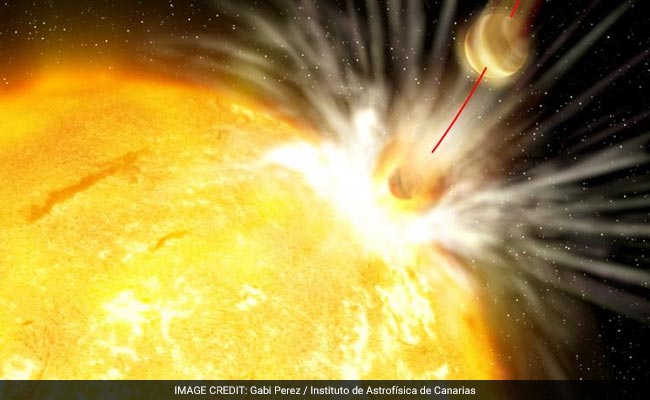
NASA's Astronomers Reveal Red Giant Stars May Destroy Their Own Planets
- Monday November 10, 2025
- Science | Edited by Astitva Raj
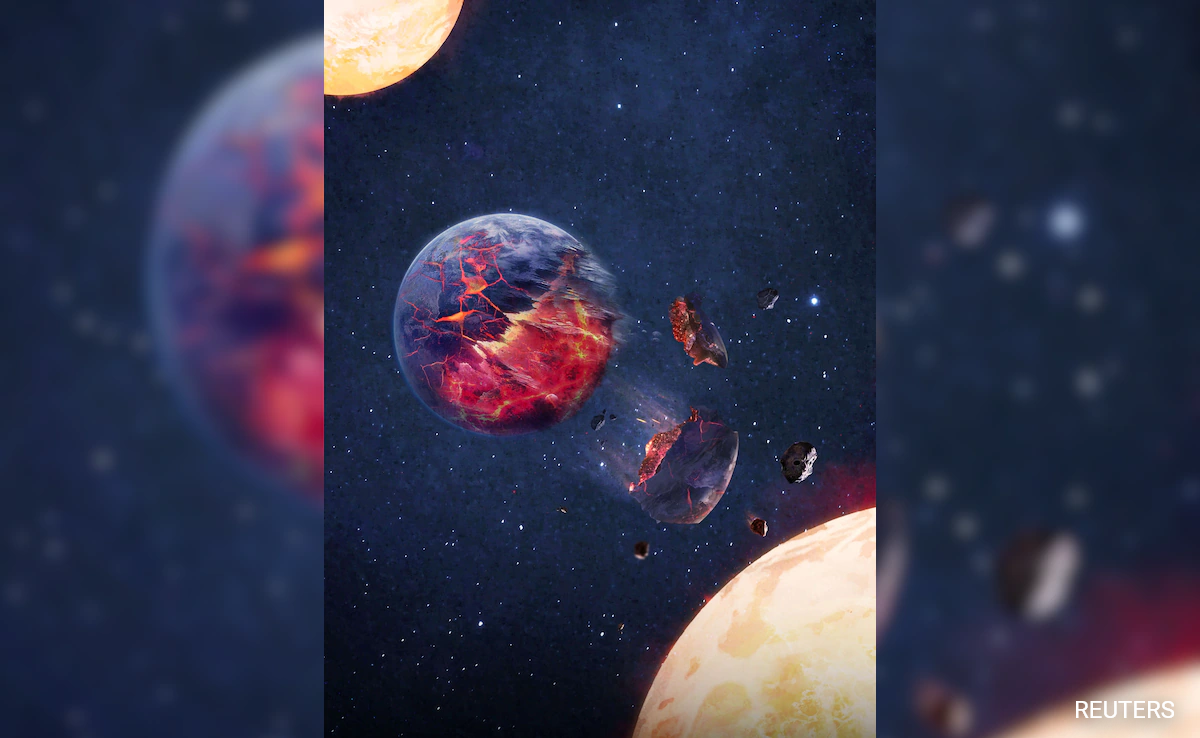
This extreme expansion poses a serious threat to nearby planets. For example, when the Sun becomes a red giant in about 5 billion years, it will likely swallow Mercury and Venus.
-
www.ndtv.com
-
China’s Tianwen-1 Captures Rare Interstellar Comet From Orbit Around Mars
- Sunday November 9, 2025
- Written by Gadgets 360 Staff
China’s Tianwen-1 Mars mission achieved a new milestone by photographing interstellar comet 3I/ATLAS, the third such object ever recorded. This breakthrough highlights China’s growing strength in planetary science, deep-space imaging, and interstellar observation, offering scientists an unprecedented look at materials beyond our solar syste
-
www.gadgets360.com
-
Astronomers Spot Signs of Baby Planets in a Star’s Mysterious Disk
- Friday November 7, 2025
- Written by Gadgets 360 Staff
Astronomers using Keck Observatory have imaged the dusty disk around HD 34282, a young star about 400 light-years away, revealing bright clumps and a 40 AU gap—clear signs of planet formation. The system provides a rare glimpse into early planetary birth, helping refine models of how gas and dust evolve into new worlds.
-
www.gadgets360.com
-
Astronomers Stunned By Three Earth-Sized Planets In Distant Unique Planetary System
- Wednesday October 29, 2025
- Science | Edited by Srishti Singh Sisodia
The study revealed that TOI-2267 has two closely bound stars orbiting each other, and the third planet transits the companion star.
-
www.ndtv.com
-
Chang’e-6 Lunar Samples Reveal Water-Rich Asteroid Fragments
- Saturday October 25, 2025
- Written by Gadgets 360 Staff
Analysis of Chang’e-6 lunar dust uncovered microscopic carbonaceous chondrite fragments—evidence of water-bearing asteroids that once struck the Moon. The discovery indicates a far greater delivery of water and organics to Earth and the Moon than thought, helping scientists refine theories about the solar system’s early volatile sources.
-
www.gadgets360.com
-
Astronomers Detect Heavy Water in Planet-Forming Disk Around Young Star
- Monday October 20, 2025
- Written by Gadgets 360 Staff
Scientists have detected heavy water in the planet-forming disk around young star V883 Orionis, confirming the water existed long before the star formed. The discovery, made using ALMA, shows that water’s origins trace back to ancient interstellar clouds, linking molecular gas, comets, and planetary systems across billions of years.
-
www.gadgets360.com
-
Scientists May Finally Explain Mysterious Crown-Like Features on Venus
- Tuesday September 30, 2025
- Written by Gadgets 360 Staff
Venus’ distinctive crown-like coronae may be explained by heat trapped beneath a rigid mantle layer, according to recent studies. This discovery provides key insights into the planet’s geological activity and helps researchers compare Venus’ surface evolution to that of other planets in our solar system
-
www.gadgets360.com
-
NASA Confirms Discovery of 6,000 Exoplanets Beyond Our Solar System
- Sunday September 21, 2025
- Written by Gadgets 360 Staff
NASA has confirmed 6,000 exoplanets beyond our solar system, highlighting three decades of accelerating discovery. From scorching hot Jupiters to worlds with jewel-like clouds, the catalog reflects cosmic diversity. Future missions aim to identify true Earth analogs and investigate signs of life across distant planetary systems.
-
www.gadgets360.com
-
Exoplanets Explained: How Astronomers Find Worlds Orbiting Stars Beyond the Sun
- Monday September 8, 2025
- Written by Gadgets 360 Staff
Exoplanets are planets orbiting stars outside our solar system, hidden by stellar glare and detected indirectly. Astronomers identify them by tracking star wobbles or dips in brightness during planetary transits. NASA’s Kepler mission revealed thousands, with TESS now expanding the search. These discoveries confirm that planetary systems are abun...
-
www.gadgets360.com
-
James Webb Spots Bizarre Planet-Forming Disk Full of Carbon Dioxide
- Friday September 5, 2025
- Written by Gadgets 360 Staff
The James Webb Space Telescope has spotted a bizarre planet-forming disk dominated by carbon dioxide where water is almost absent. This rare finding, in star system XUE 10 within NGC 6357, challenges current models of planetary formation and may reshape our understanding of habitable worlds.
-
www.gadgets360.com
-
Scientists Reveal A Surprising Mathematical Pattern Hidden In Earth's History
- Tuesday September 2, 2025
- Science | Edited by Nikhil Pandey
These insights have important implications for understanding Earth's geological past and improving predictions of future planetary changes.
-
www.ndtv.com
-
James Webb Telescope Discovers Tiny New Moon Orbiting Uranus
- Saturday August 23, 2025
- Written by Gadgets 360 Staff
A team from the Southwest Research Institute has discovered a tiny new moon orbiting Uranus using NASA’s James Webb Space Telescope. The moon, called S/2025 U1, is just 6 miles (10 kilometers) wide, too small for Voyager 2 to detect during its 1986 flyby. This discovery brings Uranus’s total known moons to 29, with S/2025 U1 orbiting 35,000 mil...
-
www.gadgets360.com
-
Mercury Has Shrunk by Several Kilometers Over Billions of Years, Scientists Report
- Tuesday August 19, 2025
- Written by Gadgets 360 Staff
Mercury’s surface reveals it has been shrinking for billions of years due to cooling and faulting. A new study estimates the planet’s radius has contracted by 2.7–5.6 kilometers, offering the most precise figures yet. The findings sharpen understanding of Mercury’s thermal evolution and could help scientists apply the same techniques to tec...
-
www.gadgets360.com
-
James Webb Telescope Detects Potential Gas Giant Exoplanet Just 4 Light-Years Away
- Friday August 8, 2025
- Written by Gadgets 360 Staff
Astronomers using JWST have spotted a possible gas giant orbiting Alpha Centauri A, only 4 light-years away. If confirmed, it would be the closest exoplanet to a Sun-like star ever imaged. The discovery could challenge current models of planetary formation in binary systems and open new opportunities for studying nearby worlds.
-
www.gadgets360.com
-
NASA's Astronomers Reveal Red Giant Stars May Destroy Their Own Planets
- Monday November 10, 2025
- Science | Edited by Astitva Raj
This extreme expansion poses a serious threat to nearby planets. For example, when the Sun becomes a red giant in about 5 billion years, it will likely swallow Mercury and Venus.
-
www.ndtv.com
-
China’s Tianwen-1 Captures Rare Interstellar Comet From Orbit Around Mars
- Sunday November 9, 2025
- Written by Gadgets 360 Staff
China’s Tianwen-1 Mars mission achieved a new milestone by photographing interstellar comet 3I/ATLAS, the third such object ever recorded. This breakthrough highlights China’s growing strength in planetary science, deep-space imaging, and interstellar observation, offering scientists an unprecedented look at materials beyond our solar syste
-
www.gadgets360.com
-
Astronomers Spot Signs of Baby Planets in a Star’s Mysterious Disk
- Friday November 7, 2025
- Written by Gadgets 360 Staff
Astronomers using Keck Observatory have imaged the dusty disk around HD 34282, a young star about 400 light-years away, revealing bright clumps and a 40 AU gap—clear signs of planet formation. The system provides a rare glimpse into early planetary birth, helping refine models of how gas and dust evolve into new worlds.
-
www.gadgets360.com
-
Astronomers Stunned By Three Earth-Sized Planets In Distant Unique Planetary System
- Wednesday October 29, 2025
- Science | Edited by Srishti Singh Sisodia
The study revealed that TOI-2267 has two closely bound stars orbiting each other, and the third planet transits the companion star.
-
www.ndtv.com
-
Chang’e-6 Lunar Samples Reveal Water-Rich Asteroid Fragments
- Saturday October 25, 2025
- Written by Gadgets 360 Staff
Analysis of Chang’e-6 lunar dust uncovered microscopic carbonaceous chondrite fragments—evidence of water-bearing asteroids that once struck the Moon. The discovery indicates a far greater delivery of water and organics to Earth and the Moon than thought, helping scientists refine theories about the solar system’s early volatile sources.
-
www.gadgets360.com
-
Astronomers Detect Heavy Water in Planet-Forming Disk Around Young Star
- Monday October 20, 2025
- Written by Gadgets 360 Staff
Scientists have detected heavy water in the planet-forming disk around young star V883 Orionis, confirming the water existed long before the star formed. The discovery, made using ALMA, shows that water’s origins trace back to ancient interstellar clouds, linking molecular gas, comets, and planetary systems across billions of years.
-
www.gadgets360.com
-
Scientists May Finally Explain Mysterious Crown-Like Features on Venus
- Tuesday September 30, 2025
- Written by Gadgets 360 Staff
Venus’ distinctive crown-like coronae may be explained by heat trapped beneath a rigid mantle layer, according to recent studies. This discovery provides key insights into the planet’s geological activity and helps researchers compare Venus’ surface evolution to that of other planets in our solar system
-
www.gadgets360.com
-
NASA Confirms Discovery of 6,000 Exoplanets Beyond Our Solar System
- Sunday September 21, 2025
- Written by Gadgets 360 Staff
NASA has confirmed 6,000 exoplanets beyond our solar system, highlighting three decades of accelerating discovery. From scorching hot Jupiters to worlds with jewel-like clouds, the catalog reflects cosmic diversity. Future missions aim to identify true Earth analogs and investigate signs of life across distant planetary systems.
-
www.gadgets360.com
-
Exoplanets Explained: How Astronomers Find Worlds Orbiting Stars Beyond the Sun
- Monday September 8, 2025
- Written by Gadgets 360 Staff
Exoplanets are planets orbiting stars outside our solar system, hidden by stellar glare and detected indirectly. Astronomers identify them by tracking star wobbles or dips in brightness during planetary transits. NASA’s Kepler mission revealed thousands, with TESS now expanding the search. These discoveries confirm that planetary systems are abun...
-
www.gadgets360.com
-
James Webb Spots Bizarre Planet-Forming Disk Full of Carbon Dioxide
- Friday September 5, 2025
- Written by Gadgets 360 Staff
The James Webb Space Telescope has spotted a bizarre planet-forming disk dominated by carbon dioxide where water is almost absent. This rare finding, in star system XUE 10 within NGC 6357, challenges current models of planetary formation and may reshape our understanding of habitable worlds.
-
www.gadgets360.com
-
Scientists Reveal A Surprising Mathematical Pattern Hidden In Earth's History
- Tuesday September 2, 2025
- Science | Edited by Nikhil Pandey
These insights have important implications for understanding Earth's geological past and improving predictions of future planetary changes.
-
www.ndtv.com
-
James Webb Telescope Discovers Tiny New Moon Orbiting Uranus
- Saturday August 23, 2025
- Written by Gadgets 360 Staff
A team from the Southwest Research Institute has discovered a tiny new moon orbiting Uranus using NASA’s James Webb Space Telescope. The moon, called S/2025 U1, is just 6 miles (10 kilometers) wide, too small for Voyager 2 to detect during its 1986 flyby. This discovery brings Uranus’s total known moons to 29, with S/2025 U1 orbiting 35,000 mil...
-
www.gadgets360.com
-
Mercury Has Shrunk by Several Kilometers Over Billions of Years, Scientists Report
- Tuesday August 19, 2025
- Written by Gadgets 360 Staff
Mercury’s surface reveals it has been shrinking for billions of years due to cooling and faulting. A new study estimates the planet’s radius has contracted by 2.7–5.6 kilometers, offering the most precise figures yet. The findings sharpen understanding of Mercury’s thermal evolution and could help scientists apply the same techniques to tec...
-
www.gadgets360.com
-
James Webb Telescope Detects Potential Gas Giant Exoplanet Just 4 Light-Years Away
- Friday August 8, 2025
- Written by Gadgets 360 Staff
Astronomers using JWST have spotted a possible gas giant orbiting Alpha Centauri A, only 4 light-years away. If confirmed, it would be the closest exoplanet to a Sun-like star ever imaged. The discovery could challenge current models of planetary formation in binary systems and open new opportunities for studying nearby worlds.
-
www.gadgets360.com