Opinion | 'Hellish Difficulty': Why India Should Be Keeping An Eye On China's New 'Shipborne' Drone
The GJ-21, which has a reported combat attack radius of up to 1,500 kilometres, when combined with a land-attack long-range precision-strike system, can have the ability to strike deep within a territory's mainland.

On April 30, an unofficial photograph began circulating in Chinese-language military fora, showing in flight a stealth drone with a flying-wing design, its landing gear deployed, and a small metal rod jutting from its nose strut. It was subsequently revealed to be the naval variant of China's GJ-11 "Sharp Sword" combat drone - the GJ-21 shipborne UAV. It is produced by Hongdu Aviation, a subsidiary of one of China's largest defence State-Owned Enterprises (SOEs) - the Aviation Industry Corporation of China (AVIC).
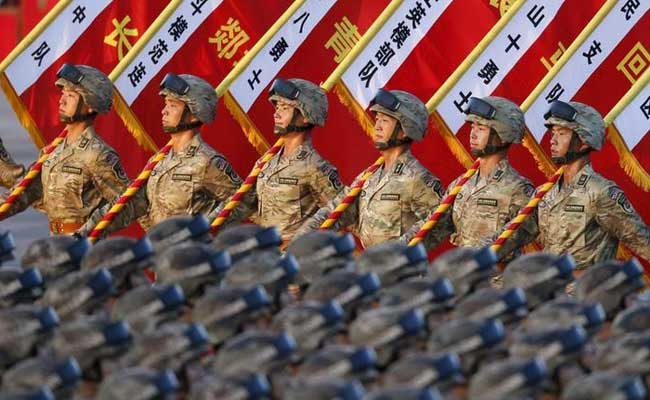
The GJ-21 has evolved over a decade. Its predecessor, the GJ-11, was first unveiled at the 70th National Day parade in 2019 in Beijing. In November 2025, it was officially codenamed "Xuanlong" (Mighty/Mysterious Dragon) in a mini-film, and subsequently also goes by the name 'Sharp Sword'. It has been one of the most prominent land-based UCAV systems in China's arsenal and was also paraded in Tiananmen Square during the 2025 September 3 military parade.
Problem Of 'Hellish Difficulty'
The UCAV has adapted its predecessor's tailless flying-wing design, and expanded on it for catapult launch and arrested recovery. Chinese commentary has dramatically called it a problem of "hellish difficulty." Because a carrier's deck is relatively short compared to a regular runway, a catapult launch enables a drone to take off at cruise speed with great ease. In 2021, a Beijing-based analyst, Li Jie, informed that the Type 076 amphibious assault ship would be equipped with electromagnetic launch capability for jet-powered UCAVs. The April 30 photographs close the loop on that front.
Today, the GJ-21 is conducting trials alongside new launch platforms that are designed to deploy the UAV as a core combat system. One is the Type 076 Sichuan, unveiled in December 2024, and which is currently in its third sea trial. It is an amphibious assault ship with a 40,000-tonne displacement, is purpose-built for stealth UCAVs, and is fitted with one electromagnetic catapult and three arresting wires. As opined by Chinese military analyst Song Zhongping, there could be up to 19 GJ-21s on the deck. Another platform is the Type 003 Fujian, China's first indigenous carrier. It was commissioned into active duty in November 2025, and has previously conducted exercises in the Bohai Sea alongside J-15T fighters, J-35 stealth fighters, and KJ-600 early-warning aircraft. It could subsequently integrate the GJ-21 as a "loyal wingman," and spring Human-Machine Team (HMT) into action.
Why More Drones?
The hints to China's military modernisation trajectory are embedded in its key doctrinal texts. One such text is the PLA Academy of Military Sciences' 2020 Science of Military Strategy. It explicitly highlighted that carrier-based UAVs are a "transformative capability" that would alter "carrier-based aircraft take-off and landing methods, and carrier-based aircraft structure." This operational emphasis has become increasingly relevant in the Chinese military's transition to a force capable of multi-domain, integrated joint operations, and the GJ-21 fits squarely within this post-reform combat architecture.
There are two main takeaways from the deployment of the stealth UCAV. Firstly, it alters the cost-benefit calculus of sea-based airpower for China. As the GJ-21 likely costs a little over US$ 30 million, when compared with the cost of a J-35, which can go up to US$ 80 million, or even the cost of a sea-based variant of a J-15 jet - ~US$ 60 million - there are clear advantages in mass production and deployment. Second, there is the long-range capability. The GJ-21, which has a reported combat attack radius of up to 1,500 kilometres, when combined with a land-attack long-range precision-strike system, can have the ability to strike deep within a territory's mainland.
What is notable for India is that the land-based GJ-11 was imaged at the Shigatse air base in Tibet in 2025, at an altitude of 3,800 metres. The lineage of the G-21 is already in service in the PLA Western Theater Command, and it is now likely to be deployed in the South China Sea. The structural constraints the Chinese ecosystem faces, which revolve around limitations to autonomous, AI-enabled control and engine performance, as well as the inability of PLA personnel to consistently adapt to new technologies, are indeed real. Further, AVIC, the SOE responsible for its design and maintenance, has had its last two Chairmen - Tan Ruisong and Zhou Ximin - dismissed on corruption and rigging charges. And yet, for a military force aiming to become expeditionary and world-class in the coming decade, its newest inductions must be watched keenly in India.
(Anushka Saxena is a researcher with the Geostrategy Programme at The Takshashila Institution. Views expressed in this article do not represent those of the institution)
Disclaimer: These are the personal opinions of the author
-
Gyanesh Kumar Has An Immunity Pin. Why A Petition Says He Can't Use It

The Opposition wants the Chief Election Commissioner prosecuted for alleged manipulation of voter rolls, but a 2023 law stands in the way. A petition in the Supreme Court now says the law has a gap.
-
Opinion | Is The World Staring At A Big Stock Market Crash - And Recession? 5 Uneasy Signs
On Wednesday, the US bond market recorded its worst day since Trump's "Liberation Day" tariffs rattled markets in April 2025. The 30-year US Treasury yield topped 5.43%, putting it on track for its highest close since 2004.
-
Form 6 For New Voters: When A Small Change Triggered A Big Row
In July 2026, the online version of Form 6 on the ECI's ECINet portal was modified to include a new declaration.
-
Opinion | Saudi Arabia's China Turn Has Begun - After Learning Much The Hard Way
Leaning on China just makes sense for the Saudis right now. The question is, can its other great 'ally' stomach it?
-
Opinion | Bihar Assault, Hisar Marriage Ban: Who'll Stop The Guardians Of Indian 'Culture'?
Why exactly does the sight of a young couple seeking a bit of alone time somewhere tend to particularly provoke a certain kind of Indian men?
-
Opinion | The Trump-Xi Summit, And India's Many Worries Of Its Own
Washington and Beijing may have chosen coexistence over confrontation. For India, that could be both a relief and a warning.
-
Opinion | China Claims It Has Cut Troops At The Indian Border. But The Math Doesn't Add Up
The reduction likely has more to do with the deployment along the LAC than the total strength active in the region
-
Opinion | China Is No Longer Waiting For Trump To Set The Rules. And He Knows It
America's old diplomatic tricks with China won't work any longer. Because China has changed, and so has its ambitions.
-
Opinion | As UN Interviews Its Next Chief, The Interviewers Have Some Explaining To Do
On the panel sit governments whose wars, vetoes, and unpaid dues have helped make the organisation ineffective.