Opinion | Trump Tariffs May Have An Unlikely Gainer In India - RSS. Here's How
The American onslaught on Indian exports and workers has provided the Modi administration an off-ramp to align closer to the RSS swadeshi ideology and perhaps bridge the widest and oldest rift between the RSS and its political arm.
At midnight of June 30-July 1, 2017, the Indian Parliament introduced the Goods and Services Tax, a radical shift in India's state revenue generation model. Prime Minister Narendra Modi compared it to historic moments; the midnight of August 14-15, 1947, at the stroke of which India declared Independence from the British, and November 26, 1949, when the country adopted its Constitution. In a televised speech to the nation eight years later this Sunday, the PM recalled GST as a monumental reform. He said the next generation of reforms begins on September 22, 2025, when a rationalised GST with just three rate slabs would kick off.
The tax tweak is a hurriedly raised bulwark against the tariff bombs lobbed by the US administration of President Donald Trump and can at best result in a temporary bump in consumption. Which is perhaps why Modi pitched it as a “savings festival" and exhorted Indian consumers to buy swadeshi, an attempt to consume the way out of an anticipated tariff-induced slump.
It has some domestic payoffs. It would somewhat appease the inflation-scarred middle-class consumer as well as businesses cribbing about the rising costs of consumption and compliance. It might help curry a little favour with the Bihar voter, who is expected to head to the polling booth in November to elect a new legislative assembly.
Bridging An Old Chasm
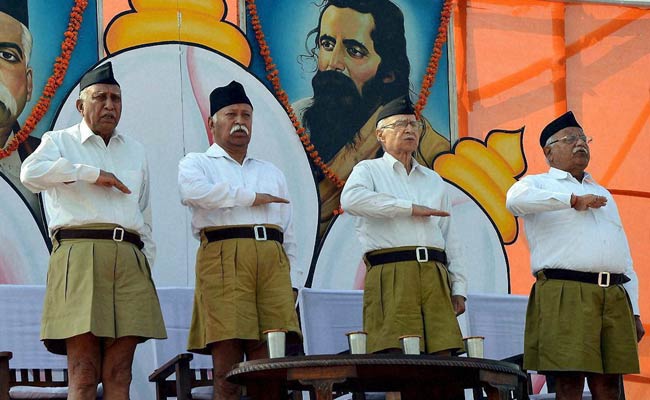
As Trump presses on, piling pressure on Modi, the biggest benefit might be in-house to the Sangh Parivar, the collective name by which the conglomerate of Rashtriya Swayamsevak Sangh (RSS) organisations is known. The US' onslaught on Indian exports and workers has provided the Modi administration an off-ramp to align closer to the RSS swadeshi ideology and perhaps bridge the widest and oldest rift between the RSS and its political arm.
The relationship between the RSS and the Bharatiya Janata Party (BJP) had hit its nadir when party chief JP Nadda remarked, ahead of the 2024 general elections, that it no longer needed the RSS' help. The BJP's poor performance in the elections led to a rethink, and over the past year, Modi has personally made efforts to repair ties, including a special mention of the organisation in his Independence Day speech and a signed encomium in national dailies to RSS chief Mohan Bhagwat on his birthday.
The Vajpayee Years
Broadly, India's economic policies have more or less remained on the same track that PV Narasimha Rao and Manmohan Singh set them on 34 years ago. When the Atal Bihari Vajpayee-led National Democratic Front came to power, it not only stayed on the track but even picked up speed, infuriating the Parivar, which had hoped for an inward turn to swadeshi, a variation of self-reliance. That did not happen, and the government opened up more sectors to foreign investment. RSS leader Dattopant Thengadi thundered that “liberalisation and globalisation is a case of Satan quoting the Bible”.

Also Read | What A Modi-Bhagwat Meet Says About RSS' Plans
Among the numerous causes of disenchantment with the Vajpayee government, for instance, was the opening up of the insurance sector. In the mid-1990s, the RSS and its affiliates had come up with an economic plan called 'Bharat ka Abhyuday: Swadeshi Rooprekha' (India's rise: An indigenous blueprint). One of its positions was: “It should be ensured that the Western, and particularly the American, health insurance system, which has enslaved the public to the clique of pharmaceutical companies, medical institutions and insurance companies, does not set its foot in India.” Evidently, that did not stop Vajpayee, who had already warned that he would pursue the swadeshi agenda only if it was feasible. The blueprint was unceremoniously cast into the dustbin.
The Souring Of The Relationship
When the Modi government took the reins in 2014, swadeshi hopes were rekindled despite his track record in Gujarat of a business-friendly politician who was comfortable with global business leaders and did not shy away from sporting foreign brands. Modi's Gujarat was a showcase of Hindutva and big capital, quite distant from the Sangh's economic thinking. On Mahatma Gandhi's 150th birth anniversary in 2019, Mohan Bhagwat wrote in a tribute that “Hind Swaraj [Gandhi's treatise] was a dream picture of Bharat's progress and performance”. To be sure, Gandhi argued in Hind Swaraj that the Railways “accentuate the evil nature of man” and machinery “represents a great sin”.
The Parivar's relationship with the government soured soon enough. “It is a theory of pain and it is wrong,” Swadeshi Jagran Manch complained even as the government prepared to celebrate its first anniversary. “The ministries are bonded slaves to the finance ministry,” the Bharatiya Mazdoor Sangh fumed. Over the next 10 years, although Modi pushed the swadeshi narrative, including campaigns such as Atmanirbhar Bharat and Vocal for Local, it was seen by a section of the Parivar as mere lip service. For instance, there was much hand-wringing in the Sangh over the government easing rules in the nuclear power sector and allowing 100% foreign direct investment in insurance.
MAGA, Swadeshi, Dual Circulation
Trump's Make America Great Again (MAGA) campaign resembles what the Parivar had in mind for India. Trump wants to create a disproportionately favourable environment for American companies and products. That is what advocates of swadeshi want too for Indian businesses. Unfortunately, India does not have a market as big and wealthy as America's. Although it is the third largest in the world in terms of GDP measured by purchasing power, on a per capita basis, it does not even figure in the first 100 countries. The root cause of the failure to develop a strong domestic market is that India is still a capital-intensive economy instead of a labour- or innovation-driven one.
Also Read | RSS vs BJP: Under The Cover Of Friendly Fire
Balancing the three is not easy. Despite its enormous success in building an investment-and-labour-driven manufacturing economy, which is now transforming into an innovation-led one, China has struggled with raising the purchasing power of its domestic market. The “dual circulation strategy”, cranked up around the same time as India's Atmanirbhar Bharat programme in the early days of the pandemic, envisaged strengthening the domestic market (internal circulation) even as it continued to export (external circulation). One of the keystones of the strategy was domestic innovation.
Interestingly, although the pandemic hastened it, the strategy was influenced more by the tariff war that Trump unleashed on China in his first term as President. The idea was also to build the domestic market for foreign companies, which, in turn, would give the country leverage.
Where India Has Lacked
On this count, successive Indian governments have failed to generate enough high-quality jobs or kickstart innovation. New ideas are also centred around streamlining taxation, labour and land in order to protect and grow investments. India's research and development intensity is about 0.6% of GDP, while that of China is about 2.6% of GDP.
Meanwhile, in Delhi last month, the RSS leadership began an exercise with Parivar affiliates operating in the economic sector to study India's position in the world, its domestic situation, and what needs to be done for it to become an economic role model to the world. The exercise is expected to be completed sometime late next year. It will be a while before it becomes clear how much the Modi administration and the Parivar would align. What is clear is that the RSS is in no mood to relent.
At a coordination meeting in Jodhpur in the first week of this month, the leadership of the organisation sent out a clear message to all its affiliates. The Sangh would pursue its goals according to its ideology and values, unwaveringly. There would be no more adjustments and compromises. It would be the Sangh way, all the way, for all in the Parivar.
(Dinesh Narayanan is a Delhi-based journalist and author of 'The RSS And The Making Of The Deep Nation'.)
Disclaimer: These are the personal opinions of the author
-
Blog | 'Baap Da Brat': Kerala Mini Cooper Crash, And Why 'Daddy' Can't Keep Saving You

There are three things you should never underestimate in India: the power of 'jugaad', the elasticity of the law, and the confidence of a 'Baap da Brat' who believes his Papa Posh can fix absolutely anything.
-
Opinion | 'Say Our Name': Why A Tiny Island Nation Wants The World To Get Its Name Right
Standing before the UN hall of nations, Naoero President David Adeang asked the world to unlearn its comfortable habits and speak a restored truth.
-
TVS Succession Row Explained: Why Venu Srinivasan's Family Is Divided Over Wealth
TVS Family Dispute: TVS Holdings is a key entity because it owns a controlling stake in TVS Motor Company. It owns 50.26% of TVS Motor.
-
Opinion | The US Is Showing India Just How Cheap Its 'Friendship' Is
Can local talent fully replace Indian contribution? Why is the US leading in setting up Global Capability Centres in India - over 60% - and pocketing the IP?
-
Jantar Mantar Tells Time. The Clock Just Stopped On Its Time As An Iconic Protest Site
On Monday, October 12, 2026, Delhi Police denotified Jantar Mantar Road as a designated site for demonstrations. The Supreme Court had given it a nudge. Here's how history met politics on that street for decades.
-
Opinion | Saudi Airport Attack, And Why Pakistan Keeps Biting Off More Than It Can Chew
For all those who were envious of Pakistan's 'new status' as "mediator extraordinaire", here is a reality check
-
Opinion | Visa Shocks To Racist Attacks, When Did America Come To Hate Indians So?
Sometimes it is about H-1B visas. Sometimes it is jobs. Sometimes it is "foreigners." Sometimes it is about temples. The language of the attack varies, but the message is consistent
-
How El Nino And Warming Oceans Could Shape Earth's Climate In 2027
From changing ocean currents to extreme weather, scientists are watching a combination of climate signals that could influence temperatures, rainfall and ecosystems in the months ahead.
-
Blog | Nana Patekar, And The Sharp, Lasting Sting Of His 'Plain-Speak'
"Subah ghar se niklo, bheed ka hissa bano..." Nana Patekar's characters often spoke with the bluntness of men who had little patience for pretence. Just like Nana himself.