


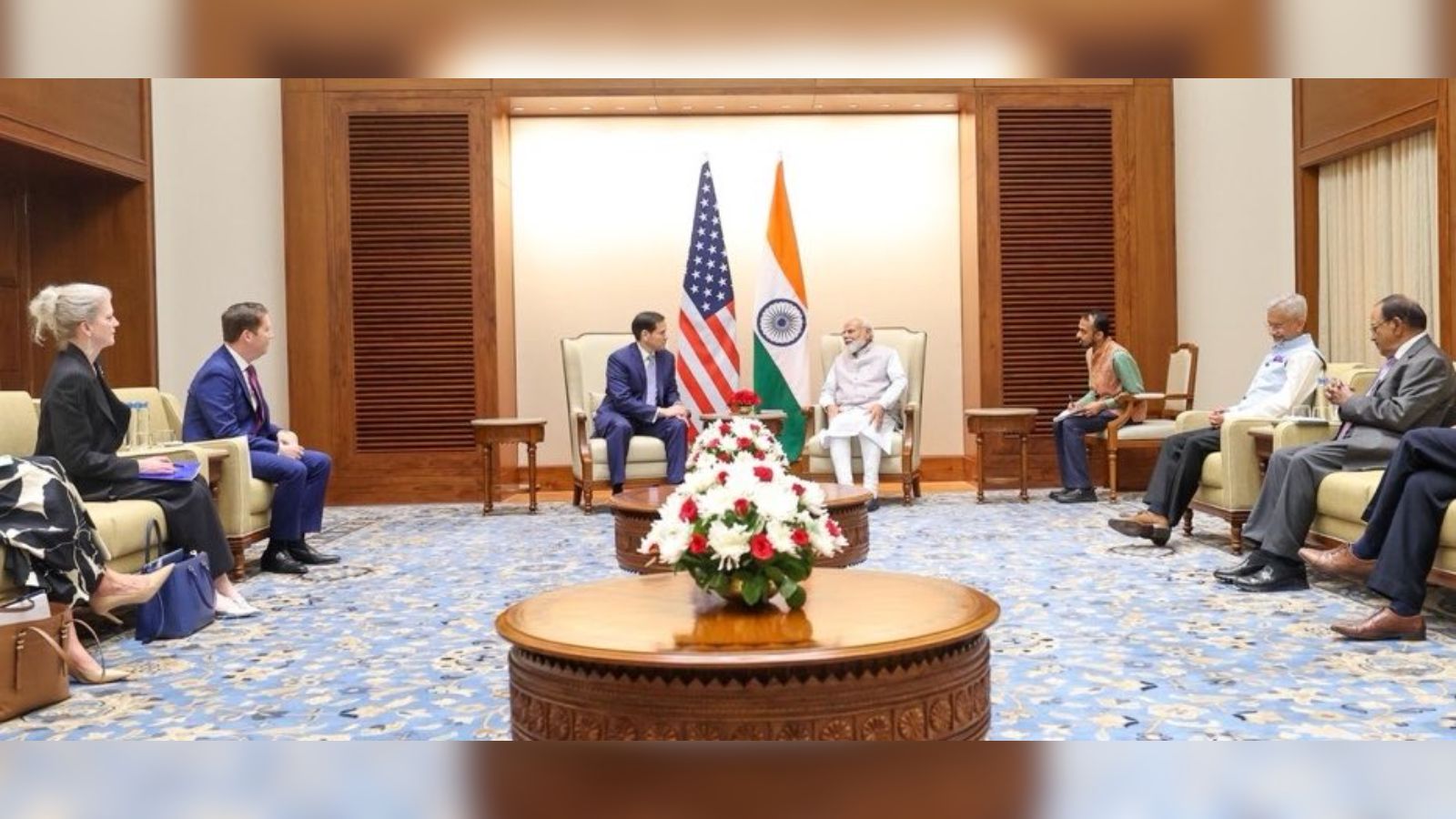








As US Secretary of State Marco Rubio arrives in India for the Quad meeting and strategic consultations, the Trump administration is preparing one of the sharpest reversals of long-standing American immigration policy in decades.
At the centre of this shift is a new USCIS approach that seeks to restrict adjustment of status inside the United States and push many legal immigrants to complete green card processing from abroad. This is not merely an administrative change. It overturns the logic Congress itself built into the American immigration system.
For decades, US law allowed legally admitted migrants to transition from temporary visas to permanent residency while remaining inside the country. Congress deliberately created categories such as the H-1B visa around the idea of "dual intent", where skilled workers could arrive temporarily while eventually seeking permanent settlement.
That framework helped build modern American technological dominance.
Indian engineers, doctors, researchers, entrepreneurs and students became central to the US economy under exactly this system. Silicon Valley, American hospitals, research universities and technology firms absorbed Indian talent at every level.
Now, that same pipeline is being politically targeted.
The implications for Indians are enormous because Indians dominate many high-skilled visa categories and already face massive green card backlogs unique to their nationality. Thousands of Indian professionals who spent years following American laws, paying taxes and building lives in the US may now face the prospect of leaving the country during processing with no certainty of return timelines.
Families could be split across continents. Careers built over decades could collapse overnight. Children raised in the United States may suddenly face instability because their parents entered a system whose rules are now being rewritten midway.
This marks a major transformation in American politics.
The Trump movement no longer limits immigration politics to illegal border crossings. Legal immigration itself is increasingly becoming the target. Student visas, employment-based migration, family sponsorship and status adjustment are now all drawn into the same political battle.
Indians sit directly in the firing line because they represent one of the most visible and successful immigrant communities in America's high-skilled sectors.
The racial undertones have become increasingly difficult to ignore. Across sections of the MAGA ecosystem, Indian professionals are routinely portrayed as people "taking over tech", replacing American workers or changing the cultural balance of the country. Social media platforms are flooded with openly hostile narratives directed specifically at Indian migrants and Indian-Americans. The striking aspect is that many of these migrants represent exactly the profile American conservatives once claimed to support: educated, economically productive, low-crime and legally compliant.
The hostility has, therefore, moved beyond questions of legality. It increasingly reflects demographic anxiety and identity politics.
Bots, outrage algorithms and coordinated information warfare networks amplify this sentiment daily. Immigration outrage generates clicks, political engagement and emotional mobilisation. Complex immigration law gets reduced into viral slogans designed to trigger resentment.
The result is a digital ecosystem where hostility towards Indian professionals has become politically useful.
The political calculation behind this shift is straightforward.
Trump and his allies see immigration as the most emotionally powerful issue available before the midterms. Expanding the target from illegal immigration to legal immigration broadens the culture war and creates a permanent atmosphere of grievance and anger.
The strategy also helps redirect public frustration over inflation, economic uncertainty and governance failures toward immigrants and administrative "loopholes." The distinction between legal and illegal immigration increasingly disappears inside this political messaging.
For India, this is no longer a peripheral American domestic debate.
Millions of Indian families are tied directly to the US educational and professional system. Indian middle-class aspirations, technology networks and global career pathways have long depended on the assumption that the United States remained open to legal skilled migration.
Washington is now signalling something very different.
As Rubio speaks in India about strategic partnership, Indo-Pacific cooperation and shared democratic values, New Delhi faces an uncomfortable reality. Indian talent remains essential to the American economy while Indian migrants increasingly face political hostility inside the United States.
That contradiction now sits at the centre of the India-US relationship.
(
Disclaimer: These are the personal opinions of the author


