Opinion | RSS At 100: Contradictions Of Imagination
Bhagwat said that except for certain core tenets, everything in the RSS is open to change. That flexibility will be useful for the RSS leadership, which has its job cut out as it tries to steer the ship into open international waters.
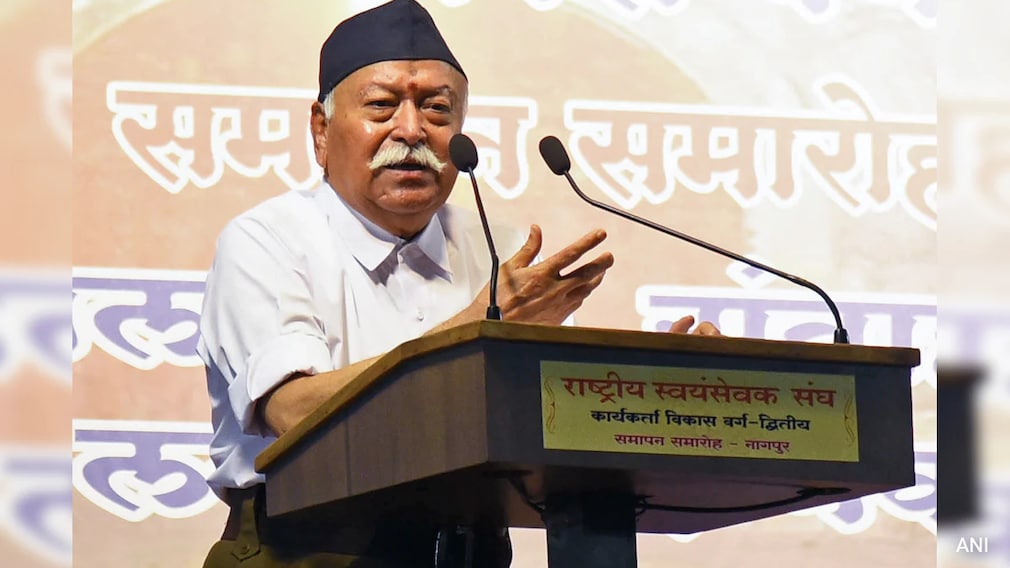
Perhaps the vicissitudes of history weighed on RSS chief Mohan Bhagwat's three-day lecture series, 100 years of Sangh journey - New Horizons, last week in New Delhi. For, visions of the horizon Bhagwat sketched out were decidedly distant and the near-term goals shrouded in operational haze. One goal, however, was clear-stripping the word Hindu of the accumulated baggage of the past century.
The sarsanghachalak recounted how the RSS had surmounted heavy odds to complete its centenary; no mean feat for an organisation that began life in British-controlled India and survived three bans. It is now comfortable in its skin, secure in its operations and confident of its method, thanks to the political umbrella of its offshoot, the Bharatiya Janata Party. Although Bhagwat portrayed the BJP as just another organisation in the larger Sangh Parivar, the RSS benefits disproportionately from the utility and security the umbrella offers.
Bhagwat said that RSS volunteers were at work, planning and executing a vision to spread the organisation to the last individual in India. He said it was in a position to do so now because conditions are favourable. At the fag end of the lecture series, he emphatically reiterated the dictum, "India is a Hindu nation. It's good for you if you accept it and a loss if you don't." Yet, there was some nuanced repositioning, which originally began in 2018 when he first held a similar lecture series at the same venue. The crux of the matter revolves around inclusion and assimilation of diverse communities, crucial for the Sangh's future expansion.
Nation, Then and Now
The RSS rejects the European nation-state model and asserts that the Indian nation supersedes the state. "India is a nation that exists despite the state," Bhagwat said. He also said that the nation encompasses in it the entirety of the subcontinent's diversity, including religious, language, and dietary customs. The Akhand Bharat of RSS' new concept comprises not a single country extending from Afghanistan to Bangladesh as imagined earlier but multiple sovereign states with people of the same origins.
Vinayak Damodar Savarkar, the original Hindutva theoretician, excluded converts to Islam and Christianity from the Hindu nation. In a departure from the Savarkarian definition of a Hindu nation consisting of only those for whom India was the fatherland and holy land, Bhagwat chose to lean on freedom fighter and India's first education minister Maulana Abul Kalam Azad to explain the new RSS position. He quoted Azad as telling an interviewer from a Lahore publication in 1946 that nation is different from religion and one cannot change one's nationhood by switching religions.
Bhagwat had first articulated the subtle shift in 2018 when he said that there is no Hindu nation without Muslims. To indicate the Sangh's earnestness, he added that some statements of second Sarsanghachalak MS Golwalkar to the contrary would be rewritten. He has now taken it further with the choice of intellectual exemplar, as Maulana Azad is often portrayed by Hindu nationalists as having pushed an Islamist agenda.
Managing the World
The RSS chief said that the organisation's immediate goal is to prepare India to become a virtuous example for the whole world, managing diversity and contradictions by taking the middle path. "Dharma, which accepts diversity, is the religion on top of religions." To be sure, the RSS considers itself a religion-agnostic, cultural organisation.
Bhagwat said that now the third generation of RSS volunteers are active outside India. They would help expand and propagate the RSS method in other countries tailored for the local population. The aim is to spread the essence of Hindu values, which are non-religious and universal, he said. That will be a challenge as it is near impossible to separate Hindu religious customs and cultural content. Even RSS intellectuals argue that Hindu nationalism is in a civilisational conflict with western nationalism, which is resulting in economic and political blowbacks for India.
In the US, which hosts the world's largest cohort of Indian diaspora, their rising wealth, visible influence and distinct identity now often figure unfavourably in domestic politics. Boisterous celebrations, such as blocking Wall Street for an Indian wedding, invite much censure. Last year, a Hanuman statue in Texas, among the tallest in the US, drew a lot of derision and hate. News of attacks on Christian churches and missionaries in India often grabs attention on social media. Some see yoga, arguably India's most successful cultural export, as a surreptitious proselytising operation.
In the runup to the US presidential elections, then candidate Donald Trump's supporters had accused Indians of stealing American jobs. When Trump appointed Chennai-born techie Sriram Krishnan as his AI policy advisor, even the President invited a backlash. As the US far right becomes stronger, politicians supporting Indians are increasingly drawing flak.
What's Within
The RSS will find managing internal contradictions in the Parivar, too, an uphill task. Even as it tries to expand the Hindu tent, many believe it's diluting Hindutva. For instance, while Mahatma Gandhi has slowly gained acceptance within the Sangh, opponents of the Mahatma remain in the fold. When the RSS decided to include Gandhi among the great men and women of India to be remembered in its morning prayers, there were vociferous protests from within its ranks. A person who witnessed the 1963 debate in Nagpur remembers that the proposal was approved after much acrimony and still left many seething. Many RSS volunteers who dislike Gandhi belong to families that migrated to India during Partition and were singed by the violence. Ardent followers of Savarkar's Hindutva, the number of whom is quite sizable in the Parivar, believe Gandhi's pacifism robbed Hindus of their vigour.
Bhagwat said that except for certain core tenets, everything in the RSS is open to change. That flexibility will be useful for the RSS leadership, which has its job cut out as it tries to steer the ship into open international waters.
(Dinesh Narayanan is a Delhi-based journalist and author of 'The RSS And The Making Of The Deep Nation'.)
Disclaimer: These are the personal opinions of the author
-
Opinion | The 'AIPC' Was Once Congress' Boldest Idea. What Happened To It?

Tharoor, to Chakravarti, to Yaskhi now, the fate of a Congress 'experiment' that started in 2017 will tell you a lot
-
Woman Biker Hit, Air Force Veteran Attacked: The Lawlessness In Gurugram
What gives confidence to some elements in Gurugram to break the law again and again in full public view and on camera?
-
Opinion | When The Feed Braves The Flood
NDTV drops the 24x7 and stakes its next chapter on presence as it inaugurates a new identity
-
The Politics Of Blue: Why Akhilesh Yadav-vs-Mayawati Over A Colour Is Just One Shade Of History
A movie starring Rajinikanth tells us how colours can carry meaning beyond what meets the eye. The latest row over Akhilesh Yadav's party adopting blue, and Mayawati objecting, can be a starting point for understanding the many shades of history.
-
2 Indians Survived 9/11, Then American Justice System Became Their Nightmare
Pulled off a Texas train hours after 9/11, two Indian men were plunged into America's largest terror manhunt.
-
Opinion | Building BRICS In New Delhi
For India as the host nation, chairing the summit tests the core tenet of its modern foreign policy: strategic autonomy.
-
Can India 'Mediate' Between Iran And UAE At BRICS? Gulf Envoy Suggested It Once
At the very start of the Israel-US war on Iran, it was a UAE diplomat who had suggested as much.
-
I Went Looking For A PG In Delhi's Kamla Nagar. Here's What I Found
In every PG visited by NDTV in Delhi's Kamla Nagar, the conversation began with amenities. Nothing in the sales pitch was about how secure the building was.