Opinion | KC Venugopal, And The Paradox Of Being The Man Rahul Can't Do Without
If KCV, Rahul's most trusted lieutenant in Delhi, ends up becoming Kerala Chief Minister, the Congress will have put its own credibility on the line in the state. But does the party care?
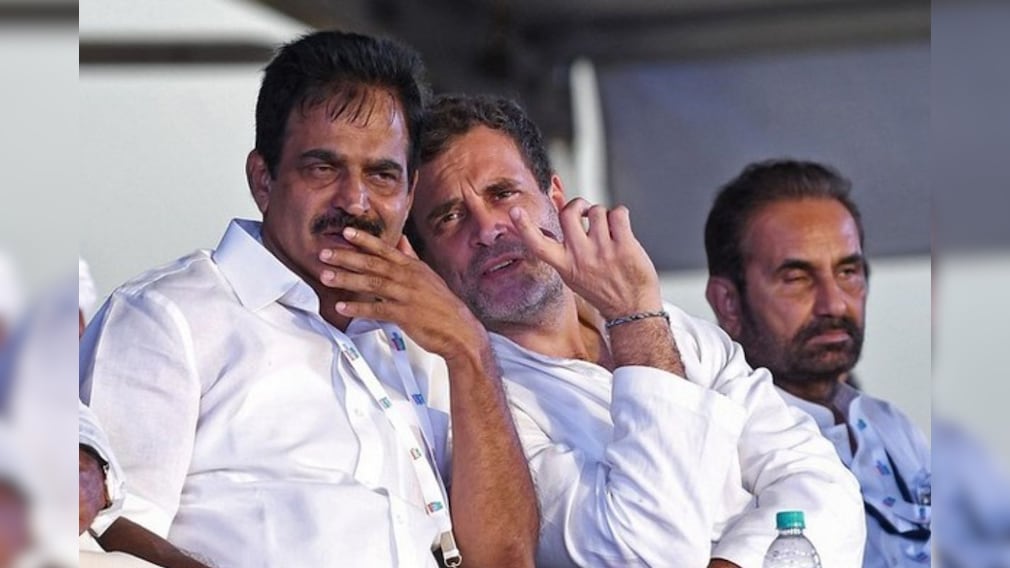
In the end, the Congress may choose a man who has spent years away from Kerala, mastering the politics of Delhi's closed rooms. KC Venugopal is one of the frontrunners in the Kerala Chief Minister race – the other two names in contention being VD Satheesan and Ramesh Chennithala. If he does emerge as the winner in this race, it will, on the surface, be almost a safe return: a former three-term MLA from Alappuzha, a former Kerala minister, a former state minister, will become the state's most powerful elected executive. But it would also be something more complicated. It would be the Congress high command placing its own credibility on the line, asking Kerala to accept that the man who kept the party's national machine running through years of defeat is also the man best placed to govern a state that has just removed the Left after a decade in power.
Why Many In Delhi Want KCV Gone
If 'KCV', as he is popularly called, manages to get in Samsthana Sarkkar Sirakandram (state secretariat as chief minister), there will be a clamour for his successor as general secretary in charge of organisation (GSO), the third most important post in the Congress. A section of party leaders wants Priyanka Gandhi to become GSO. If she declines, then the coveted post may go to Ajay Makan, Sachin Pilot or Mukul Wasnik. A cynical view in the Congress is that Venugopal may not want to leave his proximity to Rahul Gandhi, and thus sacrifice his chief ministerial ambition and make way for VD Satheesan and Ramesh Chennithala, staying on as the GSO, much to the chagrin of Congress leaders of various hues and shades.
The Kerala mandate itself for the Congress is emphatic. In the 140-member Assembly, the party has won 63 seats, the IUML 22, the Kerala Congress (KEC) seven, the RSP three, and Kerala Congress (Jacob) one, giving the UDF a commanding 102-seat victory. The LDF has been pushed out after 10 years in office, with the CPI(M) reduced to 26 seats and the CPI to eight. Kerala has returned to its old rhythm of alternation, but not softly; this was a corrective verdict, almost a political audit.
A Man For All Seasons
Venugopal's political career began in student and youth politics; he went on to serve as an MLA from 1996 to 2009, became Kerala's Tourism and Devaswom Minister between 2004 and 2006, entered the Lok Sabha in 2009, was re-elected in 2014, served as Union Minister of State for Power and Civil Aviation, entered the Rajya Sabha in 2020, returned to the Lok Sabha in 2024, and became chairperson of the Public Accounts Committee. His career has
moved through every chamber of Congress politics: the street, the Assembly, Parliament, the Union Council of Ministers, the Rajya Sabha, the Lok Sabha, and finally the party's organisational nerve centre.
But the real Venugopal story is not told by the offices he has held. It is told by access gained. In the Congress ecosystem, where influence is often measured less by public applause than by who takes your call, Venugopal became indispensable because Rahul Gandhi trusted him. He has been described in party circles as Rahul Gandhi's “eyes and ears”, a role compared functionally to Ahmed Patel's relationship with Sonia Gandhi.
How Ahmed Patel Introduced KCV To Rahul
That comparison is both flattering and dangerous. Patel was the great listener of Congress politics, the man who knew how to calm factions without appearing to dominate them. Venugopal, by contrast, has often attracted the charge that he concentrates power rather than defuse it. His rise has made him the favourite target of leaders who believe access to Rahul Gandhi became too narrow, too personalised, and too dependent on one man's gatekeeping. Reports have described how, unlike some earlier organisational chiefs whose roles were limited by Patel's towering presence, Venugopal would attend almost all important internal meetings, turning the general secretary in charge of the organisation into a position of unusual centrality.
There is an old Congress-circle anecdote that captures both his rise and the discomfort it produced. Ahmed Patel is credited for having brought Venugopal closer to Rahul Gandhi. The story goes that when Venugopal became an MP, Patel arranged for him to sit next to Rahul in the Lok Sabha, assuming that a relatively non-descript Kerala MP would have limited influence on the Gandhi scion. The reverse happened. By 2019, Patel reportedly described Venugopal as “his mistake”.
Venugopal's defenders argue that he has always been underestimated. He was not a television warrior, not a rhetorical bruiser, not a street-corner populist. He was the man sent into difficult rooms. He came out of Kerala's student politics, was once part of the “reformist” young brigade, and first came to national attention in 1991 when the then Chief Minister, K. Karunakaran, gave him a Lok Sabha ticket from Kasaragod at the age of 28. He lost narrowly, but the attempt announced him as a young politician of ambition and timing.
Cut to 2026, and Venugopal's own language reflects a clear political self-image: disciplined, obedient, organisational, almost anti-charismatic. After the UDF's Kerala victory, he said the people of Kerala had shown full faith in the Congress and the UDF and were fed up with ten years of LDF rule. This becomes his governing mandate. He has not been chosen to dazzle Kerala - he has been chosen to stabilise it.
3 Calculations Behind Venugopal
Venugopal's selection would signal three calculations. First, that the Congress wants a Chief Minister with command over MLAs and access to Delhi. After the CLP meeting in Thiruvananthapuram, AICC observers Ajay Maken and Mukul Wasnik met the 63 newly elected Congress MLAs one by one, following the customary one-line resolution authorising party president Mallikarjun Kharge to take the final decision.
That procedure, routine on paper, carried unusual meaning this time. A section of Congress opinion now sees the decision to authorise Kharge not as an act of institutional deference but as a way of returning the call to Rahul Gandhi's political orbit. The argument is not procedural but psychological: if Maken and Wasnik are allowed to settle the question inside the CLP process, Venugopal's critics believe the outcome would carry more local legitimacy. By shifting the decisive authority upward, the party has made the contest less about Thiruvananthapuram and more about Delhi - and in Congress circles, Delhi still means Rahul Gandhi's judgement, as much as Kharge's signature. The observers were asked to consult; the high command reserved the right to decide.
The Numbers Argument
Second, Venugopal's camp appears to have won the arithmetic argument. Party sources said 47 of the Congress's 63 elected MLAs, including KPCC president Sunny Joseph, proposed Venugopal's name during one-to-one meetings with the central observers. The same account put Ramesh Chennithala at eight MLAs and VD Satheesan at six, with Venugopal having skipped the observers' meeting himself.
But those numbers have become part of the story, not the end of it. Satheesan's supporters have questioned whether the projected arithmetic reflects a free internal consensus or a managed narrative inside the state unit. The allegation in Congress circles is that the claim of overwhelming support is amplified by the current Kerala Congress leadership in a way that weakens the CLP leader's claim even before the high command formally decides anything.
That allegation remains political, not documentary; but it explains why Venugopal's numerical victory might not automatically become a moral victory.
Pre-emptive Action?
Third, the high command wants insurance against factional drift. Kerala Congress politics has long been a theatre of strong personalities. Ramesh Chennithala has seniority. VD Satheesan has public momentum. Venugopal has central authority. For a party returning to power after 10 years, the leadership appears to have preferred the man most able to discipline ambition.
The arguments deployed against the others are revealing. In Chennithala's case, the case is seniority: at 69, he and his supporters could argue that this is perhaps his last real chance to occupy the chair. In Satheesan's case, the counter-argument is time: at 61, he could be told that he would have more opportunities in the future. Venugopal, at 63, occupies the convenient middle - not the oldest claimant, not the youngest, but one whose authority comes from Delhi rather than from the calendar.
The decision also allows Rahul Gandhi to convert a personal aide into a governing example. That is also the risk. If Venugopal succeeds, Rahul's judgement is vindicated. If he fails, the charge will be brutal: that Kerala's mandate was used to reward loyalty rather than leadership.
What Venugopal Would Mean For Kerala
A Venugopal government is likely to be more managerial than flamboyant. Its first priority will be restoration: credibility in administration, smoother Centre-state negotiation, welfare delivery without the fatigue that marked late LDF rule, and a sharper Congress narrative around development, jobs and institutional probity. His national experience may help Kerala access networks beyond Thiruvananthapuram. His parliamentary background may make him attentive to procedure. His organisational instincts may reduce internal sabotage.
He will also need to neutralise the optics of his own selection. Before the election, the Congress had decided not to field sitting MPs in the Assembly polls. Installing Venugopal despite that position requires a political explanation, and it now requires a safe Assembly seat within six months. History offers little comfort: in 2004, K Muraleedharan had to resign from the AK Antony cabinet after losing a crucial by-election.
The second challenge is internal peace. The power struggle is not invisible. Rival camps have held demonstrations, flex boards have appeared in support of competing claimants, and one set of banners outside Kerala House in Delhi carries the sentiment that the one who leads the battle should lead the state, while Venugopal supporters put up “We Want KC” boards outside the KPCC headquarters in Thiruvananthapuram.
A Chief Minister chosen after such a visible factional contest must govern on two fronts at once. He must run Kerala, and he must constantly prevent the Congress from running itself into resentment. The deeper question is whether Venugopal can transform from organiser to interpreter. Kerala does not merely want files cleared. It wants to be spoken to. It wants a Chief Minister who can explain unemployment, fiscal stress, migration, cooperative politics, minority anxieties, environmental fragility, and the state's uneasy relationship with the Centre. Venugopal's instinct has long been to work behind the curtain. The Chief Minister's chair doesn't have one.
The Tragedy For Satheesan
If Satheesan misses out, it's not because his claim is weak, but because it is almost too strong. He is, in popular imagination, the face of the UDF's campaign. He led the Opposition against Pinarayi Vijayan for five years and helped turn the alliance into a 100-seat force. He has also made it clear that he was not interested in any post other than Chief Minister, a position that strengthens his moral claim but weakens his negotiability.
His supporters understand this as a question of political justice. In Nettoor, his native place, demonstrators carried a large flex board with the slogan: “Whoever led the election battle should rule the state.” Similar protests surfaced elsewhere, with supporters arguing that the leader who carried the campaign should be given the chair.
The allies also lean towards him. The IUML, Kerala Congress factions and the RSP have backed Satheesan during consultations, arguing that he led both the Opposition and the campaign, and that public opinion should be weighed alongside MLA preference. The IUML, the second-largest UDF constituent with 22 MLAs, is particularly significant because Satheesan's stand against majoritarianism and against community organisation's meddling in party affairs has strengthened his wider secular appeal.
Yet, Satheesan's strength comes with friction. He represents campaign legitimacy, but Venugopal represents command. He represents public emotion, but Venugopal represents organisational control. The Congress high command will choose the kind of power it understands best.
The tragedy for Satheesan, if he doesn't get the post, would be that he helped create the victory that made Venugopal possible. The danger for Venugopal is that everyone in Kerala knows it.
(Rasheed Kidwai is an author, columnist and conversation curator)
Disclaimer: These are the personal opinions of the author
-
China Is Mining The Iran War For Lessons On US Military Power

China is studying two wars at once: Op Sindoor for lessons on Indian air defence and Beijing-backed Pakistani systems, and in Iran for US strike doctrine, AI targeting and air-defence saturation - with Taiwan as a likely endgame.
-
Opinion | What's Behind Araghchi's Visit To China Right Before Trump-Xi Meeting?
Beijing remains indispensable to Tehran as an economic backer and diplomatic shield, but it is not prepared to become its war ally.
-
How 'Smiling Buddha' In Pokhran Permanently Altered India's Place In Global Politics
On May 18, 1974, coinciding with Buddha Purnima, India conducted what it officially described as a 'Peaceful Nuclear Explosion', code named 'Smiling Buddha'.
-
AI Courses Are India's New Craze. But Are They Helping Students Land Jobs?
National Technology Day: From campuses to workplaces, Indians are racing to learn AI for jobs, fuelling a nationwide surge in practical AI courses.
-
Blog | Suvendu Adhikari: The Man Who Never Forgot How He Was Denied A Stage In 2011
The story of Suvendu Adhikari begins in 2011 - from a stage in Dharmatala that made him invisible and denied him the limelight he thought should've been his.
-
Analysis | What Are Vijay's 5 Big Options Right Now? Look At Maharashtra, Bihar, And Karnataka
Governor's 'discretion' can play a big role in what happens after an assembly election throws up a hung verdict. Here's how three states navigated this deadlock.
-
Opinion | One Year Of Op Sindoor: Why 'Round 2' Will Be A Different Beast Entirely
Drones, China and Trump. A sequel to Operation Sindoor is not just likely, but it will also be highly challenging.
-
Opinion | Is INDIA Bloc Set To Split After Tamil Nadu, Bengal Results? A Look At The Mess
Curiously, the disintegration of the Opposition alliance is something a section of leaders within the Congress might even be looking forward to. Here's what may come next for the bloc...
-
Opinion | Wrong To Delay Vijay 'Sarkar', Two Leaves Must Blow The Whistle
This is a clear case - Vijay's TVK is the number one party by a mile in a hung verdict and needs to have the chance to prove its numbers on the floor of the house