Opinion | Scindia's Ghost Is Haunting Congress Again - This Time In Karnataka
As Deputy Chief Minister DK Shivakumar stakes his claim to the top post, the party's high command is walking a tightrope, acutely aware that one misstep could lead to a repeat of the catastrophic loss it suffered in Madhya Pradesh in 2020.
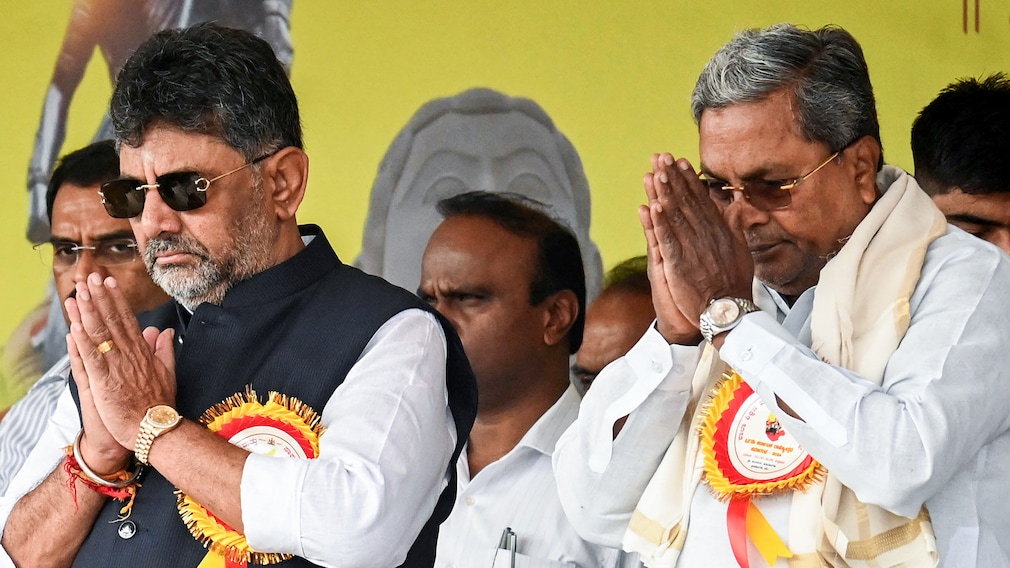
The Congress party finds itself navigating treacherous political waters in Karnataka, with echoes of the Madhya Pradesh debacle of 2020 reverberating through the corridors of power in Bengaluru. As Deputy Chief Minister DK Shivakumar stakes his claim to the top post, citing a purported 2.5-year rotational arrangement, the party's high command is walking a tightrope, acutely aware that one misstep could lead to a repeat of the catastrophic loss it suffered in Madhya Pradesh.
The Madhya Pradesh Shadow
The scars of Madhya Pradesh remain fresh in Congress memory. In December 2018, the party had successfully formed a government in the state, only to lose power to the Bharatiya Janata Party (BJP) in March 2020, just as the COVID-19 pandemic was beginning to grip the nation. The architect of this political upheaval was Jyotiraditya Scindia, who led a group of MLAs in a mass resignation before defecting to the BJP, reducing the Kamal Nath-led government to a minority.
Scindia's rebellion wasn't merely about political ambition; it was fuelled by deep-seated grievances. He felt sidelined in the race for the state Congress president position, and his supporters believed that the powerful duo of Chief Minister Kamal Nath and senior leader Digvijay Singh were systematically ignoring his claims to power while promoting their own children's political careers. The final straw came when Kamal Nath, even after becoming Chief Minister, continued to hold onto the Congress president position, consolidating power in a way that left Scindia feeling marginalised and betrayed.
Karnataka's Political Theatre
Fast forward to 2025, and Karnataka is witnessing what local political observers are calling a similar "nataka" (drama). The state's political landscape is divided into two camps: supporters of current Chief Minister Siddaramaiah, who want him to complete his full term, and backers of DK Shivakumar (DKS), who believe it's "now or never" for their leader to assume the top post.
DKS has been vocal about his aspirations, exhorting the high command to honour what he claims was a promise of a rotational arrangement. However, there has been no official confirmation of any such agreement, leaving the situation murky and ripe for conflict. The absence of a clear, documented understanding has only intensified the jockeying for position.
Complicating matters further, several other leaders sense an opportunity in this chaos. Veteran politicians like G Parameshwara, MB Patil and Satish Jarkiholi are positioning themselves as potential compromise candidates. Meanwhile, party president Mallikarjun Kharge and his son are also seen as dark horses who could potentially stake their claim if the two main contenders neutralise each other.
Key Factors In DKS vs. Siddaramaiah Battle
The resolution of this power struggle hinges on several critical factors. First and foremost is the question of numbers - who commands the loyalty of more MLAs in the assembly? The arithmetic of power will ultimately determine who gets the top post.
The caste dynamics add another layer of complexity. Siddaramaiah represents the OBC (Other Backward Classes) community and has successfully recreated the AHINDA (Kannada acronym for minorities, backward classes, and Dalits) coalition originally crafted by the legendary Devaraj Urs. DKS, on the other hand, hails from the influential Vokkaliga community, which has traditionally wielded significant political power in Karnataka. This is not just a battle between two individuals; it represents a contest between past political formulas and future aspirations, between different caste configurations and their claims to power.
The loyalty factor cannot be overlooked. Siddaramaiah moved to the Congress from the Janata Dal (Secular) in 2006 and, through political acumen and strategic maneuvering, outwitted established leaders like Kharge, Parameshwara, and Muniyappa to become Chief Minister in 2013. This history has created lingering resentments. Kharge, in particular, is known to blame Siddaramaiah for denying him the Chief Minister's post, adding a personal dimension to the current crisis.
The irony wasn't lost on political observers when Kharge, upon being asked who would resolve the dispute, replied, "the high command", prompting widespread trolling on social media reminding everyone that he himself was the Congress president. As an interested party with his own aspirations and those of his son in play, many believe he should have recused himself from this decision-making process.
High Command's Dilemma
The situation is further complicated by the perceived preferences of the Gandhi family. Rahul Gandhi is reportedly backing Siddaramaiah, whose OBC plank aligns with the party's national strategy of consolidating backward class votes. Making DKS the Chief Minister could undermine this broader political narrative. However, Sonia Gandhi reportedly has a soft corner for DKS, who is considered both resourceful and loyal, having even gone to jail for the party - a sacrifice that hasn't been forgotten.
The Congress high command faces an uncomfortable truth: it doesn't enjoy the same authority and heft it did after a surprise performance in the general elections of 2024, when it doubled its tally, thanks largely to Rahul Gandhi's Bharat Jodo Yatra. After consecutive losses in state elections over the last two years, its ability to impose decisions and maintain discipline has been significantly eroded. Can it afford a split? Can it risk either DKS or Siddaramaiah defecting to the BJP or seeking outside support to form an alternative government?
History offers a cautionary tale. The JD(S)-Congress coalition government of 2018 lasted just over a year. When HD Kumaraswamy was forced to resign after Congress MLAs - ostensibly from Siddaramaiah's camp - resigned, the government fell into minority. This precedent shows how fragile alliances can be and how quickly political fortunes can change.
Siddaramaiah, much like Bihar's Nitish Kumar, has proven to be a leader who cannot be forcibly removed. Unless he voluntarily relinquishes power, any attempt to dislodge him could trigger unpredictable consequences.
Four Possible Scenarios
The second scenario involves a change of guard, with DKS becoming Chief Minister and leaders like Parameshwara and MB Patil appointed as Deputy Chief Ministers to balance different power centres and caste equations.
The third and most alarming situation for Congress would see a BJP-JD(S) government formation with outside support from the DKS camp - a replay of the Madhya Pradesh script, which could be devastating for the party's national ambitions.
The fourth scenario, equally troubling, would involve Siddaramaiah moving back to his old party, the JD(S), and forming a government as Chief Minister with the BJP's support from outside - turning his original defection full circle.
Karnataka's Political Culture
Karnataka, like Maharashtra, is a state where money and power play outsized roles in political calculations. The fluidity of political loyalties here is remarkable. Approximately a third of current MLAs have, at various points in their careers, been members of all three major parties: the Congress, the BJP, and the JD(S). Party-hopping is not an aberration but a feature of Karnataka's political landscape.
This instability is reflected in the state's governance history. Karnataka has witnessed thirteen chief ministerial terms already, another two periods of President's Rule. Such frequent changes underscore the volatile nature of the state's politics and the challenges of maintaining stable governments.
The Test Ahead
The Congress high command's ability to manage this crisis will be a litmus test of its political acumen and authority. Can it balance competing ambitions, manage caste equations, maintain party unity, and keep the government stable - all while preventing a repeat of the Madhya Pradesh disaster?
The stakes couldn't be higher. Karnataka is one of the few major states where the Congress currently holds power. Losing it would not only be a blow to party morale but would also significantly diminish its bargaining power in national politics. Moreover, with crucial elections on the horizon in other states, the perception of weak leadership or inability to manage internal conflicts could have cascading effects on the party's prospects nationwide.
As the political drama unfolds in Bengaluru, all eyes are on how the Congress high command navigates these troubled waters. The lessons from Madhya Pradesh are clear: ignore internal dissent at your peril, and never underestimate the capacity of ambitious leaders to chart their own course when they feel cornered or betrayed. Whether Congress has learned these lessons will soon become evident.
(Amitabh Tiwari is a political strategist and commentator. In his earlier avatar, he was a corporate and investment banker)
Disclaimer: These are the personal opinions of the author
-
Opinion | Building BRICS In New Delhi

For India as the host nation, chairing the summit tests the core tenet of its modern foreign policy: strategic autonomy.
-
Can India 'Mediate' Between Iran And UAE At BRICS? Gulf Envoy Suggested It Once
At the very start of the Israel-US war on Iran, it was a UAE diplomat who had suggested as much.
-
Opinion | When The Feed Braves The Flood
NDTV drops the 24x7 and stakes its next chapter on presence as it inaugurates a new identity
-
I Went Looking For A PG In Delhi's Kamla Nagar. Here's What I Found
In every PG visited by NDTV in Delhi's Kamla Nagar, the conversation began with amenities. Nothing in the sales pitch was about how secure the building was.
-
Opinion | How Trump Is Doing More For BRICS Than Its Critics Ever Could
By trying to bully BRICS countries into submission, Trump may be giving the grouping the very relevance he is trying to deny
-
Opinion | BRICS Has Grown Up. Now It Must Behave Like An Adult
The India-China accommodation will be a key driver of the grouping, but a 'non-Western' agenda will work well only if it focuses on ending global conflict as much as on stabilising the global economy
-
Opinion | 9/11, And The Price Of Fighting Terror For A Quarter Century
Twenty-five years later, 9/11 is more than just a lived memory for those who witnessed it in real time, as I did as a UN official
-
Opinion | US Can Threaten, Not Dictate: What India's Iran Message Really Means
If India's Bishkek message was a signal to the US, then Pezeshkian's arrival in New Delhi for BRICS will be a defining note: that India's strategic autonomy is not up for debate