How Apache Chopper's Presence Near Pakistan Border Will Shift The Equation
What truly sets the Apache apart, and makes it feared across theatres of war, is the AN/APG-78 Longbow radar system mounted above its rotor.
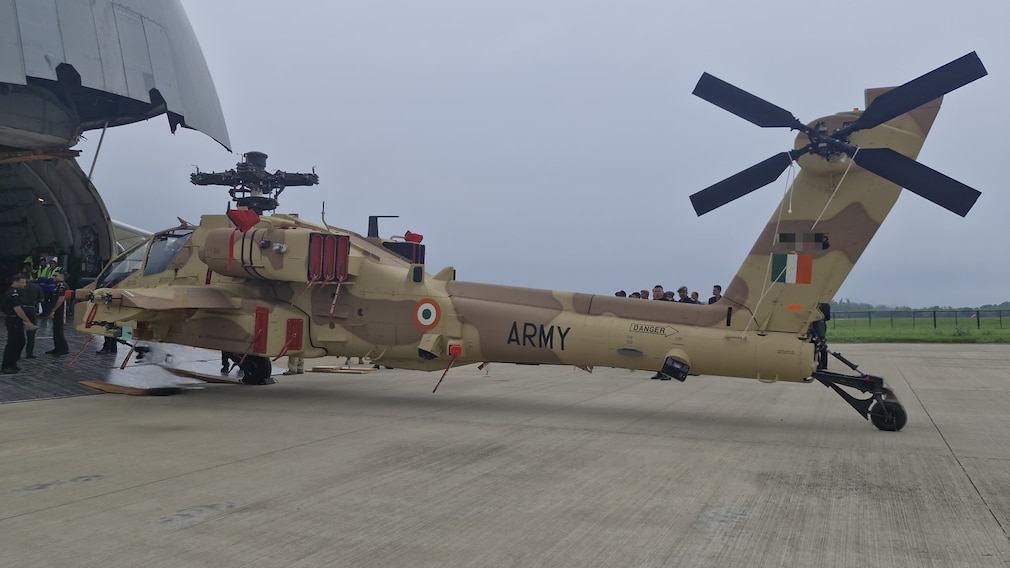
Fifteen months after a squadron was raised in Jodhpur to house the world's most feared attack helicopter, the Indian Army today took delivery of the first three of six Boeing-built AH-64E Apache helicopters.
The desert camo painted helicopters, which sport fuselages built by a Tata-Boeing joint venture on the outskirts of Hyderabad, are destined for combat patrol missions near the Pakistan border, where they will immediately be a major boost to the Indian Army's combat rotorcraft fleet, currently comprised of Indian-made Dhruv Rudra and Prachand helicopters.
The Indian Army's Apache helicopters are not the first in country. The Indian Air Force operates two squadrons of the type, based in Pathankot and Jorhat, each 'taking care of' the northern sectors and eastern sectors facing China.
Heavily armed, the Apache's arsenal includes a 30 mm M230 chain gun for close support, 70 mm Hydra rockets for area saturation, and AGM-114 Hellfire missiles that can destroy armoured vehicles and tanks from over six kilometres away. For aerial threats, it carries air-to-air Stinger missiles, making it lethal not just to tanks, but even to helicopters and UAVs. The Indian Army and IAF versions of the Apache are identical.

The Indian Army's order for 6 Apaches is almost certain to go up to at least three times that number
What truly sets the Apache apart, and makes it feared across theatres of war, is the AN/APG-78 Longbow radar system mounted above its rotor. About half of the Apaches for the Indian Army and IAF are Longbow-fitted versions of the helicopter. This mast-mounted, millimetre-wave radar can track up to 128 ground targets and prioritise 16 simultaneously. Its positioning allows the Apache to scan and assign targets while remaining hidden behind terrain, literally popping up only to deliver fire. That radar, paired with advanced infrared sensors, helmet-mounted displays, and night vision systems, makes the Apache a predator in the dark, ideal for sudden, overwhelming strikes. Their very presence adds several layers of deterrent caution on Pakistani ground movements.
For the Indian Army, the AH-64E will also be able to receive live sensor feeds from drones, giving it situational awareness of the kind Indian Army copter pilots have never had before. This networked combat ability allows the Apache to detect threats, coordinate attacks, and share targeting data in real time, offering commanders a comprehensive, multi-domain view of the battlefield.
Its induction comes weeks after Operation Sindoor, and at a time when India's western frontier remains live with threats. The Apache's presence near the Pakistan border shifts the equation. It can engage enemy armour, radar posts, terror camps and logistics convoys with speed and precision. Its survivability, with armoured crew compartments, crash-resistant systems, and hardened rotors, ensures it can take damage and still complete missions.
The Indian Army's order for six Apaches is almost certain to go up to at least three times that number.
-
Opinion | The 'AIPC' Was Once Congress' Boldest Idea. What Happened To It?

Tharoor, to Chakravarti, to Yaskhi now, the fate of a Congress 'experiment' that started in 2017 will tell you a lot
-
Woman Biker Hit, Air Force Veteran Attacked: The Lawlessness In Gurugram
What gives confidence to some elements in Gurugram to break the law again and again in full public view and on camera?
-
Opinion | When The Feed Braves The Flood
NDTV drops the 24x7 and stakes its next chapter on presence as it inaugurates a new identity
-
The Politics Of Blue: Why Akhilesh Yadav-vs-Mayawati Over A Colour Is Just One Shade Of History
A movie starring Rajinikanth tells us how colours can carry meaning beyond what meets the eye. The latest row over Akhilesh Yadav's party adopting blue, and Mayawati objecting, can be a starting point for understanding the many shades of history.
-
2 Indians Survived 9/11, Then American Justice System Became Their Nightmare
Pulled off a Texas train hours after 9/11, two Indian men were plunged into America's largest terror manhunt.
-
Opinion | Building BRICS In New Delhi
For India as the host nation, chairing the summit tests the core tenet of its modern foreign policy: strategic autonomy.
-
Can India 'Mediate' Between Iran And UAE At BRICS? Gulf Envoy Suggested It Once
At the very start of the Israel-US war on Iran, it was a UAE diplomat who had suggested as much.
-
I Went Looking For A PG In Delhi's Kamla Nagar. Here's What I Found
In every PG visited by NDTV in Delhi's Kamla Nagar, the conversation began with amenities. Nothing in the sales pitch was about how secure the building was.