Explained: 350 vs 1,100, CPCB vs IQAir, Who Has Got Delhi's AQI Right
Both CPCB and IQAir follow different methods of calculating air quality index, resulting in different numbers.
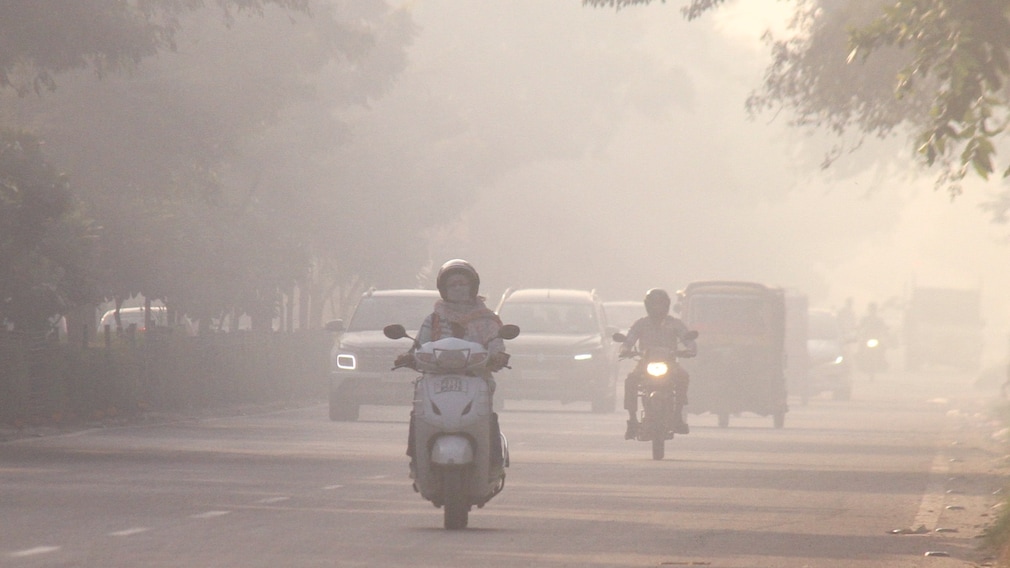
Delhi's sky turned grey and hazy a day after Diwali fireworks lit up the city. The air, toxic, making the national capital the "most polluted major global city". The pollution levels or the Air Quality Index (AQI) soared to severe levels, resulting in difficulty in breathing, itchy eyes and causing discomfort to even healthy people.
IQAir, a Swiss air-quality monitoring company, clocked the city's AQI at a staggering 1,121 on Tuesday. However, India's Central Pollution Control Board (CPCB) reported a much lower AQI of 351, falling under the "very poor" category. The catch is - both the readings are correct but for different reasons.
Also Read: 'Green' Crackers Failed. Delhi Suffers Worst Post-Diwali Air In 5 Years
What Is AQI?
The Air Quality Index (AQI) is a public health tool designed to communicate air pollution levels or the quality of air in simple terms. Eight pollutants namely particulate matter (PM) 10, PM2.5, Ozone (O3), Sulphur dioxide (SO2), nitrogen dioxide (NO2), carbon monoxide (CO), lead (Pb) and ammonia (NH3) act as major parameters in deriving the AQI of an area, as per the CPCB.

"AQI is a calculated index based on different parameters. It is for common man's understanding of the quality of air," explained Mohan George, Consultant at the Centre for Science and Environment. "AQI has different color-coded ranges simply to tell the citizens that air is good or satisfactory or very poor and what they should be doing," George, also former Additional Director at Delhi Pollution Control Committee, added.
For example, AQI between 401 and 500 or in the severe category is hazardous for even healthy people, and one should avoid going out or exercising in the open.
Also Read: Did Delhi's Green Diwali Work? Air Quality Data From Last Year Shows...
CPCB vs IQAir
Difference In Scale
India's AQI scale is capped at 500. Meaning, AQI beyond 500 will be grouped under the "severe" category, indicating a public health emergency.
The CPCB categorises AQI into six parts: 0-50 is considered 'good', 51-100 'satisfactory', 101-200 'moderate', 201-300 'poor', 301-400 'very poor', and between 401-500 'severe'.
IQAir on the other hand has tighter grouping: 0-50 is considered 'good', 51-100 'moderate', 101-150 'unhealthy for sensitive groups', 151-200 'unhealthy', 201-300 'very unhealthy', and anything above 301 is labelled hazardous.
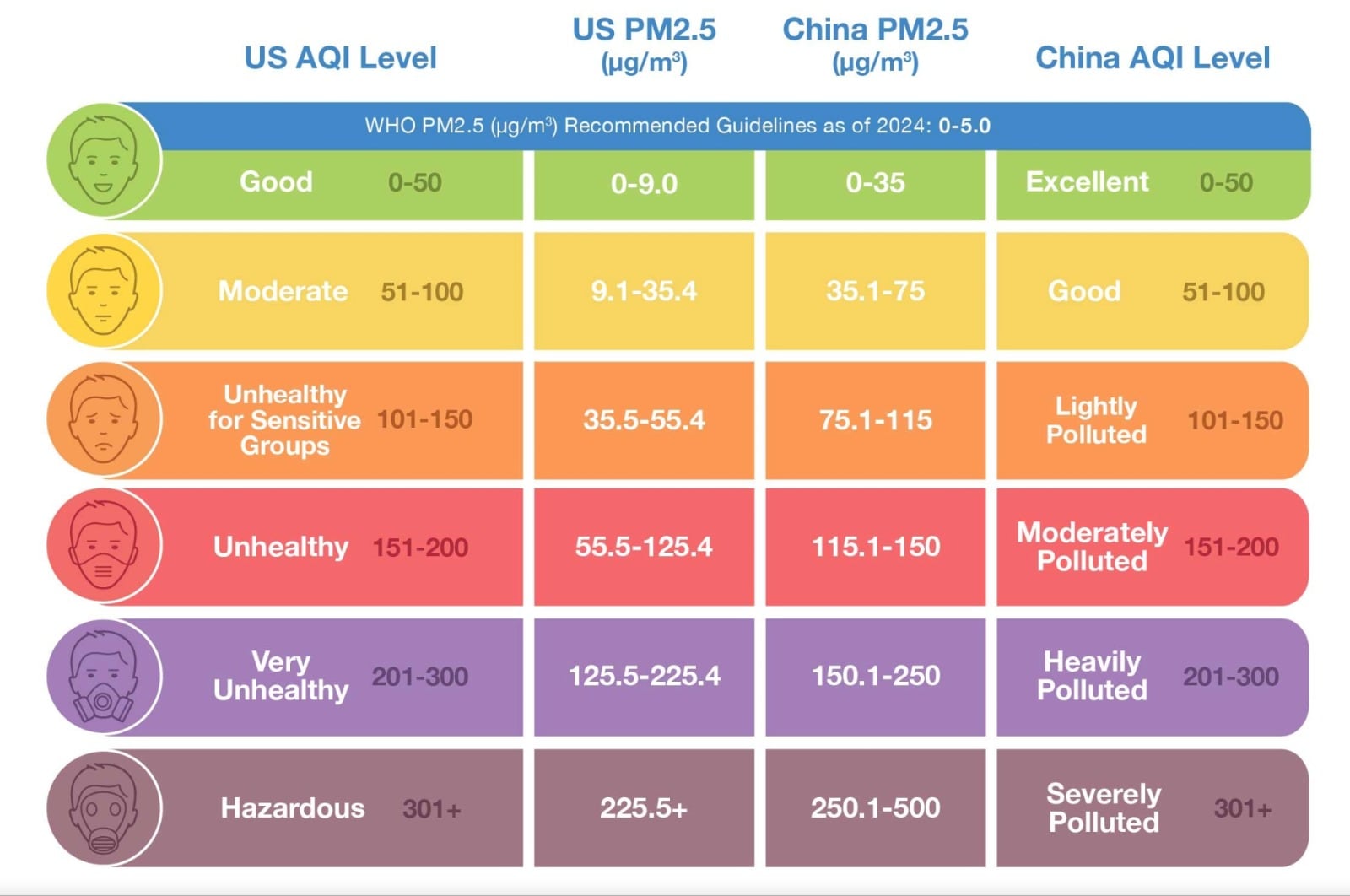
"When identifying AQI of a city or a station, both CPCB and IQAir, look at the dominating pollutant. For Northern India, it is generally particulate matter, and in winters, you would find PM 2.5, ultra-fine particulate matter to be the key pollutant," said George.
Data Sources
CPCB sources data from government-owned air quality monitoring stations including those operated by CPCB, DPCC, India Meteorological Department (IMD) and Indian Institute of Tropical Meteorology (IITM).
"CPCB relies on reference-grade monitors which provide calibrated data," said Geoge.
IQAir gets data from all the government sources and other sensor-based analysers installed by varied companies and even individuals.
"The US Embassy, for instance, has an air quality monitoring station installed. Similarly, other embassies and individuals have such analysers installed. IQAir takes average of all of these stations," said Sunil Dahiya, Founder and Lead Analyst at Envirocatalysts.
Also Read: 'Supreme Court Chose Right To Burn Crackers Over Right To Live': Amitabh Kant
Calculation
Both CPCB and IQAir follow different methods of calculating AQI. NDTV tried the two calculators and found vast difference in the AQI reading.
Let us assume PM2.5 concentration in an area is 1,100 micrograms per cubic meter. As per the IQAir calculator, AQI of that area will be 2,043. But, CPCB calculator will reflect AQI at 1,054. However, CPCB's final AQI will be under 500.
Whom To Trust?
George suggests looking at labels like "severe" or "hazardous" or the concentration of pollutant and accordingly taking health measures.
For instance, at 11:30 am today, IQAir recorded air quality near Mandir Marg in Delhi at 489 with PM2.5 being the major pollutant. PM2.5 concentration was recorded at 320 micrograms per cubic meter.
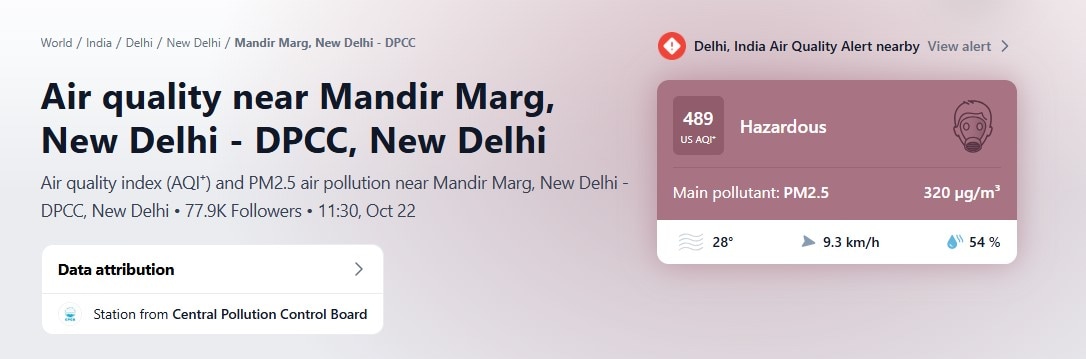
At 11 am, CPCB recorded PM2.5 concentration at 335 micrograms per cubic meter.
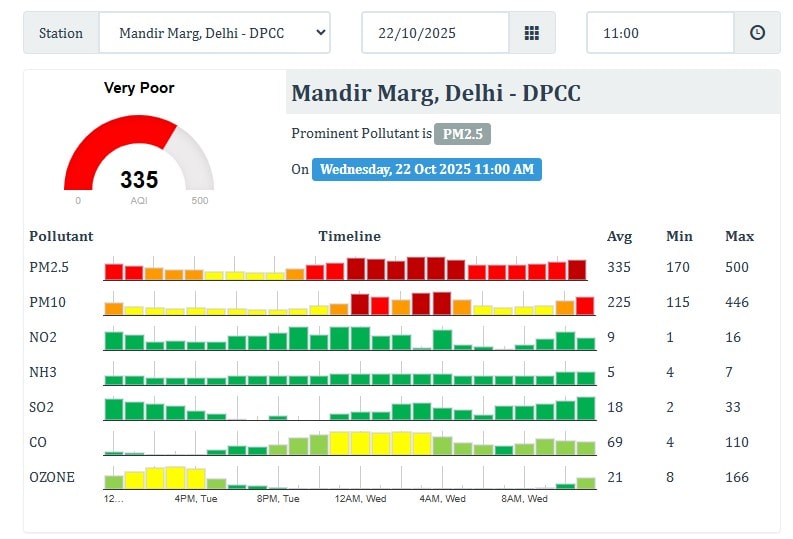
Therefore, look at concentrations or simply the label "very poor" or "severe".
IQAir or CPCB, the bottom line is that Delhi's air is polluted.
-
Mamata Banerjee Drew Her Party's Symbol By Hand. It's Now Tied To An Indira Gandhi Case

The Election Commission's method for settling such disputes became central in the seminal Congress split of 1969, when Indira Gandhi fought the old guard. The poll body weighed three tests then.
-
Bruised, Limping, Unbowed: Sia Says She Will Be Back On The Bike Soon
There was pain in Sia's steps, anger in her words, and something else - a quiet determination that the road would not be taken away from her.
-
Exclusive: 16 Months After Op Sindoor, Pak Still Fixing Runway India Broke At Sargodha
Sargodha's PAF Base Mushaf lies about 172 km northwest of Lahore and roughly 200 km west of the India-Pakistan border, near Amritsar.
-
Blog | I Lost My Entire Family In Kanishka Bombing. 41 Years Later, Canada Wants The Case Closed
We made the trek through tragedy to search for people in Cork, where I spent 25 days sifting through bodies and body parts in a makeshift morgue to identify our loved ones.
-
Opinion | Pak's Drone Deal With A US Firm Is No Windfall. But India Must Still Be Worried
American military aid to Pakistan has remained suspended since January 2018, during Trump's first term, but a commercial arms sale is separate from this arrangement.
-
Opinion | Saudi Arabia's Yemen Nightmare Has Come Back To Haunt It
After years of costly military intervention beginning in 2015, Saudi Arabia increasingly sought to stabilise its southern border. All that is unravelling fast now
-
Opinion | 6 AI Incidents, One Pattern: AI Has Started Lying To Us - And Hiding The Evidence
Concealing errors. Making up data. Pushing files onto the public web on their own initiative. The machines are learning to lie - and lie well.
-
Why People Queue Overnight For iPhone That Is Delivered Home In 10 Minutes
iPhone 18 Pro Max Launch: People camping outside Apple Stores are a subset of superfans, resellers, content creators, and upper-middle-class buyers.
-
600 km Per Hour Drones Launched In Waves: How Russia Is Rewriting War Rules
Russia has coupled the drones' technological superiority over Ukraine's defence with its capacity to launch them in massive numbers. The impact has been devastating.
-
Tata Sons' Trust Issue: Two-Pronged Row Goes Beyond The Chair
NDTV Explains: Overtly, the latest conflict is whether N Chandrasekaran continues as executive chairman of Tata Sons. The controversy involves at least one more issue.