'Caste' Among Minorities Shatters Myth Of Muslim Vote Banks In Bihar
The Muslim consolidation of votes strategically against the BJP has been higher in Bihar since 2015, given the overwhelming hegemony of the BJP across North India in 2014 and 2019.
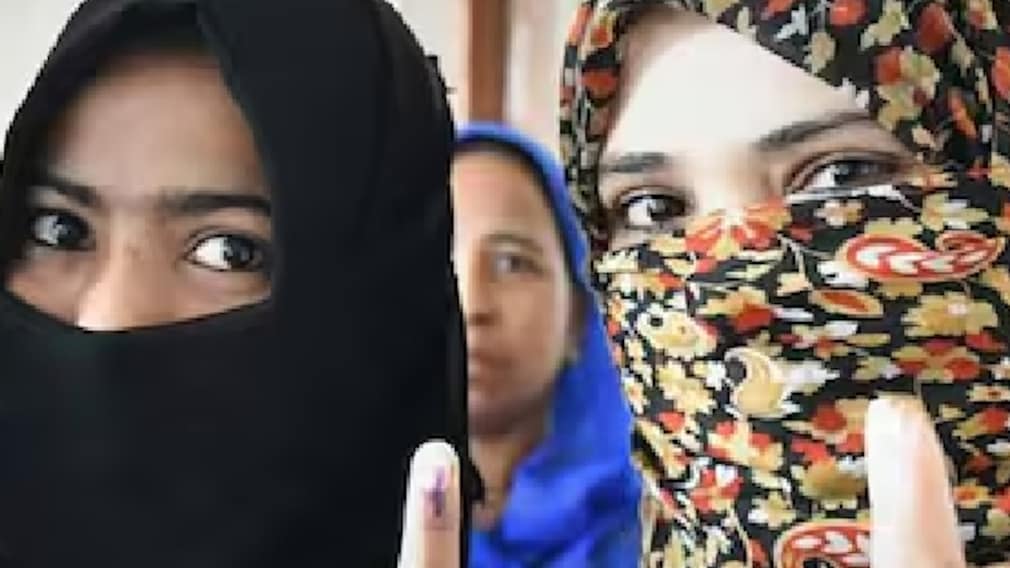
There is a certain myth that moves around Indian elections as smoothly as the holy river Ganges through Bihar - a myth insistently simple and yet quietly complex. That the 'Muslim vote' is a single, easily counted thing you can herd into a booth and, like cattle, brand with the mark of a single party.
Walk through Phulwari Sharif in Patna late at night or stand by a chai stall in Siwan at dawn. Mingle among minorities in Sakri (a Nagar Panchayat in Madhubani district) or among shoppers and shopkeepers of Glesan Bazaar (named after British administrator and linguist George Abraham Grierson) in Madhubani town. Or wander along the small lanes of Kishanganj.
And one sees the absurdity of that simplicity. Voting is unequivocally strategic and intimate; it is a conversation between memory and fear, between grievance and hope. It is also arithmetic and algebra.
The Caste Within The Minority
While travelling across Bihar, learn to look for the small inner maps a place keeps of itself: the way a city will remember a river, a language, a habit.
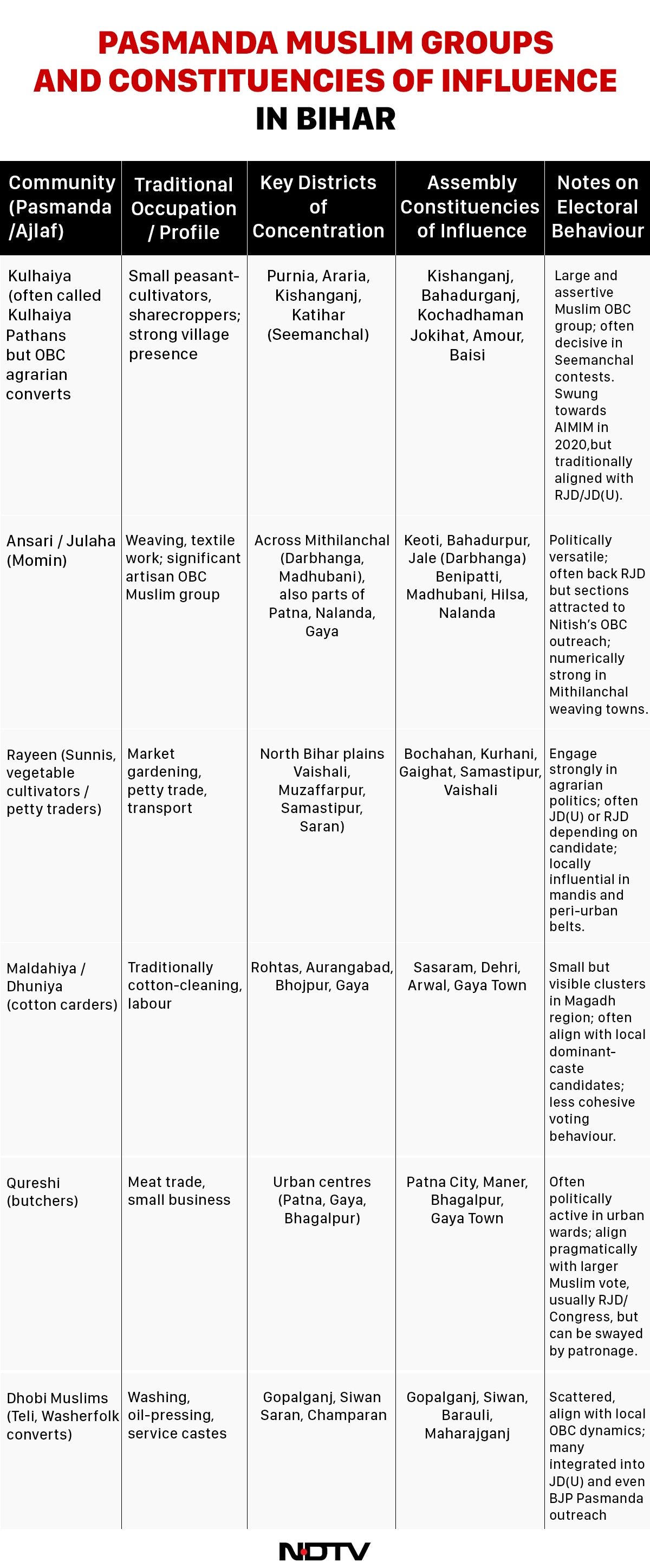
Bihar keeps such maps within its Muslim population - not one map, but many: the old, vertical lines of ashraf/ajlaf/arzal; the newer political edges traced by the Persian word Pasmanda; the scattered geography of Seemanchal and Mithilanchal, where numbers change the rules of the game.
To ask 'how do Muslims vote?' in Bihar is to ask a question that wants a single latitude and longitude but will only accept a constellation of answers.
Muslims Vote According To Caste, Numerical Strength In Constituency
Two insightful and useful rules have been argued by scholars who specialise in minority voting behaviour.
The pioneering work was conducted by Yale Professor Harry W Blair, now at Bucknell University, who explored the intersection of caste and religion in Bihar. Writing from an older, careful, and empirical perspective, he argued Muslim voting in Bihar tends to be shaped by caste divisions and by numbers.
That is, where they are numerous (enough to be a local majority or decisive bloc), they will more often support a Muslim candidate or a party that seems most capable of protecting their local interests (Seemanchal). Where they are thinly dispersed, their preferences mirror the majority population because local clientelism and personal ties matter more than communal identity. And where the minorities are a critical block (say between 20 and 30 per cent), they vote for a 'secular party'.
Harvard-based Feyaad Allie (writing more recently from the Carnegie Endowment) emphasises a different, complementary pattern from the national scene: since 2019 Indian Muslims have shown a stronger tendency to vote against the BJP as a national choice - a defensive, consolidating move in response to perceived exclusion and insecurity even while internal divisions (by caste, region, sect) remain important.
Minority Consolidation Since 2015, Favouring Mahagathbandhan
In the 2015 election, an overwhelming 80 per cent of Muslims voted for the Mahagathbandhan, which then consisted of the RJD, Congress, and Janata Dal United. And only eight per cent voted for the BJP-led National Democratic Alliance.
In 2020, when Nitish Kumar allied with the BJP and jointed the new NDA and Asaduddin Owaisi's AIMIM was a factor in Seemanchal, still 76 per cent of Muslims voted for the Mahagathbandhan. And only five per cent of the Akhilyat voted for the NDA.
The two insights are not contradictory; one is local arithmetic, the other is national psychology.
The Muslim consolidation of votes strategically against the BJP has been higher in Bihar since 2015, given the overwhelming hegemony of the BJP across North India in 2014 and 2019.
Arithmetic At Voting Booth, Psychology Across Bharat
That duality - arithmetic at the booth, psychology across Bharat - explains why Bihar resists easy stories. There are places like Seemanchal (Kishanganj-Katihar-Araria-Purnia) where the Muslim presence is so dense that local dynamics create distinct outcomes.
In 2020, the Owaisi-led AIMIM contested a limited set of seats and won five in Seemanchal, announcing to the state there are corners of Bihar where the Muslim identity can be mobilised as an independent force. Blair's hypothesis of the number of minority voters in a constituency proved accurate.
But even there, the story did not remain tidy. Defections, local bargains, and the gravitational pull of established parties quickly complicated the picture. Almost all AIMIM MLAs later switched to the RJD.
So what of November 2025? Will Muslims in Bihar consolidate behind the Mahagathbandhan (now led by the RJD and Congress) or split for Owaisi's AIMIM?
The honest answer is: both scenarios are plausible, and your confidence about which will happen depends on how you fold together arithmetic and psychology.
However, Muslims will largely vote for the Mahagathbandhan compared to the AIMIM. The former Chairman of the Indian Council of Social Science Research, the late Professor Javeed Alam had rightly argued: "Muslims since independence, vote largely for mainstream secular political parties led by Hindu leaders more than smaller Muslim parties led by Muslim leaders."
The caste inside Islam - ashraf, ajlaf, arzal, and the rise of 'pasmanda'
When scholars talk about Muslim 'caste', they are not inventing Hindu categories and forcing them onto Islam. They are looking at social stratifications that have long existed inside South Asian Muslim society.
In that respect, South Asian Muslims are unique and different from Muslims of the Middle East.
Claims of noble foreign descent (ashraf), artisan and converted agrarian groups (ajlaf), and the most marginal occupational groups (sometimes called arzal).
These social divisions carry status, marriage rules, and often local influence. In recent decades, a political vocabulary - 'pasmanda' (literally 'the left-behind') - brought together ajlaf and arzal claims into an assertion of backwards-class identity demanding redistribution and representation.
Why does this matter politically? Because the 'pasmanda' identity reframes some Muslims as socio-economically disadvantaged groups who can be courted through OBC/benefits narratives rather than only communal appeals. Parties that promise reservation-style benefits, jobs, or dignity to these groups can sometimes pierce what looks like religious solidarity and win votes based on caste/benefit politics.
How the 'myth of the Muslim vote-bank' shatters under inspection
The myth collapses under inspection, not because Muslims are capricious but because their choices are structured by caste, by region, by local brokers, by their numbers in the particular constituency, and by national moods. Three short conclusions:
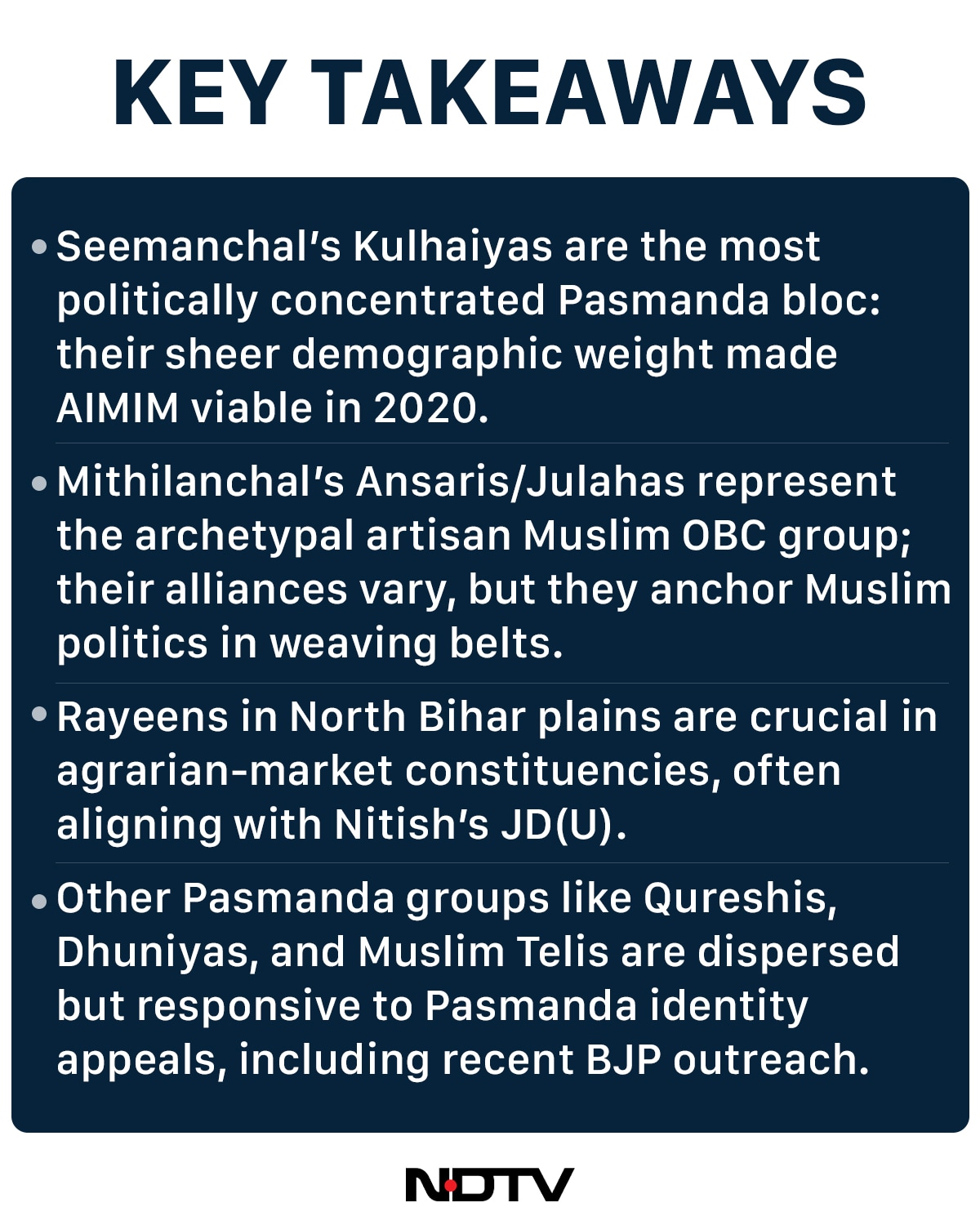
- The Muslim electorate is internally differentiated. Ashraf/ajlaf/arzal hierarchies and 'pasmanda' identity politics mean that different segments have different priorities. Any strategy that treats Muslims as a monolith will fail both empirically and politically.
- Numbers matter - and so does geography. In Seemanchal, concentrated Muslim numbers allow a distinct political actor (AIMIM) to win and to reshape competition. Elsewhere, dispersed demographics mean local bargains and caste-based outreach (Nitish's JDU, some BJP moves) determine outcomes.
- National narratives overlay local realities. Since 2019 Muslim voters have been consolidating against BJP at the national level, but that national mood is filtered by local caste hierarchies and clientelist networks. 'Pasmanda' voters - concerned with reservation, jobs and dignity - sometimes respond to OBC-style outreach by difference-seeking parties (JDU, BJP's targeted programs), even while the broader anti-BJP sentiment remains potent in other constituencies.
A last, small human image
Consider a single face of a common man: the commuter, the tea-seller, the pilgrim, who is at once ordinary and emblematic.
If you stand in Glesan Bazaar in Madhubani, someone will tell you a community's vote is about bread, about a schoolteacher for a child, about a shivala or a madrasa's uncertain grant - not a vote printed with a communal stamp.
In Kishanganj, the same voter will be speaking from a history of numbers and fear of exclusion because of the Special Intensive Revision conducted hurriedly by the Election Commission.
In both places, the same electorate is doing what voters always do: weighing present goods, past grievances, and future anxieties.
So, the 'myth of the Muslim vote-bank' is not so much false as incomplete. It is a half-map that leaves out the contours of caste and region that actually make up the political terrain.
To parse Bihar's Muslim vote is, therefore, to read several maps at once - the caste map, the regional map, their numbers in the constituency and the national mood - and to remember always that political life unfurls in kitchens and in mosques as much as it does in electoral arithmetic.
-
In Bombed Facilities, Unstable Tunnels, US' Toughest Uranium Extraction Yet

Before US and Israeli strikes in June 2025, the International Atomic Energy Agency estimated that Iran possessed roughly 441 kilograms of uranium enriched to 60 per cent, alongside approximately 200 kilograms enriched to 20 per cent.
-
Opinion | Pakistan's Ever-Running Saudi 'Lifeline' Has Its Limits
There is a gap between what Pakistan seeks from its Gulf partners and their willingness to offer it.
-
The 60-Day Clock That May Stop Trump's Iran War, And How He Could Ignore It
Under the War Powers Resolution, also called the War Powers Act, an American president who has activated the armed forces without Congressional approval has 60 days to stand down.
-
Opinion | Iran Was Giving Trump The Best Deal America Ever Had. Why He Walked Away From It
The JCPOA is dead. The Oman negotiations failed. Islamabad shows little promise. What is left for US and Iran now?
-
1 War, 3 Bills: UAE's Bailout, Iran's $270 Billion, Trump's Off-Ramp Search
The Wall Street Journal said the UAE has sought a financial guarantee from the US for damage sustained during the war on Iran, a demand that could open Washington to financial contagion, with other Gulf countries joining the queue for payouts.
-
Analysis | Can Donald Trump Face An 'Arrest Warrant' - Like Netanyahu And Putin?
No one in living memory imagined a moment when the world would seriously debate the possibility of an American president being dragged before a court. Has it come now?
-
US' $240 Million Drone Over Cuba That's Strangling China's Oil Supply
From Venezuela to Hormuz to Malacca, the US has made three moves to strangle China's oil. Now a $240M drone over Cuba signals move four — and Trump wants the island. The chessboard is almost complete.
-
Opinion | Amir Hamza Attack Was A Symptom. A Deadlier Storm Is Brewing Within Lashkar
There is an ongoing power struggle within Lashkar for the top spot, which may lead to new terrorists wanting to 'prove' themselves. The obvious means? India.
-
Noida Turns 50: How The Planned City Outgrew Its Initial Brief
Noida's growth has been steady. This created trust. And trust attracted capital. Today, Noida is no longer just a supporting player in the NCR story.
-
Opinion | Trump's Favourite Field Marshal: How Munir Became The President's Best Man
Pakistan and the United States are not obvious analogues. And yet, their respective leaders have made a comparison inevitable today.