'Caste' Among Minorities Shatters Myth Of Muslim Vote Banks In Bihar
The Muslim consolidation of votes strategically against the BJP has been higher in Bihar since 2015, given the overwhelming hegemony of the BJP across North India in 2014 and 2019.
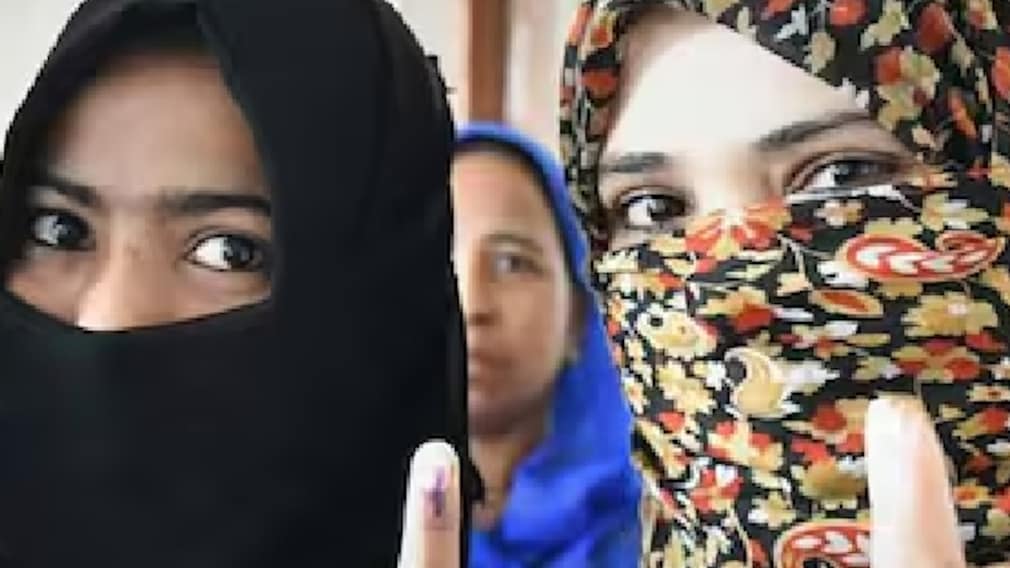
There is a certain myth that moves around Indian elections as smoothly as the holy river Ganges through Bihar - a myth insistently simple and yet quietly complex. That the 'Muslim vote' is a single, easily counted thing you can herd into a booth and, like cattle, brand with the mark of a single party.
Walk through Phulwari Sharif in Patna late at night or stand by a chai stall in Siwan at dawn. Mingle among minorities in Sakri (a Nagar Panchayat in Madhubani district) or among shoppers and shopkeepers of Glesan Bazaar (named after British administrator and linguist George Abraham Grierson) in Madhubani town. Or wander along the small lanes of Kishanganj.
And one sees the absurdity of that simplicity. Voting is unequivocally strategic and intimate; it is a conversation between memory and fear, between grievance and hope. It is also arithmetic and algebra.
The Caste Within The Minority
While travelling across Bihar, learn to look for the small inner maps a place keeps of itself: the way a city will remember a river, a language, a habit.
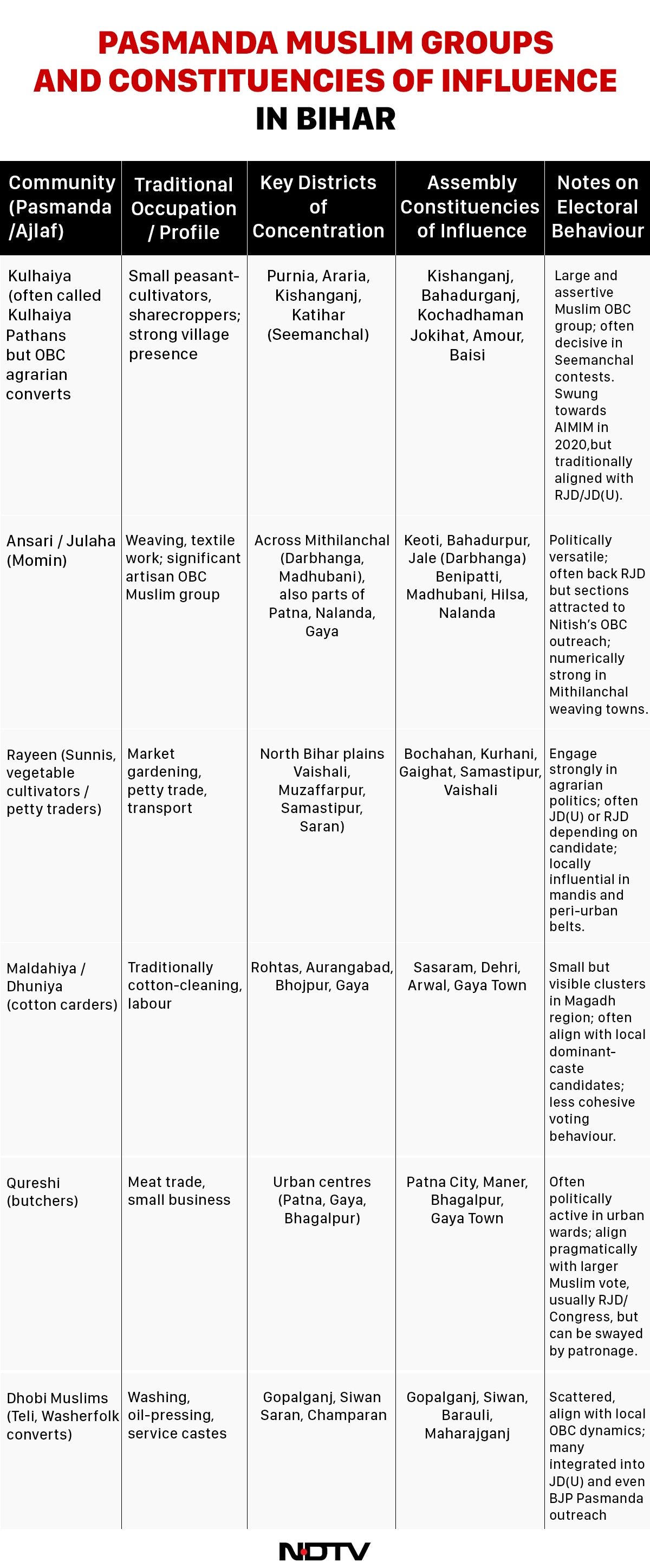
Bihar keeps such maps within its Muslim population - not one map, but many: the old, vertical lines of ashraf/ajlaf/arzal; the newer political edges traced by the Persian word Pasmanda; the scattered geography of Seemanchal and Mithilanchal, where numbers change the rules of the game.
To ask 'how do Muslims vote?' in Bihar is to ask a question that wants a single latitude and longitude but will only accept a constellation of answers.
Muslims Vote According To Caste, Numerical Strength In Constituency
Two insightful and useful rules have been argued by scholars who specialise in minority voting behaviour.
The pioneering work was conducted by Yale Professor Harry W Blair, now at Bucknell University, who explored the intersection of caste and religion in Bihar. Writing from an older, careful, and empirical perspective, he argued Muslim voting in Bihar tends to be shaped by caste divisions and by numbers.
That is, where they are numerous (enough to be a local majority or decisive bloc), they will more often support a Muslim candidate or a party that seems most capable of protecting their local interests (Seemanchal). Where they are thinly dispersed, their preferences mirror the majority population because local clientelism and personal ties matter more than communal identity. And where the minorities are a critical block (say between 20 and 30 per cent), they vote for a 'secular party'.
Harvard-based Feyaad Allie (writing more recently from the Carnegie Endowment) emphasises a different, complementary pattern from the national scene: since 2019 Indian Muslims have shown a stronger tendency to vote against the BJP as a national choice - a defensive, consolidating move in response to perceived exclusion and insecurity even while internal divisions (by caste, region, sect) remain important.
Minority Consolidation Since 2015, Favouring Mahagathbandhan
In the 2015 election, an overwhelming 80 per cent of Muslims voted for the Mahagathbandhan, which then consisted of the RJD, Congress, and Janata Dal United. And only eight per cent voted for the BJP-led National Democratic Alliance.
In 2020, when Nitish Kumar allied with the BJP and jointed the new NDA and Asaduddin Owaisi's AIMIM was a factor in Seemanchal, still 76 per cent of Muslims voted for the Mahagathbandhan. And only five per cent of the Akhilyat voted for the NDA.
The two insights are not contradictory; one is local arithmetic, the other is national psychology.
The Muslim consolidation of votes strategically against the BJP has been higher in Bihar since 2015, given the overwhelming hegemony of the BJP across North India in 2014 and 2019.
Arithmetic At Voting Booth, Psychology Across Bharat
That duality - arithmetic at the booth, psychology across Bharat - explains why Bihar resists easy stories. There are places like Seemanchal (Kishanganj-Katihar-Araria-Purnia) where the Muslim presence is so dense that local dynamics create distinct outcomes.
In 2020, the Owaisi-led AIMIM contested a limited set of seats and won five in Seemanchal, announcing to the state there are corners of Bihar where the Muslim identity can be mobilised as an independent force. Blair's hypothesis of the number of minority voters in a constituency proved accurate.
But even there, the story did not remain tidy. Defections, local bargains, and the gravitational pull of established parties quickly complicated the picture. Almost all AIMIM MLAs later switched to the RJD.
So what of November 2025? Will Muslims in Bihar consolidate behind the Mahagathbandhan (now led by the RJD and Congress) or split for Owaisi's AIMIM?
The honest answer is: both scenarios are plausible, and your confidence about which will happen depends on how you fold together arithmetic and psychology.
However, Muslims will largely vote for the Mahagathbandhan compared to the AIMIM. The former Chairman of the Indian Council of Social Science Research, the late Professor Javeed Alam had rightly argued: "Muslims since independence, vote largely for mainstream secular political parties led by Hindu leaders more than smaller Muslim parties led by Muslim leaders."
The caste inside Islam - ashraf, ajlaf, arzal, and the rise of 'pasmanda'
When scholars talk about Muslim 'caste', they are not inventing Hindu categories and forcing them onto Islam. They are looking at social stratifications that have long existed inside South Asian Muslim society.
In that respect, South Asian Muslims are unique and different from Muslims of the Middle East.
Claims of noble foreign descent (ashraf), artisan and converted agrarian groups (ajlaf), and the most marginal occupational groups (sometimes called arzal).
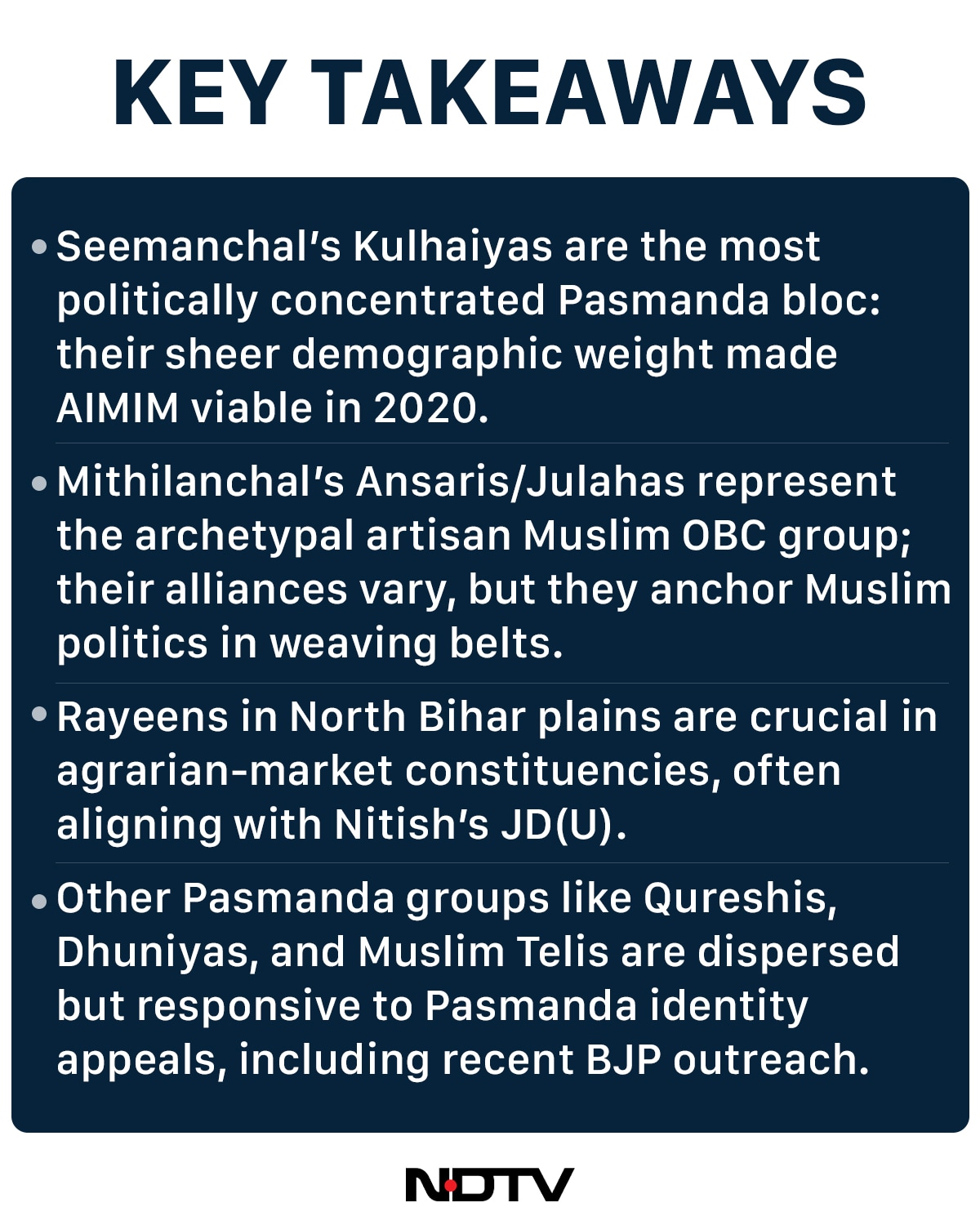
These social divisions carry status, marriage rules, and often local influence. In recent decades, a political vocabulary - 'pasmanda' (literally 'the left-behind') - brought together ajlaf and arzal claims into an assertion of backwards-class identity demanding redistribution and representation.
Why does this matter politically? Because the 'pasmanda' identity reframes some Muslims as socio-economically disadvantaged groups who can be courted through OBC/benefits narratives rather than only communal appeals. Parties that promise reservation-style benefits, jobs, or dignity to these groups can sometimes pierce what looks like religious solidarity and win votes based on caste/benefit politics.
How the 'myth of the Muslim vote-bank' shatters under inspection
The myth collapses under inspection, not because Muslims are capricious but because their choices are structured by caste, by region, by local brokers, by their numbers in the particular constituency, and by national moods. Three short conclusions:
- The Muslim electorate is internally differentiated. Ashraf/ajlaf/arzal hierarchies and 'pasmanda' identity politics mean that different segments have different priorities. Any strategy that treats Muslims as a monolith will fail both empirically and politically.
- Numbers matter - and so does geography. In Seemanchal, concentrated Muslim numbers allow a distinct political actor (AIMIM) to win and to reshape competition. Elsewhere, dispersed demographics mean local bargains and caste-based outreach (Nitish's JDU, some BJP moves) determine outcomes.
- National narratives overlay local realities. Since 2019 Muslim voters have been consolidating against BJP at the national level, but that national mood is filtered by local caste hierarchies and clientelist networks. 'Pasmanda' voters - concerned with reservation, jobs and dignity - sometimes respond to OBC-style outreach by difference-seeking parties (JDU, BJP's targeted programs), even while the broader anti-BJP sentiment remains potent in other constituencies.
A last, small human image
Consider a single face of a common man: the commuter, the tea-seller, the pilgrim, who is at once ordinary and emblematic.
If you stand in Glesan Bazaar in Madhubani, someone will tell you a community's vote is about bread, about a schoolteacher for a child, about a shivala or a madrasa's uncertain grant - not a vote printed with a communal stamp.
In Kishanganj, the same voter will be speaking from a history of numbers and fear of exclusion because of the Special Intensive Revision conducted hurriedly by the Election Commission.
In both places, the same electorate is doing what voters always do: weighing present goods, past grievances, and future anxieties.
So, the 'myth of the Muslim vote-bank' is not so much false as incomplete. It is a half-map that leaves out the contours of caste and region that actually make up the political terrain.
To parse Bihar's Muslim vote is, therefore, to read several maps at once - the caste map, the regional map, their numbers in the constituency and the national mood - and to remember always that political life unfurls in kitchens and in mosques as much as it does in electoral arithmetic.
-
3 Minutes, 6 Stanzas, Century-Old Debate: The Many Turns In Vande Mataram's Journey

PM Narendra Modi launched a year-long commemoration of the song's 150th anniversary on November 7, 2025. In December, both Houses held special discussions on it, during which the 1937 Congress decision was scrutinised.
-
Indian Family Wipeout Over iPhone: The Dangerous Lure Of Consumer Tech Debt
Young buyers walk into physical retail stores, hand over basic identity documents and walk out with a consumer electronic device that costs more than their entire family's monthly take-home income
-
China Outspends India In Space, But New Delhi Holds The Trust Card
The US remains the undisputed leader in the global space race. But it's realistic for India to aim for the third place, says Bellatrix Aerospace COO.
-
It's About The Provenance: Head Of Strategy Koreel Lahiri Decodes One Identity Of NDTV
We at NDTV consciously recognise the fact that the same consumer inhabits several screens during the course of a day.
-
Opinion | India's UPI Miracle Has Created A Difficult, Rs 20,000-Crore Question
UPI's whole magic was the Rs 30 payment it charged nothing for. But how long can it stay free?
-
Opinion | Manmohan Singh, Bachchans, And Other Secrets Of 10 Janpath: The Sonia Gandhi Story
She entered politics reluctantly, mastered its power games, chose Prime Ministers, and managed betrayals. Congress's most powerful woman finally tells the world how.
-
Opinion | Why The Congress-Samajwadi 'Merger' Fantasy Could Be Opposition's Biggest Self-Goal
Rahul Gandhi and Akhilesh Yadav do not need to become one another. They need to become better at being themselves, together.
-
Opinion | Mumbai's 'Marathi' Test For Cabbies, And The Art Of Fixing The Wrong Problems
All these years, India's financial capital has worked just fine without a Marathi mandate for its taxiwallahs. Whose problem is the new language rule actually solving now?
-
Opinion | Rs 1.05 Lakh Crore Lost: Inside The Dangerous Rise Of India's Gen Z Stock Traders
Investors under 30 now account for 37.9% of the total investor base in India. But they are also losing money at a much higher rate. Why are they doing it?




-
News Updates
-
Featured
-
More Links
-
Follow Us On
