The Importance Of Being Nitish Kumar In Bihar
In Bihar's ledger of seasons, Nitish Kumar's career reads like a long monsoon: the early downpour of 2005-10, the pause and reversal of 2014-15, the fitful showers since.
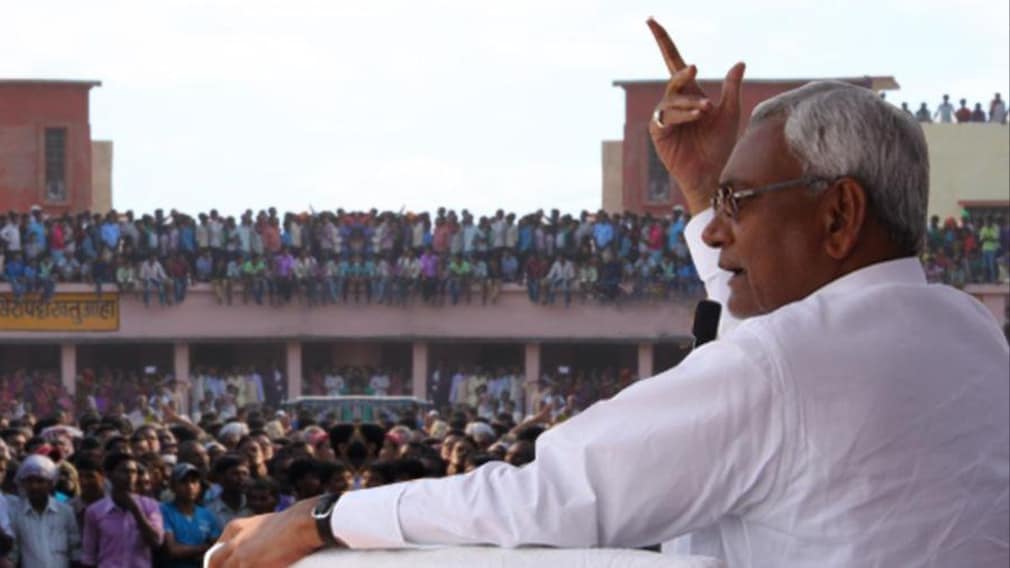
In the north of India, where the Ganga and its tributaries (Gandak, Kosi, and Kamala) bend themselves into languid curves across the plains of Bihar, Nitish Kumar has, for two decades, been the steady custodian of a land accustomed more to tumult than to calm. Since 2005, when he wrested Bihar from the long shadow of Lalu Prasad Yadav, Nitish Kumar has remained the fixture-sometimes the anchor, sometimes the irritant, often the last survivor-of a state that has seen its sons leave in millions to seek work elsewhere. If the Hindi heartland has been defined by flux, Bihar has had, for better and worse, the continuity of Nitish Kumar.
To look at Nitish Kumar on the eve of another election (November 2025) -his eighth contest as chief ministerial face-is to witness a paradox. He is the longest-serving Chief Minister of Bihar, a man 20 years in power, and yet he is still spoken of as "swing factor," "kingmaker," "survivor." Unlike the towering majoritarian leaders of our time, Nitish has been more the quiet craftsman, reshaping alliances, recalibrating loyalties, remaining always just enough in power without allowing himself the indulgence of permanence.
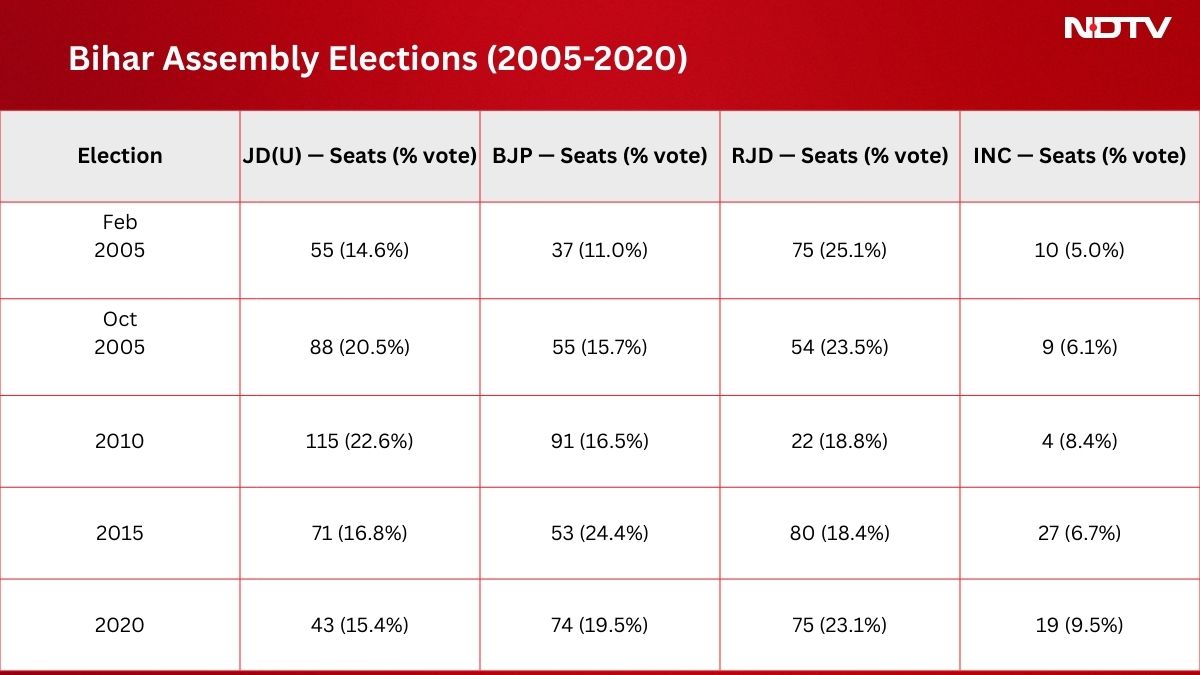
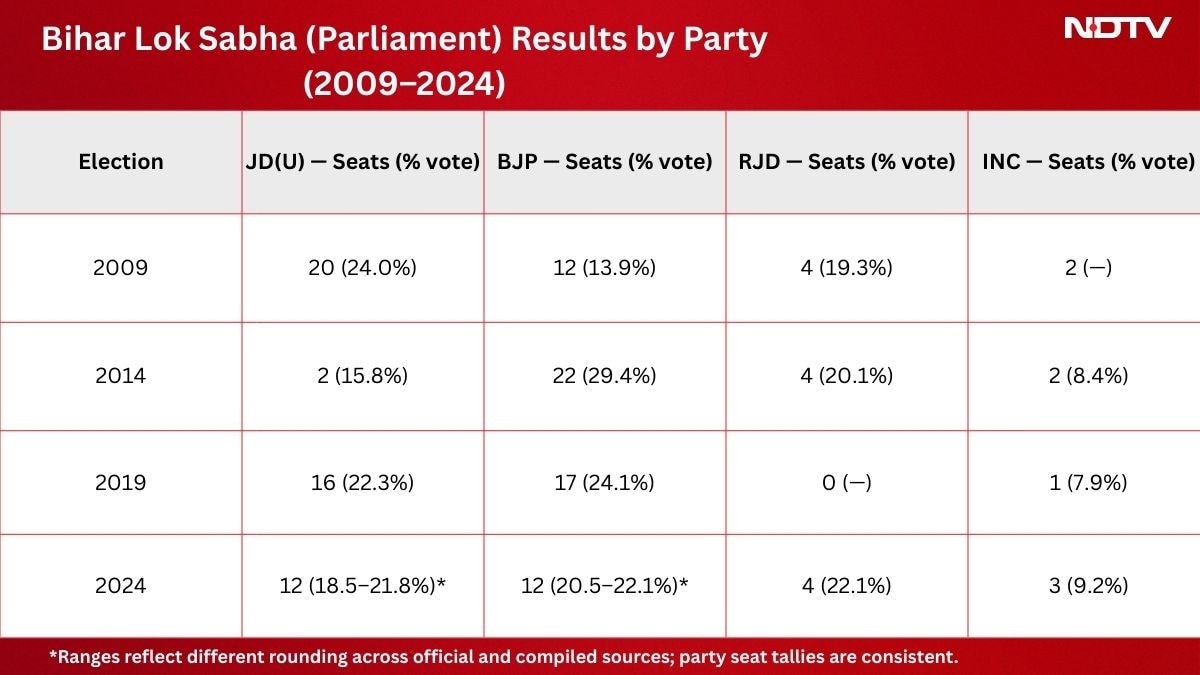
In Bihar's ledger of seasons, Nitish Kumar's career reads like a long monsoon: the early downpour of 2005-10, the pause and reversal of 2014-15, the fitful showers since. The numbers, squared into tables, carry their own poetry. In 2010, Nitish is the state's central metaphor-115 seats for JD(U), roads and classrooms as quiet revolutions, cycles and computers for girls, 50 per cent seats reserved for women in panchayats. By 2015, he trades solitude for a chorus with yesterday's rivals; it works-until the melody frays. In 2020, he returns with the alliance intact but the spotlight elsewhere-BJP 74, JD(U) 43-a veteran now more conductor than soloist.
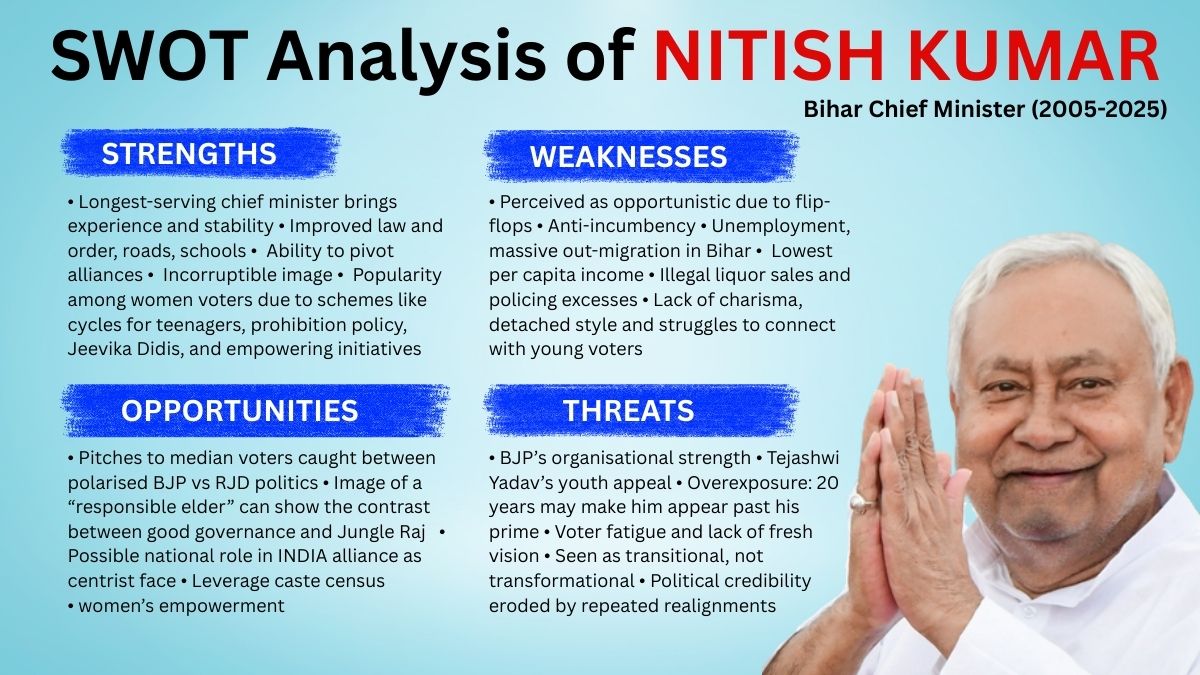
And so, a SWOT analysis of Nitish Kumar is less a business school exercise than a meditation on how endurance can be its own ideology.
Strengths: The Engineer's Eye for Governance
Nitish's greatest strength lies in the perception-part reality, part legend-that he is the engineer-turned-politician who restored governance to Bihar. When he came to power in 2005, Bihar was synonymous with lawlessness, the caricature of "jungle raj." Nitish's early years were defined by bringing back a sense of order: roads that could be driven upon, street lights that actually lit, teachers who turned up in schools, policemen who patrolled. In a state used to despair, this was near-revolutionary.
Why Women Voters Adore Nitish Kumar
According to a recent InkInsight Opinion poll, 60.4 per cent of women are likely to vote for the Nitish Kumar-led NDA, while only 28.4 per cent may choose the Tejashwi Yadav-led Mahagathbandhan. Around 45 per cent of women surveyed said they want Nitish Kumar as the Bihar Chief Minister, while around 31 per cent said they want Tejashwi Yadav as the Chief Minister. Nitish Kumar has a massive 32 per cent Gender Gap advantage over his nearest rival. In the quiet charisma of Nitish, many women see not just a leader, but a partner in their journey toward empowerment and equality. As they cast their votes, they are not merely participating in a democratic exercise; they are affirming their agency in the narrative of Bihar's unfolding story.
There is also Nitish Kumar's survival instinct, which in Indian politics is not an accident but a strength. Nitish has switched partners-allying with the BJP, breaking away, returning, joining the Mahagathbandhan with RJD and Congress, then swinging back again-all with a remarkable ability to explain his moves as "necessity" rather than "betrayal". His critics, especially RJD leader Lalu Prasad, call him the classic "Paltu Ram," (The Ideological Switcher). In a world of shrill ideological certainties, Nitish has thrived as the pivotal player, the pragmatic centrist. His USP has always been "sushasan" (good governance) rather than ideology, and that has allowed him to pivot without collapsing.
Finally, there is his persona itself-low-key, uncharismatic in the conventional sense, but serious, austere, incorruptible in the public imagination. Nitish never sought to be a mass orator; he sought instead to be the quiet administrator. For a state weary of bluff and bluster, that sobriety was reassuring.
Weaknesses: Fatigue Of Power, Fragility Of Conviction
Yet longevity exacts its price. What once looked like pragmatism now appears as opportunism. The endless flip-flops from BJP to RJD to BJP again, and perhaps elsewhere tomorrow-have left him looking less like a statesman and more like a weathervane in Patna's political storm. If strength is survival, weakness is the manner of that survival. Nitish today is seen as someone who cannot win alone, who depends on coalitions to remain relevant.
There is also the unmistakable fatigue of incumbency. Two decades in power have eroded the freshness of Nitish's early years (2005-2010). The roads are better, yes, but employment still bleeds away to Delhi, Punjab, and Mumbai. Bihar's per capita income lags most Indian states. Nitish's prohibition policy, once touted as moral reform, very popular among women voters, has been plagued by black markets, police excesses, and daily hypocrisy.
Even his personal aloofness-once an asset against the rough-and-tumble of caste politics-has begun to look like detachment, an inability to connect with the younger voter who seeks energy, not reserve. Nitish is a man of the 2000s still trying to command the 2020s.
Opportunities: The Middle Ground In A Polarised Time
Nitish's opportunity lies in his old instinct: the middle path. In an India increasingly polarised between Hindu nationalism and regional populism, Nitish still occupies a space of moderation. He speaks, however cautiously, about caste census, about women's reservations, about social justice, while also being acceptable to Hindutva forces when expedient. If the 2025 Bihar elections fracture sharply between BJP and RJD, Nitish could again be the "hinge"-the indispensable man around whom coalitions form.
He also has the opportunity of memory. For many in Bihar, Nitish is still the man who restored dignity to governance after the collapse of the 1990s. If he can revive that narrative-remind voters of what he once brought-he may yet hold his ground as the responsible elder in a noisy family feud. As a poor rickshaw-puller, Mahesh from the Paswan community, proudly told me on my recent visit to Bihar: "Vikas hi Nitishji ka pehchan hai," (Nitish Kumar's identity fication is Development and Governance).
Nationally, with the INDIA Bloc searching for a consensus face, Nitish's non-threatening, centrist, "acceptable-to-all" profile remains a card not fully played. He could never be Narendra Modi, but he could be the anti-Modi by stealth: modest, grounded, low-key.
Threats: The March Of Time, The Rise Of Rivals
Today, the threats crowd in. Time itself is Nitish's greatest adversary: after 20 years, even good governance sounds like an old song. Tejashwi Yadav has youth on his side, the BJP has organizational muscle, and Nitish is stranded in between, too weak to dominate, too necessary to discard.
His constant political switches threaten to alienate not just allies but voters who no longer know what Nitish stands for. The more he moves, the less he appears to move forward. And in a political culture increasingly dominated by charisma, social media presence, and mass rallies, Nitish's restrained style feels anachronistic.
There is also the threat of being remembered as a transitional figure: the man who kept Bihar afloat but could not propel it into prosperity. Although the state GSDP has crossed double digits for quite a few years during its two decades, Bihar, compared to other states, by most economic indicators, remains at the bottom of the heap. The culturally diverse state with a glorious history of more than 2,000 years, stretching to the Mauryas, the Guptas and the iconic King Ashoka, Bihar, despite all attempts by the Nitish government, seems stuck in a time-warp, what economists call "The deadly trap of low equilibrium".
Coda: The Survivor's Solitude
To watch Nitish Kumar in 2025 is to watch a survivor in a time of emperors. Modi dominates Delhi, Mamata commands neighbouring Bengal, Yogi Adityanath appears like a regional hegemon in Uttar Pradesh, other regional satraps roar in their fiefdoms. Nitish, however, remains the quiet, solitary figure, engineering his alliances as carefully as he once engineered bridges. His strength is his sobriety; his weakness, his lack of fire. His opportunity remains the middle ground; his threat - time.
In the end, the SWOT analysis collapses into a single paradox: Nitish Kumar is indispensable, yet dispensable; central, yet peripheral; always there, yet never quite commanding the stage. Perhaps this is not a weakness at all, but the very secret of his endurance. Like the Ganga flowing through his state, Nitish Kumar does not seek to dazzle; he seeks only to continue. And in Bihar, continuation itself has been a revolution.
-
Opinion | Building BRICS In New Delhi

For India as the host nation, chairing the summit tests the core tenet of its modern foreign policy: strategic autonomy.
-
Can India 'Mediate' Between Iran And UAE At BRICS? Gulf Envoy Suggested It Once
At the very start of the Israel-US war on Iran, it was a UAE diplomat who had suggested as much.
-
Opinion | When The Feed Braves The Flood
NDTV drops the 24x7 and stakes its next chapter on presence as it inaugurates a new identity
-
I Went Looking For A PG In Delhi's Kamla Nagar. Here's What I Found
In every PG visited by NDTV in Delhi's Kamla Nagar, the conversation began with amenities. Nothing in the sales pitch was about how secure the building was.
-
Opinion | How Trump Is Doing More For BRICS Than Its Critics Ever Could
By trying to bully BRICS countries into submission, Trump may be giving the grouping the very relevance he is trying to deny
-
Opinion | BRICS Has Grown Up. Now It Must Behave Like An Adult
The India-China accommodation will be a key driver of the grouping, but a 'non-Western' agenda will work well only if it focuses on ending global conflict as much as on stabilising the global economy
-
Opinion | 9/11, And The Price Of Fighting Terror For A Quarter Century
Twenty-five years later, 9/11 is more than just a lived memory for those who witnessed it in real time, as I did as a UN official
-
Opinion | US Can Threaten, Not Dictate: What India's Iran Message Really Means
If India's Bishkek message was a signal to the US, then Pezeshkian's arrival in New Delhi for BRICS will be a defining note: that India's strategic autonomy is not up for debate