Why BJP's 'Double Engine' Needs Nitish Kumar In Bihar: A SWOT Analysis
This dilemma - needing Nitish's coalition arithmetic while chafing at his dominance - has defined the BJP's Bihar odyssey.
In the vast, sun-scorched plains of Bihar, shaped like a griddle, where the Holy Ganges and its tributaries (Ghaghara, Gandak, Kosi, Kamala, Sone and Baghmati) meander like a weary traveller through fields of mustard and rice, verdant orchards of Digha Malda mangoes and Shahi lichees, politics unfolds not as a straight path but as a labyrinth of alliances, betrayals, and unfulfilled promises. It is a land where the air hums with the distant rumble of trains - those iron serpents that stitch the subcontinent together - reminding one of progress's relentless churn.
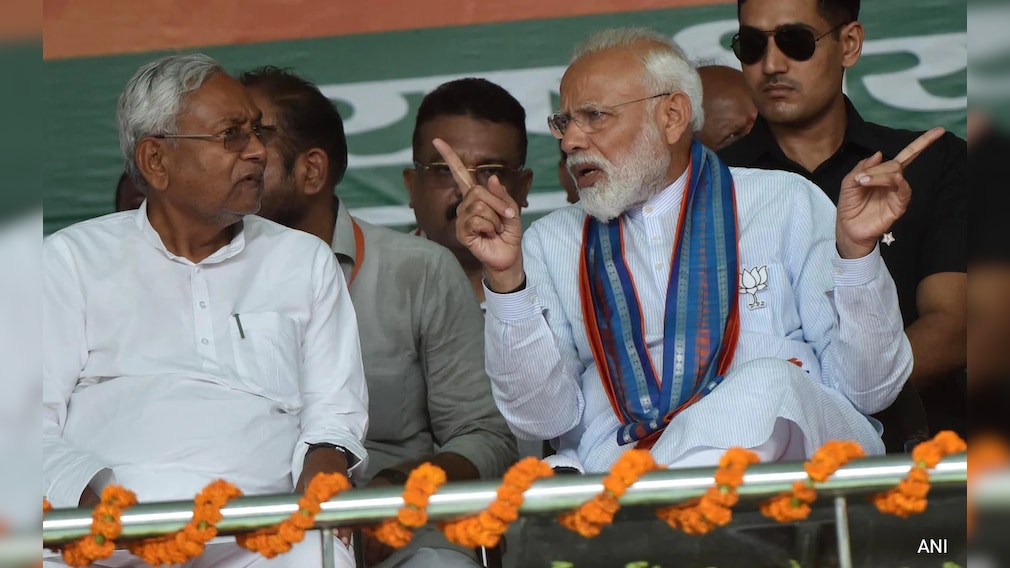
Yet, for the Bharatiya Janata Party (BJP), the metaphor of the "double engine" government so triumphantly invoked by Prime Minister Narendra Modi to signify synchronised power at the Centre (Delhi) and state (Patna), rings with a cruel irony. In Bihar, over the last two decades, the BJP has never truly been the locomotive engine pulling the train forward; it has been, at best, a faithful carriage, hitched to the unpredictable engine of Nitish Kumar's Janata Dal (United). This dependency forms the heart of the party's enduring dilemma: a national giant reduced to a regional supplicant, forever chasing stability in a state where loyalty shifts like the course of the Ganges during monsoon floods.
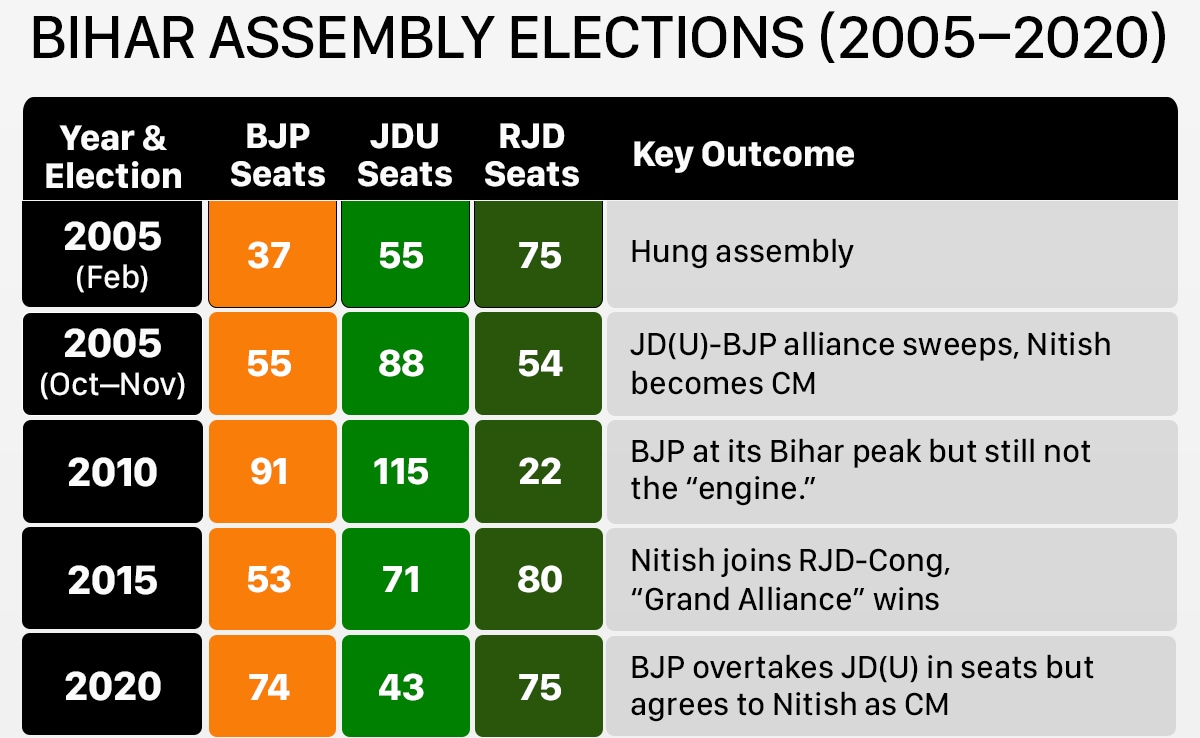
Picture the scene in 2005, when Nitish Kumar first ascended to the chief minister's chair, ending the long shadow of Lalu Prasad Yadav's Rashtriya Janata Dal (RJD) rule. Bihar, then synonymous with "jungle raj"-a term evoking lawlessness and decay-found in Nitish a pragmatic reformer. Roads were paved, electricity flickered to life in forgotten villages, criminals were incarcerated, and law and order improved dramatically. A semblance of governance emerged from the chaos. The BJP, sensing opportunity, allied with JD(U), providing the saffron muscle to Nitish's developmental blueprint. Together, they stormed to victory in 2010, with the NDA claiming a landslide. But even then, the engine was Nitish's: his "Sushasan Babu" (good governance man) image propelled the coalition, while the BJP played second fiddle, content with deputy roles and ministerial berths. Narendra Modi's rise as Gujarat's chief minister was still a distant echo; in Bihar, the narrative was local, rooted in caste equations and Nitish's deft balancing of Kurmi, Koeri, Extremely Backwards Classes (EBCs), and Mahadalit votes.
Biharis vs Baharis In 2015 Turfed BJP
The alliance fractured in 2013 over Modi's prime ministerial ambitions, which Nitish deemed too polarising for Bihar's secular fabric. Nitish broke away, only to realign with the RJD in 2015, forming the Mahagathbandhan that humbled the BJP in assembly polls. The main slogan that won the election was "Biharis vs Baharis" (insider Biharis vs Outsiders). Yet, by 2017, ideological rifts - Nitish's discomfort with Lalu's corruption scandals - drove him back to the NDA fold. This "Paltu Ram" (turncoat) reputation, as critics dubbed him, underscored the BJP's predicament: Nitish was indispensable for navigating Bihar's fractured caste mosaic, yet his volatility made every partnership a gamble.
The 2020 elections crystallised this: despite the BJP winning more seats than JD(U) - 74 to 43 - Nitish retained the CM post, a concession that chafed party cadre. The "double engine" slogan, meant to evoke seamless synergy, instead highlighted the asymmetry: Modi's national firepower bolstered the alliance, but locally, the train chugged on Nitish's steam. As one observer noted, the JD(U)-BJP tandem had "lost its steam," burdened by governance lapses and anti-incumbency.
There is something almost cruel in this arrangement. Elsewhere, the BJP is the dominant force, dictating alliances and scripting leadership arcs. In Uttar Pradesh, it transformed Yogi Adityanath into a national figure; in Madhya Pradesh, it ushered Shivraj Singh Chouhan into the cockpit. But Bihar has been the BJP's unsolved riddle: it has power, but not authority; votes, but not roots; a Prime Minister to campaign for it, but no chief ministerial face to embody its aspiration.
Loss Of Sushil Modi, BJP's Only Anchor
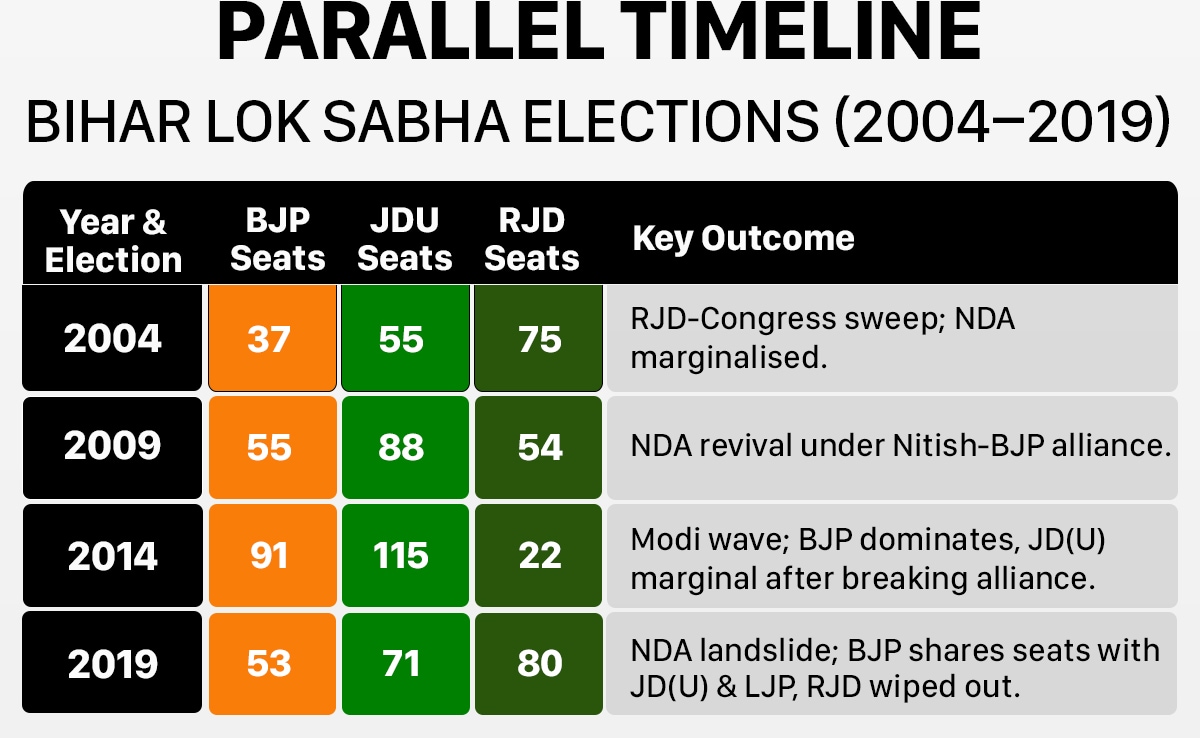
The death of former-BJP leader, the late Sushil Kumar Modi, on May 13, 2024, marked a poignant turning point, stripping the BJP of its most enduring Bihar anchor. Sushil, a soft-spoken RSS veteran shaped by the JP movement, had been the party's face in the state for over three decades. He orchestrated the NDA's architecture, serving as deputy CM and finance minister multiple times and acting as the vital bridge to Nitish. His passing left a void: no "tall leader" to match his stature, no one to smooth the frictions of alliance politics.
Sushil Modi's passing away was more than the departure of a man - it was the quiet burial of a certain equilibrium. For decades, Sushil Modi had served as the BJP's interlocutor with Nitish Kumar, a man comfortable in the shadows, shaping the alliance like a trusted accountant who never seeks the corner office. His absence has revealed the BJP's hollow bench.
No Match For Nitish Kumar's Survival Tactics
The younger generation of BJP leaders - Nitish Mishra (son of former Congress chief minister, late Dr Jagannath Mishra, UK-educated and polished, or Nityanand Rai, earnest but not towering - remains a promising apprentice rather than a commanding figure. Dilip Jaiswal and Samrat Choudhary carry the OBC credential, but credibility remains elusive. BJP leaders like Ashwini Choubey, Ravi Shankar Prasad are already in their early 70s and from the so-called upper castes: not the right material for a future Chief Minister's post. Younger BJP leaders who have been cabinet ministers at the Centre, like Rajiv Prasad Rudy or Shahnawaz Hussain, have never found a firm foothold in Bihar. They all pale into insignificance compared to Nitish Kumar. None of them can match Nitish Kumar's paradoxical blend of self-effacing humility and ruthless survival.
So the BJP keeps returning to Narendra Modi, borrowing his charisma like a torch in a cave that it has never learned to map. Each election rally becomes a referendum on the Prime Minister's magnetism rather than the party's own state architecture. The cruellest irony is this: the BJP in Bihar is more a franchise than a family, more a branch office than a headquarters.
"Modi Factor" Only Artillery
Election after election, the BJP has doubled down on Prime Minister Modi's charisma - the "Modi factor" - using his rallies like artillery barrages to rally the faithful. Yet, this reliance exposes the core cruelty: in a state where politics is intensely personal and caste-bound, national stardom alone cannot forge lasting roots. Bihar demands a local helmsman, and without one, the BJP remains tethered to Nitish, even as his popularity wanes amid perceptions of silence and bureaucratic captivity.
And yet, the BJP has never been absent. It has been indispensable in every coalition since 2005. Its organisational stamina, its disciplined cadre, its ideological clarity - all have kept the saffron flame alive. But as the 2025 assembly elections loom, the party's central dilemma resurfaces: how long can it ride Nitish Kumar's engine without ever learning to drive?
This dilemma - needing Nitish's coalition arithmetic while chafing at his dominance - has defined the BJP's Bihar odyssey. Nitish's frequent flips, from anti-Modi crusader to NDA stalwart, force the party into perpetual negotiation. Why cling to him? Because Bihar's electorate, fragmented by castes like Yadavs (RJD's base), EBCs, and upper castes (BJP's core), rewards alliances over solo runs. Alone, the BJP risks dilution; with Nitish, it gains a veneer of inclusivity. But the cost is autonomy: the "double engine" becomes a single track, dictated by JD(U)'s whims. As 2025 looms, whispers of Nitish's retirement, his fragile health, add layers of uncertainty, leaving BJP leaders in Delhi huddled with Amit Shah, plotting seat shares and contingencies. The party eyes more seats - perhaps equal to JD(U)'s - hoping to leverage its 2020 edge, but the ghost of dependency lingers.
On the eve of the 2025 assembly elections, this quandary crystallises in a SWOT analysis of the BJP's position in Bihar:
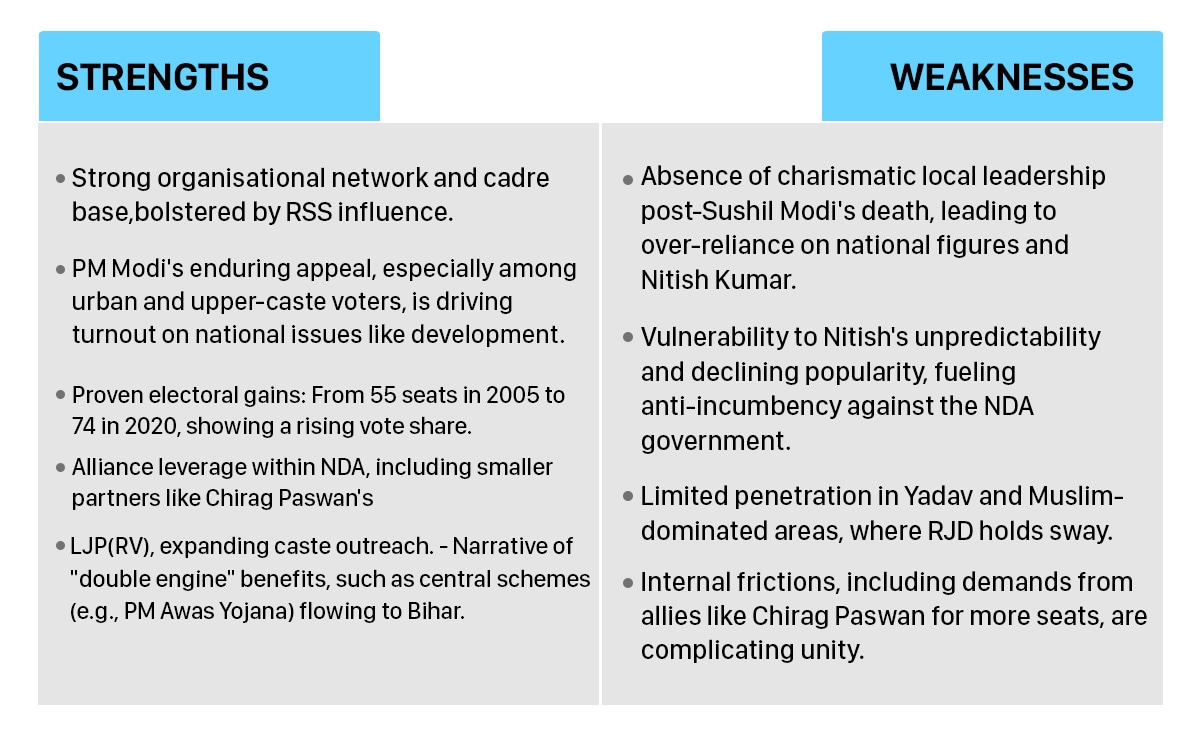
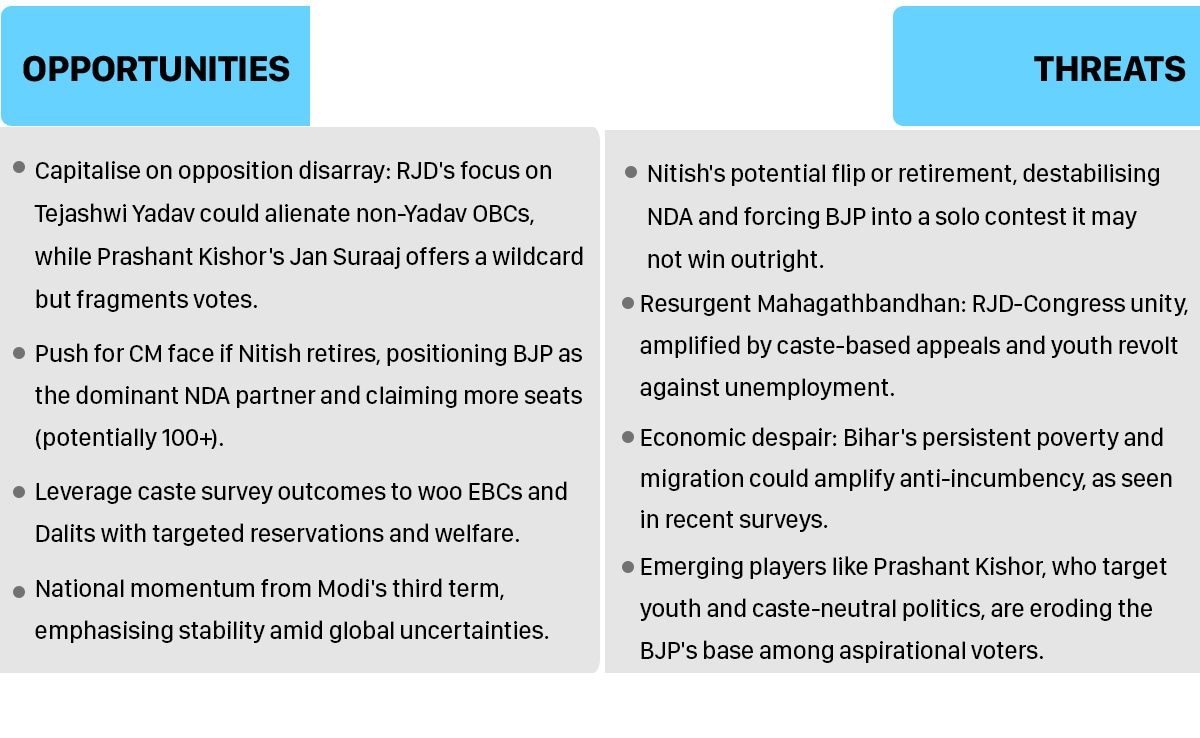
In this SWOT mirror, the BJP's Bihar story reflects a broader Indian paradox: the tension between national ambition and regional reality. Like a traveller on Bihar's endless rails, the party hurtles forward, but always as a passenger, dreaming of the day it seizes the controls. Yet, in the cruel calculus of politics, such dreams often dissolve into the river's mist, leaving only the echo of engines straining against the tide.
-
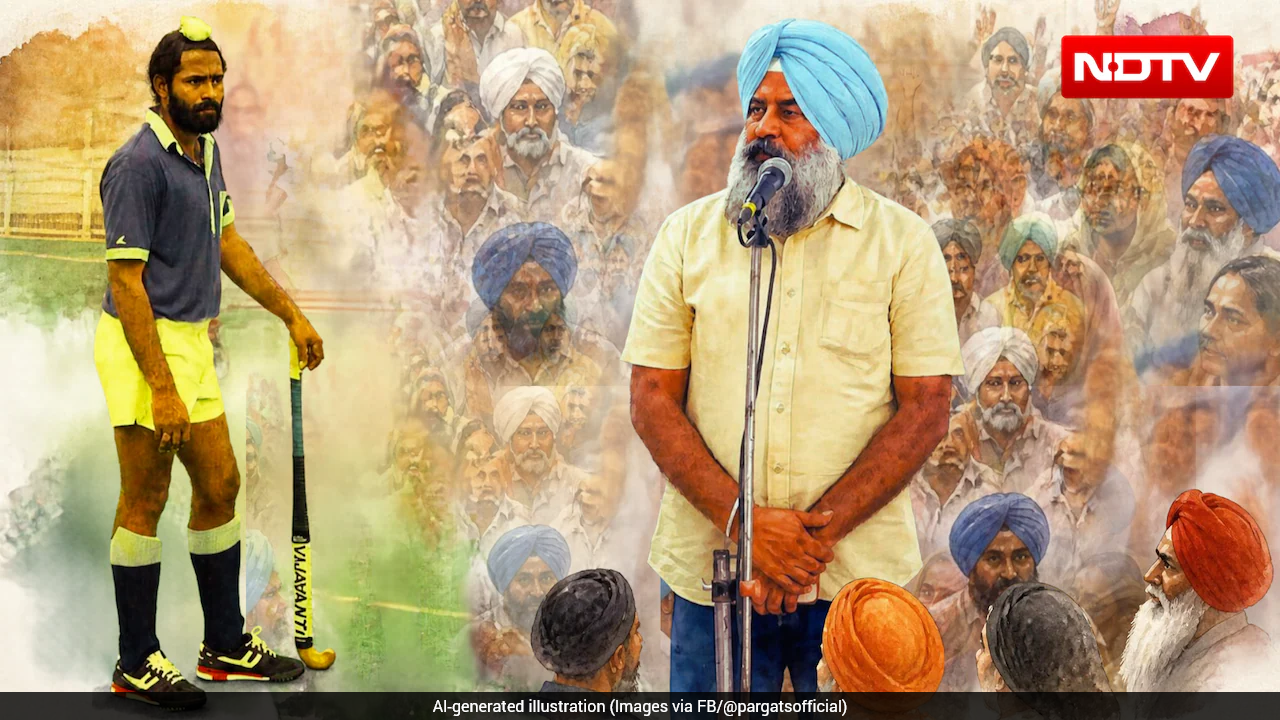
Congress Falls Back On A Fullback: Where Pargat Singh Fits In The Punjab Poll Play

Vijay Inder Singla, a Hindu face, was reportedly the frontrunner before the Congress replaced one Jat Sikh with another as its Punjab unit chief. How far does such arithmetic work in the state's politics? Pargat's appointment holds some of the answers.
-
Why Doesn't Congress Boycott If Polls Are "Fixed"? Answer Lies Beyond Rahul Gandhi's "Distraction" Quip
The starkest demand for a boycott has come from outside the political Opposition, from the Cockroach Janta Party. But does a boycott help? Here's what research, examples, and expert analysis tell us.
-
'Sully' To Gimli, Sioux To Patna: When Pilots Got It Unbelievably Right
Captain Smit Machchhar fought off his co-pilot after being stabbed and opened the cockpit door, saving 174 people.
-
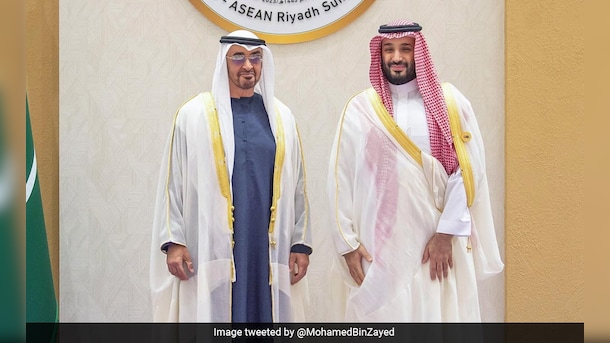
Opinion | Are Saudi Arabia And UAE Reuniting Again After 10 Years?
On Tuesday, the UAE's Vice President, Deputy Prime Minister and Chairman of the Presidential Court, Mansour bin Zayed, met Saudi Crown Prince Mohammed bin Salman.
-
Opinion | 'Lies, Damned Lies, Statistics': On The Controversy Around India's GDP Growth Figures
The debate is less about a single figure than about a decade-long erosion of trust in official statistics.
-
Opinion | Why India Cannot Keep 'Overestimating' Its Value To Washington
Some of India's value to Washington came from the tension between the US and China. That is changing now.
-
Opinion | India Has A 'Lobbying' Problem In Washington, And It Has Come Back To Haunt It
While the EU, Japan, the UK and South Korea secured quick deals, India's efforts were getting drained in prolonged negotiations and the wrong kind of lobbying.
-
India Is Getting Old Before Getting Rich, Will Turn 'Aged' In 16 Years: Moody's
Countries with the steepest fertility declines today will age the fastest in the coming decades. India's drop has been steep.
-
Opinion | Why Does Trump Want To Sell Arms To A US 'Adversary'? Inside His Strange Bargain
Trump's aides maintain that no such offer had been made. But the story points to a larger strategy