Bollywood Has A 'Partition Curse'. Will Batwara 1947 Break It?
Batwara 1947 doesn't have to choose between the Gadar audience and the serious Partition-film audience.
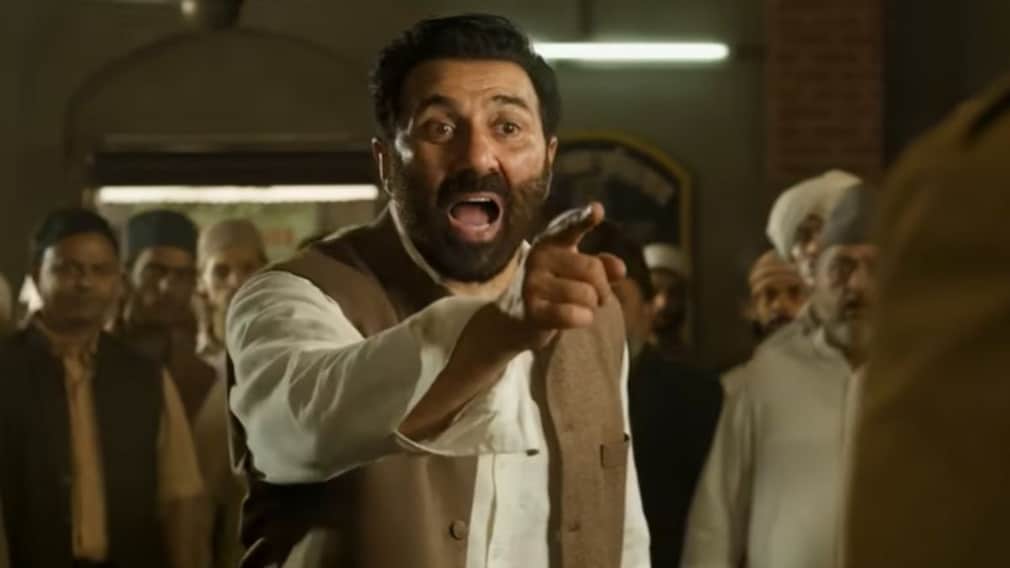
On paper, Batwara 1947 has everything going for it. Sunny Deol is enjoying a major career revival as a leading man. He has reunited with writer-director Rajkumar Santoshi, his partner on classics like Ghayal, Ghatak, and Damini. To this day, the roaring dialogues from those films are still part of Bollywood pop culture.With Aamir Khan producing and AR Rahman and Javed Akhtar on music and lyrics, Batwara 1947 has plenty of star power. Yet, the buzz around the film has been surprisingly muted.
Bollywood has a "Partition curse": Hindi audiences have rarely embraced films that directly confront the trauma of 1947. Big or small, artsy or commercial, nearly every film centered on the Partition trauma of 1947 has flopped at the box office. The lone exception remains Sunny Deol's own mega-blockbuster Gadar (and its massive 2023 sequel), which proved that perhaps audiences will embrace Partition only when historical grief is turned into a larger-than-life victory, preferably with uprooting a hand-pump thrown into the mix.
Even the recent, miraculous box-office fightback of Imtiaz Ali's sublime Main Vaapas Aaunga seems to prove the rule. Despite a herculean effort by Ali and a groundswell of deeply moved, viral word-of-mouth, the film remains far from a commercial blockbuster., Now, while the trailer for Batwara 1947 tried to mimic Gadar's roaring, high-decibel energy, the expected hype has simply failed to catch fire.
Why Do Partition Stories Struggle At The Box Office?
Bollywood's archive of Partition films is full of artistic triumphs that suffered brutal box-office deaths. MS Sathyu's landmark Garm Hava captured the quiet heartbreaks of Partition. Balraj Sahni gave a career-defining performance as a patriarch torn between staying in India and leaving for Pakistan. Deepa Mehta's 1947: Earth, starring Aamir Khan, told the chilling story of friendships and communal violence in Lahore.
Chandra Prakash Dwivedi's Pinjar (2003), based on Amrita Pritam's novel, confronted the brutal abduction and suffering of women during the Partition riots. Pamela Rooks' Train to Pakistan (1998), adapted from Khushwant Singh's novel, offered an equally grim portrait of communities torn apart by the newly drawn border.
Recommended


Even when packaged for mass appeal, the Partition backdrop couldn't break the curse at the ticket counter.
Kamal Haasan's ambitious Hey Ram (2000), featuring Shah Rukh Khan, attempted to wrap the bloody politics of 1947 inside a star-studded revenge thriller. Years later, Vidya Balan's Begum Jaan (2017) tried a more overtly commercial approach, turning the horrors of Partition into a high-decibel, gun-toting drama with plenty of mass appeal. Yet neither film managed to turn its Partition setting into box-office success.
Beyond the Partition backdrop, these films share one striking fact: whether they won National Awards, earned critical acclaim or became cult classics years later, every one of them failed at the box office.
Partition's Grief Vs Glory
The question may not be whether audiences care about Partition, but how the story is told. That brings us back to Gadar, Hindi cinema's solitary Partition blockbuster. Perhaps it cracked the code by understanding that mass audiences want triumph, not just trauma. Gadar used Partition as the backdrop for a larger-than-life fantasy in which one man could fight back against history itself.
Could the box-office curse really be this simple?
Acclaimed films such as Garm Hava, Pinjar and Earth force viewers to sit with displacement, loss, communal violence and, at times, sexual brutality. They show that most people lost their minds and their humanity in 1947. That kind of real-world guilt makes for great award-bait, but it kills popcorn sales dead. They offer zero escape. Their characters are helpless victims of history, not superheroes who can rewrite history.
And perhaps that is the problem.
Perhaps the average moviegoer may not want to spend two or three hours reliving one of the subcontinent's darkest chapters, unless the film also gives them a reason to cheer. Gadar did exactly that. It turned grief into revenge, helplessness into heroism and Partition into a victory fantasy. The question is whether Batwara 1947 can find a similar emotional release without turning its complex human story into another simple good-versus-evil spectacle.
Gadar, by contrast, turned Partition into a playground for the quintessential Bollywood hero. Tara Singh does not merely survives the violence of Partition, he crosses the border, takes on impossible odds and brings his family back home. It turns a tragedy into a hero's victory.
Could the secret also lie in the comforting simplicity of a good old-fashioned cartoon conflict? Gadar neatly took an insanely complex, multi-layered human disaster and reduced it to standard Bollywood grammar: good versus evil, hero versus villain, India versus Pakistan.
Amrish Puri's Ashraf Ali is given the role of antagonist, while Sunny Deol becomes the embodiment of defiance. For an audience conditioned to love a clear, uncomplicated target, isn't a villainous Pakistan far easier to digest than the messy moral ambiguity of Earth or Pinjar, where everyone's hands are dirty? Where there are no uncomplicated heroes or villains?
Throw in a dash of chest-thumping nationalism, chartbuster music, and absurd action, and Partition suddenly becomes a backdrop rather than a depressing burden. That is why the iconic hand-pump scene of Gadar works. It transforms historical trauma into pure cinematic victory. Instead of mourning Partition, the audiences leave cheering for Tara Singh.
That may also explain why Gadar 2 could reproduce the formula two decades later. It offered nostalgia, nationalism, family emotion and a familiar enemy, wrapped around a larger-than-life Sunny Deol performance. So give the crowd a villain to hate, a hero to cheer and a border to smash, and the same history suddenly becomes commercially irresistible. Nuances and historical complexity can go grab a drink at the bar.
Does Batwara 1947 Share The Gadar Vibe? Or Is It Aiming For Something Harder?
Both Sunny Deol and director Rajkumar Santoshi insist that Batwara 1947 is no Gadar, promising a grounded, human story instead, but the trailer occasionally seems to speak a different language.
"Tu mere baap ko nahi jaanta... woh na ghar dekhenge, na sarhad... seedha ghuske maarenge," Sunny's son declares in the film. Another exchange: Villain says, "Panga lena hai?" followed by Sunny's signature - "Iraada toh nahi hai, par aitraaz bhi nahi hai." The voice, the aggression and the unmistakable Deol swagger inevitably recall the Tara Singh template.
But Batwara 1947 could be attempting something far more interesting.
Adapted from Asghar Wajahat's acclaimed 1989 play Jis Lahore Nai Vekhya, O Jamya E Nai (He who has not seen Lahore is not born yet), the film is ultimately about what happens when the politics of Partition collides with ordinary human beings. The story follows a Muslim family (Sunny Deol's) who moves into a haveli in Lahore abandoned by its Hindu owners, only to discover that an elderly Hindu woman (Shabana Azmi) refuses to leave.
The film's central conflict, therefore, isn't simple binary of Hindu versus Muslim or India versus Pakistan. Instead, it is about ordinary people trying to retain their humanity when history gives them every reason to lose it. In doing so, Batwara 1947 could be flipping the familiar Bollywood Partition template on its head.
Here, a Muslim protagonist fights to protect an elderly Hindu woman, establishing that the real enemy is not the person across the border, but the hatred Partition unleashed. At a time when Hindi cinema routinely relies on loud, black-and-white hostility, Batwara 1947 is attempting something harder: making compassion, secularism and basic human goodness work as mainstream drama.
Can it pull that off without losing the high-decibel swagger expected from a Sunny Deol-Rajkumar Santoshi film? That is the big test.
Interestingly, the film may have more to learn from the recent turnaround of Main Vaapas Aaunga than from Gadar 2. The quiet, word-of-mouth miracle of Imtiaz Ali's Main Vaapas Aaunga proves that when a story touches something genuine in the soul, audiences will eventually find their way to it.
Batwara 1947 doesn't have to choose between the Gadar audience and the serious Partition-film audience. If Santoshi can deliver the emotional catharsis of a mainstream Hindi film with the humanity of Wajahat's story, he could have something rare: a Partition film that entertains without reducing the past to a simple good-versus-evil story.
And he has two powerful advantages: Sunny Deol's enduring box-office pull and the proven Deol-Santoshi combination, which should at least give the film a strong opening.
The bigger question is what happens after that. Will audiences embrace a message of compassion, or do they just want another hand-pump spectacle? The box office will have the final word. And history suggests that, when it comes to Partition, the hand-pump usually wins.
Also Read | Awarapan 2 Vs Batwara 1947: Emraan Hashmi Film Leads By 81% In Advance Booking
-
Blog | 'Baap Da Brat': Kerala Mini Cooper Crash, And Why 'Daddy' Can't Keep Saving You

There are three things you should never underestimate in India: the power of 'jugaad', the elasticity of the law, and the confidence of a 'Baap da Brat' who believes his Papa Posh can fix absolutely anything.
-
Opinion | 'Say Our Name': Why A Tiny Island Nation Wants The World To Get Its Name Right
Standing before the UN hall of nations, Naoero President David Adeang asked the world to unlearn its comfortable habits and speak a restored truth.
-
TVS Succession Row Explained: Why Venu Srinivasan's Family Is Divided Over Wealth
TVS Family Dispute: TVS Holdings is a key entity because it owns a controlling stake in TVS Motor Company. It owns 50.26% of TVS Motor.
-
Opinion | The US Is Showing India Just How Cheap Its 'Friendship' Is
Can local talent fully replace Indian contribution? Why is the US leading in setting up Global Capability Centres in India - over 60% - and pocketing the IP?
-
Jantar Mantar Tells Time. The Clock Just Stopped On Its Time As An Iconic Protest Site
On Monday, October 12, 2026, Delhi Police denotified Jantar Mantar Road as a designated site for demonstrations. The Supreme Court had given it a nudge. Here's how history met politics on that street for decades.
-
Opinion | Saudi Airport Attack, And Why Pakistan Keeps Biting Off More Than It Can Chew
For all those who were envious of Pakistan's 'new status' as "mediator extraordinaire", here is a reality check
-
Opinion | Visa Shocks To Racist Attacks, When Did America Come To Hate Indians So?
Sometimes it is about H-1B visas. Sometimes it is jobs. Sometimes it is "foreigners." Sometimes it is about temples. The language of the attack varies, but the message is consistent
-
How El Nino And Warming Oceans Could Shape Earth's Climate In 2027
From changing ocean currents to extreme weather, scientists are watching a combination of climate signals that could influence temperatures, rainfall and ecosystems in the months ahead.
-
Blog | Nana Patekar, And The Sharp, Lasting Sting Of His 'Plain-Speak'
"Subah ghar se niklo, bheed ka hissa bano..." Nana Patekar's characters often spoke with the bluntness of men who had little patience for pretence. Just like Nana himself.