1 War, 3 Bills: UAE's Bailout, Iran's $270 Billion, Trump's Off-Ramp Search
The Wall Street Journal said the UAE has sought a financial guarantee from the US for damage sustained during the war on Iran, a demand that could open Washington to financial contagion, with other Gulf countries joining the queue for payouts.

War is an expensive business. Post-war reconstruction even more so.
The US has spent between $890 million and $1 billion daily since the war began Feb 28. Israel has forked out $11.2 billion overall, so far, with over half - $6.2 billion - in the first 20 days alone.
And post-war costs - on repairing civilian and energy infrastructure in Gulf states like Saudi Arabia - will exceed $60 billion. Of this, $50 billion is just to restore oil and gas facilities, consultants Rystad said.
The UAE has been worst hit among the Gulf states.
Missiles and drones have damaged or destroyed civilian buildings, like The Fairmont The Palm hotel in Dubai, and energy infrastructure, such as the Fujairah oil export terminal that was an outlet for a million barrels of crude per day. Debris also hit two Amazon data centres. The strikes disrupted banking-related cloud services and computing facilities across the region.
Iran Drone Strikes On Data Centres Signal Pivot In Next-Gen Warfare
UAE's backstop push
It is unsurprising, therefore, that the UAE has reportedly opened talks with the US over a financial backstop in case the war continues, which seems likely given lack of progress in peace talks.
According to the Wall Street Journal, last week UAE Central Bank chief Khaled Mohamed Balama sought a currency swap with the US Federal Reserve. Points flagged included damage to oil and gas infrastructure due to Iranian missile strikes.
And the significant loss in dollar revenue due to the Strait of Hormuz blockade.
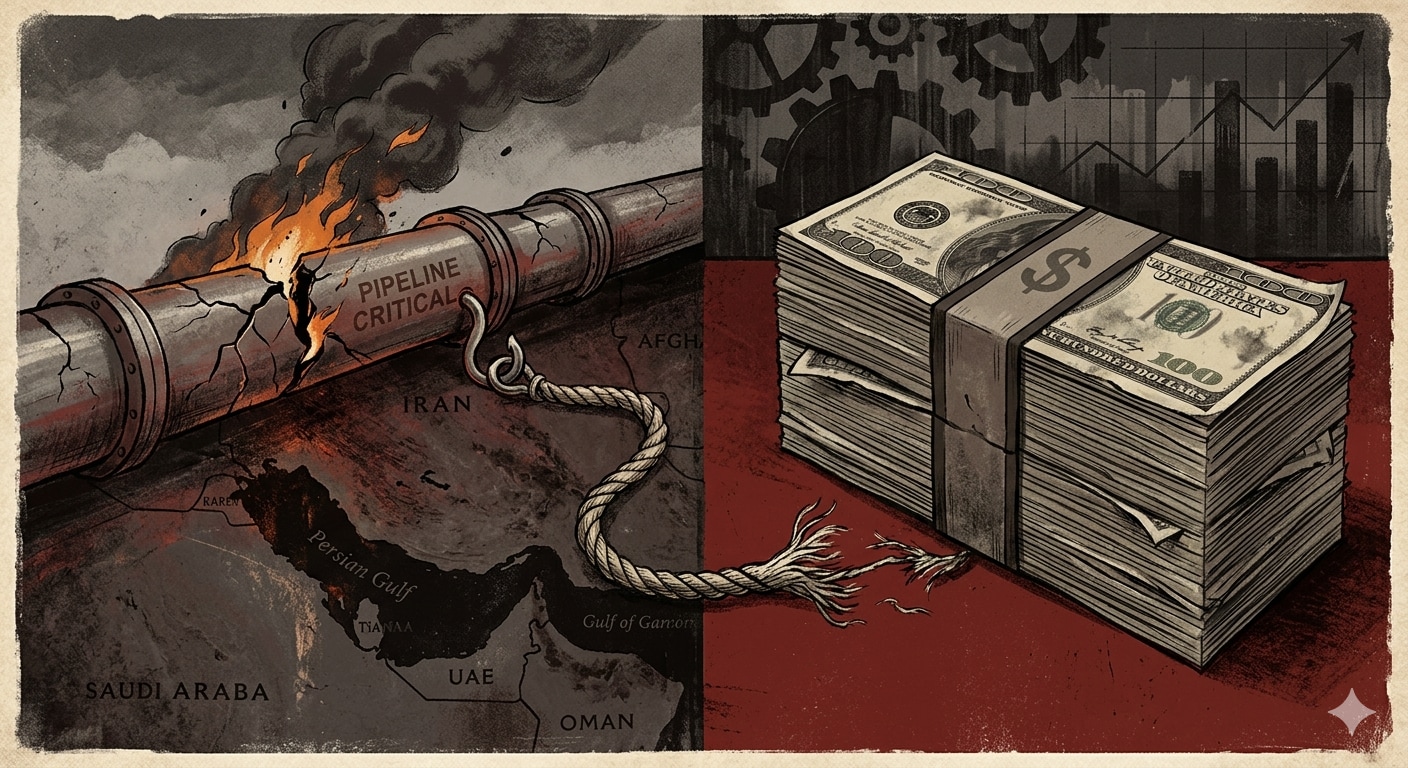
Image generated by AI
A financial backstop is a safety net that sees a major shareholder, or in this case the US, offer a guarantee to offset deeper economic crises because of the fighting.
And a currency swap is an agreement to exchange principal and interest in one currency for those in another. In this case, it could mean the US providing a loan in dollars and the UAE repaying loan and interest in dirham, or a third currency.
No formal request has been made, though informal talks have begun.
Crucially, Emirati officials have pointed to damages from a war the US started without talking to regional allies.
UAE wants US to pay for war
A backstop would be a politically explosive development because the US said March 30 it was considering demanding payments from Gulf nations to fund its war. White House spokesperson Karoline Leavitt told reporters President Donald Trump was "quite interested" in such a plan.
There is precedent for this; in the 1991 Gulf War, Saudi Arabia paid $16.8 billion and Kuwait $16 billion. The US, in fact, only paid an estimated 12 per cent of costs.
The UAE's backstop request, if confirmed, flips this script - i.e., it demands the US pay for the fighting - at a time when there is growing pressure on Trump to find an off-ramp and end a war that has driven the world into an energy crisis and exposed faultlines in US-Europe relations.
This also presents a contagion risk for Washington.
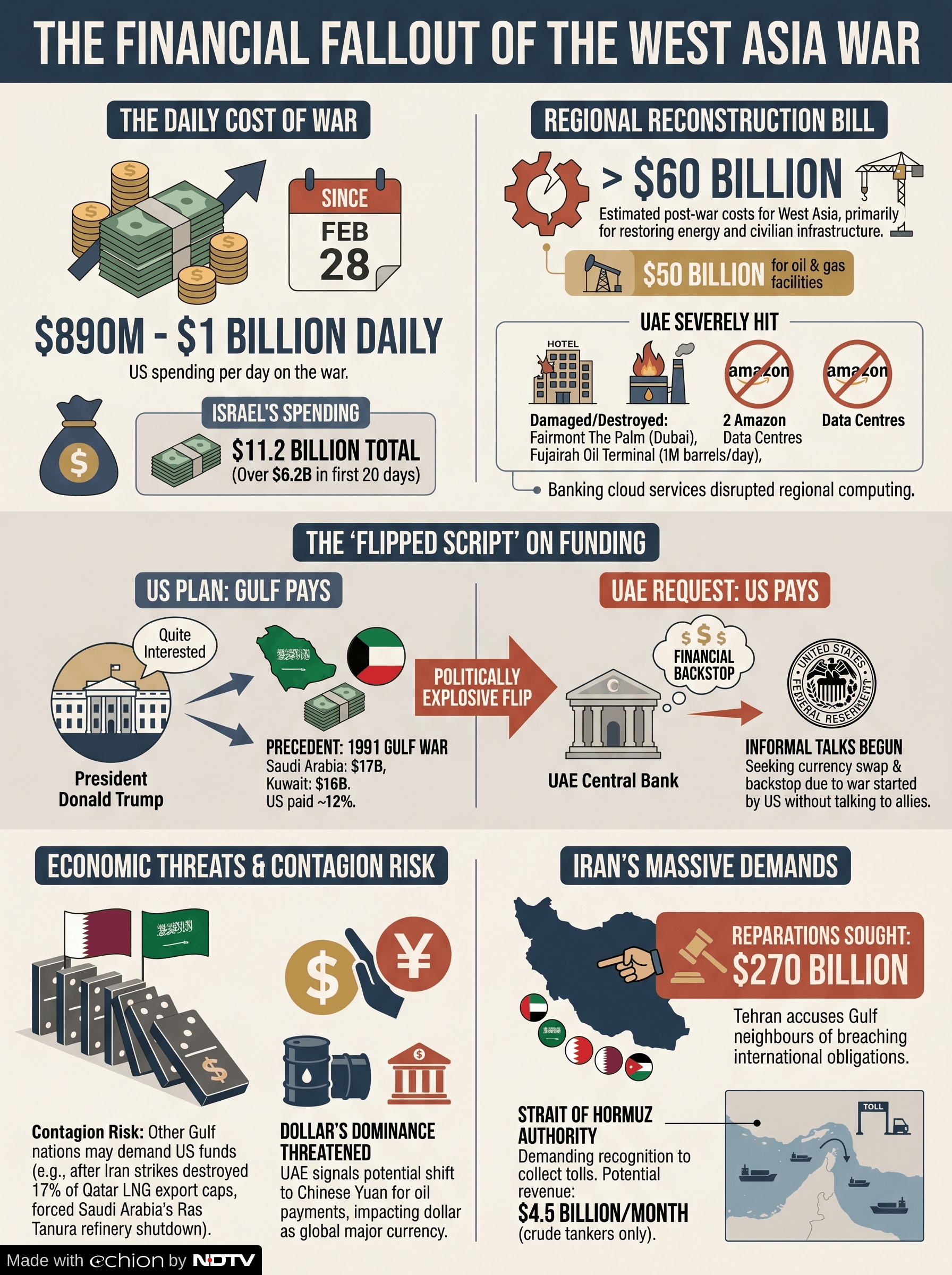
That is, if it does pay out, expect other Gulf nations to queue up, particularly after Iran missiles destroyed over 17 per cent of Qatar's LNG export capabilities and forced Saudi Arabia into a cautionary shut down of its Ras Tanura oil refinery.
How could it affect the US
Apart from having to add a backstop bill to staggering daily war costs, it could affect the dollar's position as the world's major currency, a position it holds (in large part) specifically because it is the preferred payment for oil and gas transactions.
The UAE has already signalled a potential shift to the Chinese yuan for such transactions, something that will worry Trump, particularly after the Chinese central bank opened a second yuan clearing bank in the Emirates in October last year.
Growing financial cooperation between Gulf states and China has been a feature of ties over the past two-three years, with Beijing keen on expanding financial connectivity and, crucially, stronger relations with the world's energy hub.
And what about Iran
Meanwhile, Iran has sought compensation from its Gulf neighbours.
Last week Tehran accused the UAE, Saudi Arabia, Bahrain, Qatar, and Jordan - all of whom it believes has been actively involved in the war - of having "breached international obligations".
Tehran has asked for reparations worth a staggering $270 billion. The number was pegged to claims by a government spokeswoman in an interview with Russia's RIA Novosti news agency.
This doesn't include demands for its authority over the Strait of Hormuz to be recognised internationally, which would allow it to collect a 'toll' from transiting vessels.
Having its authority recognised could translate into a huge financial windfall for Iran - a conservative $1-1.5 million per ship is a staggering $4.5 billion a month for crude tankers alone.
The post-war money game
Ultimately, it is all about the money.
Saudi Finance MInister Mohammed Aljadaan last week said it could take "weeks, if not months" for Gulf energy output, including fertilisers and other industrial inputs, to stabilise and return to pre-war levels.
On restoring oil supply alone, he said: "... the basic logistics of scheduling tankers and bringing them back after the chaos we have seen over the last couple of months... that will take possibly to the end of June."
The two-week US-Iran ceasefire - which has seen multiple setbacks - ends April 22. The one round of peace talks held so far, - in Pakistan - have been futile. A second round is expected this week, but the Gulf states are cautious about real progress.
Aljadaan made that point at an IMF meeting in Washington, saying that any end to the war needs to be "credible enough" to convince all stakeholders - including shipping firms and marine insurance providers - to believe the fighting will not restart.
"... please prepare yourselves, your economies and your people that this will take longer than you expect," he warned.
-
Opinion | Iran To Saudi, Pakistan Is Now Fast Running Out Of Sides To Play

Pakistan's long history of playing all parties to its own benefit may have reached the end of its road.
-
Gyanesh Kumar Has An Immunity Pin. Why A Petition Says He Can't Use It
The Opposition wants the Chief Election Commissioner prosecuted for alleged manipulation of voter rolls, but a 2023 law stands in the way. A petition in the Supreme Court now says the law has a gap.
-
Opinion | Is The World Staring At A Big Stock Market Crash - And Recession? 5 Uneasy Signs
On Wednesday, the US bond market recorded its worst day since Trump's "Liberation Day" tariffs rattled markets in April 2025. The 30-year US Treasury yield topped 5.43%, putting it on track for its highest close since 2004.
-
Form 6 For New Voters: When A Small Change Triggered A Big Row
In July 2026, the online version of Form 6 on the ECI's ECINet portal was modified to include a new declaration.
-
Opinion | Saudi Arabia's China Turn Has Begun - After Learning Much The Hard Way
Leaning on China just makes sense for the Saudis right now. The question is, can its other great 'ally' stomach it?
-
Opinion | Bihar Assault, Hisar Marriage Ban: Who'll Stop The Guardians Of Indian 'Culture'?
Why exactly does the sight of a young couple seeking a bit of alone time somewhere tend to particularly provoke a certain kind of Indian men?
-
Opinion | The Trump-Xi Summit, And India's Many Worries Of Its Own
Washington and Beijing may have chosen coexistence over confrontation. For India, that could be both a relief and a warning.
-
Opinion | China Claims It Has Cut Troops At The Indian Border. But The Math Doesn't Add Up
The reduction likely has more to do with the deployment along the LAC than the total strength active in the region
-
Opinion | China Is No Longer Waiting For Trump To Set The Rules. And He Knows It
America's old diplomatic tricks with China won't work any longer. Because China has changed, and so has its ambitions.