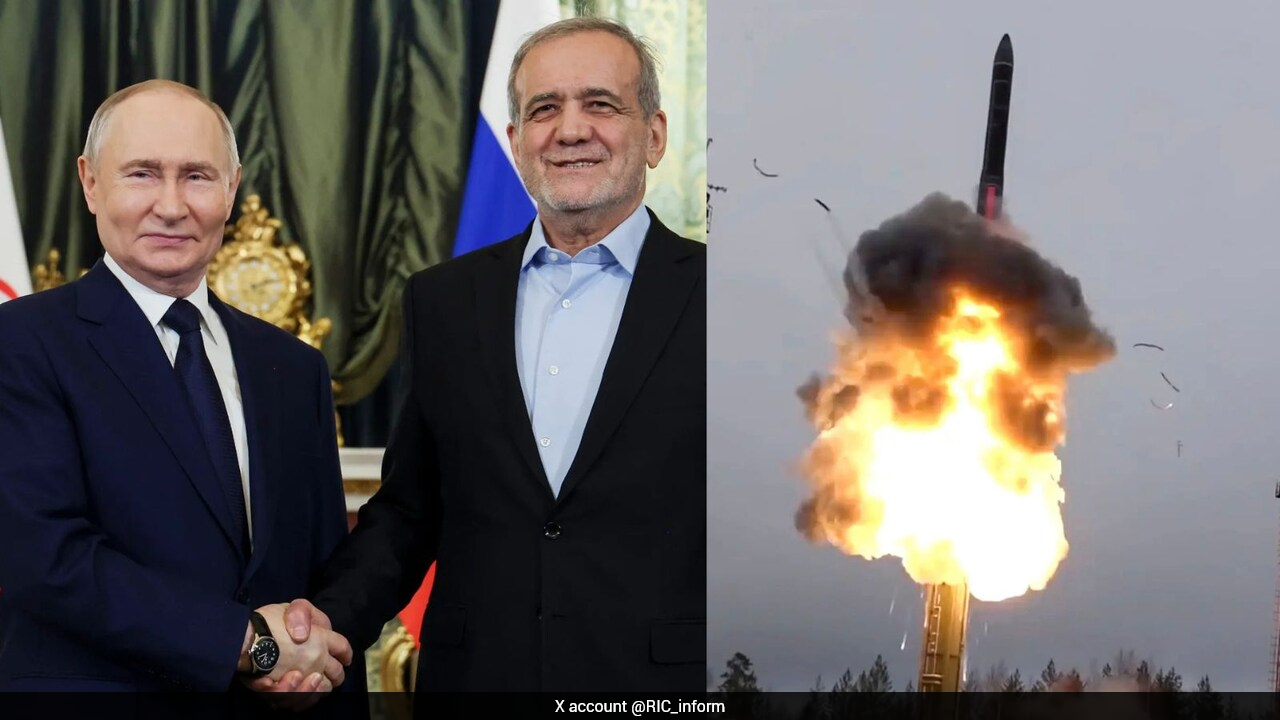
Russia has been quietly helping Iran develop a new generation of supersonic cruise missiles capable of being a threat to US aircraft carriers and warships in the Middle East, according to a report by The Financial Times.
The secret programme, codenamed C430L, began taking shape in 2023 and centres on technology that could allow Iranian missiles to travel at several times the speed of sound.
The ramjet propulsion system is a technology that Iran has been trying to develop for years. Such a system could give Tehran a faster, harder-to-intercept missile, leaving Western air defence systems with far less time to detect and respond to an incoming attack.
A Deal Requiring High-Level Approval
The scale of the technology transfer suggests that the programme would have needed approval from the highest levels of the Russian government.
"This is the transfer of a highly strategically sensitive military technology from Russia that the Iranians have wanted to acquire for decades," Fabian Hinz, an expert on Iranian missiles and senior analyst with Conflict Armament Research, a UK-based weapons-tracing organisation, told The Financial Times.
"A programme like this would require political clearance from the very top in Russia."
The arrangement appears to fit into a wider military partnership between Moscow and Tehran. Iran has supported Russia's drone programme, while Russia has provided assistance for Iran's missile development.
Leaked documents reviewed by The Financial Times suggest preparations for the C430L deal were already underway before the contract was formally signed in November 2023, just weeks after the October 7 attacks.
Iran Has Wanted Ramjet Technology For Years
Iran had been pursuing ramjet propulsion well before its partnership with Moscow. In 2019, then-Supreme Leader Ayatollah Ali Khamenei was seen inspecting sites linked to the country's military development programmes. Iranian state media later reported the testing of ramjet prototypes in August 2023.
"For the Iranians, this would give them a qualitatively new strategic weapon system that could threaten US Navy vessels," Jim Lamson, a former Iran-focused military analyst with the CIA who is now at the James Martin Center for Nonproliferation Studies, told the publication.
The advantage would not just be speed. A missile flying at extremely high velocity while staying close to the surface would give defenders a much smaller window to identify, track and intercept it.
How Russia And China Are Helping Iran
The reported missile cooperation comes amid wider accusations from Ukraine and Western officials that Russia has been providing Iran with battlefield assistance, including satellite imagery, drone support and weapons components.
Russian President Vladimir Putin himself promised continued Russian support during a conversation with Iranian President Masoud Pezeshkian on Tuesday.
Moscow was "trying to give you the help you need in this difficult period" during the war with the US and was "supplying you with the goods you need", Putin said, without providing details.
Separately, Iran's Islamic Revolutionary Guard Corps secretly obtained a high-resolution Chinese satellite that was later used to monitor US military positions across the Middle East.
The satellite was used around the time of Iranian missile and drone attacks this year. The US later sanctioned Chinese supplier Earth Eye, accusing it of providing satellite imagery to Iran during the conflict and saying the intelligence enabled Iranian attacks on American forces.
Track Latest News Live on NDTV.com and get news updates from India and around the world


