Jensen Huang Controversy Raises Questions About Celebrity CEOs
A flamboyant CEO can build a great company. But a great company should never have to depend on the CEO being infallible.
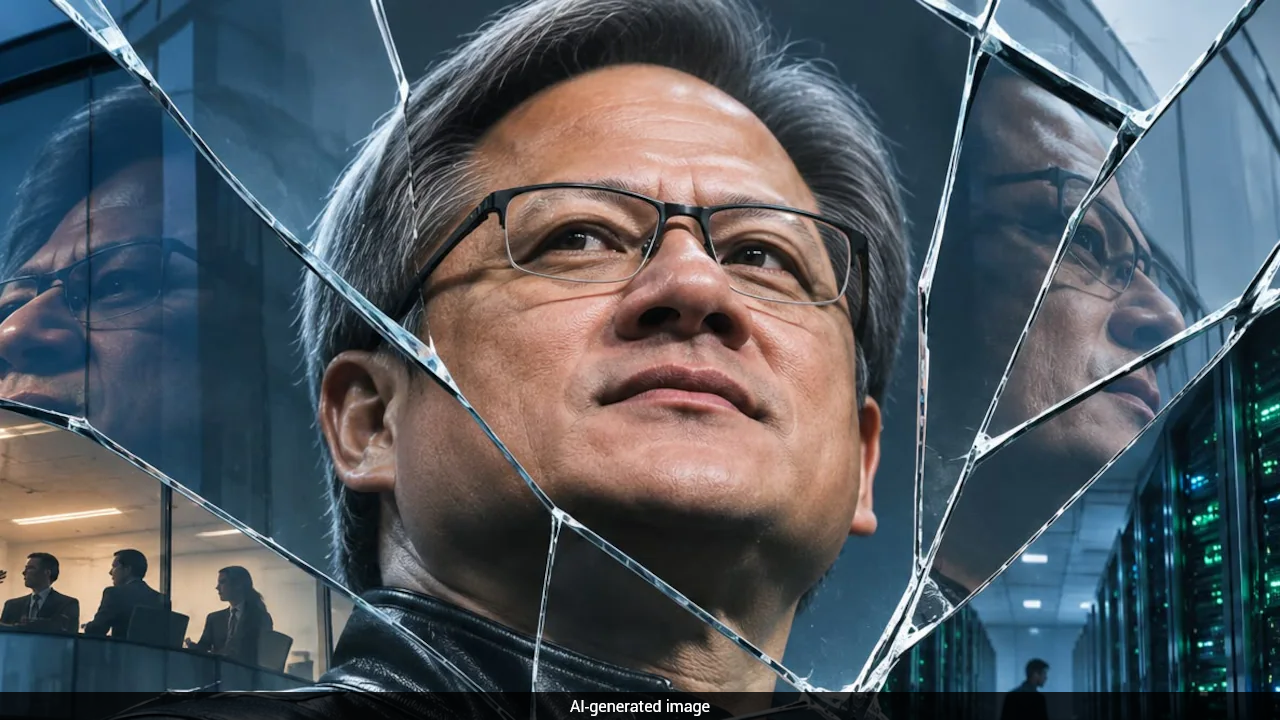
There is something almost theatrical about the modern technology CEO. The black turtleneck, the signature leather jacket, the carefully choreographed product launch and the keynote address that feels more like a rock concert than a corporate presentation. In an age when companies compete for attention as fiercely as they compete for customers, the chief executive has increasingly become the face of the brand. But what happens when the person becomes bigger than the institution?
Nvidia's Jensen Huang is an interesting case study in this debate. The billionaire CEO, instantly recognisable in his trademark black leather jacket, has become one of the most influential faces of the artificial intelligence revolution. Under his leadership, Nvidia has transformed from a graphics chipmaker into a technology powerhouse at the centre of the global AI boom.
READ | Jensen Huang Had Affair With Nvidia Executive Who Reported To Him: Report
Huang is now facing an extraordinary controversy that extends beyond his personal life. After reports about his alleged relationship with Alice Huang, a former executive at Singapore-based Megaspeed who US authorities reportedly suspect of having links to Chinese intelligence, Nvidia announced an independent investigation and is expected to fire the CEO. Huang has admitted to being unfaithful to his wife, apologised to his family and said he would cooperate with the investigation.
When The CEO Becomes The Brand
For years, corporate success stories have been built around charismatic founders and executives. Some of these names include Steve Jobs at Apple, Elon Musk at Tesla and SpaceX and Richard Branson at Virgin. Their personalities, public appearances and unconventional approaches became inseparable from the identities of their companies.
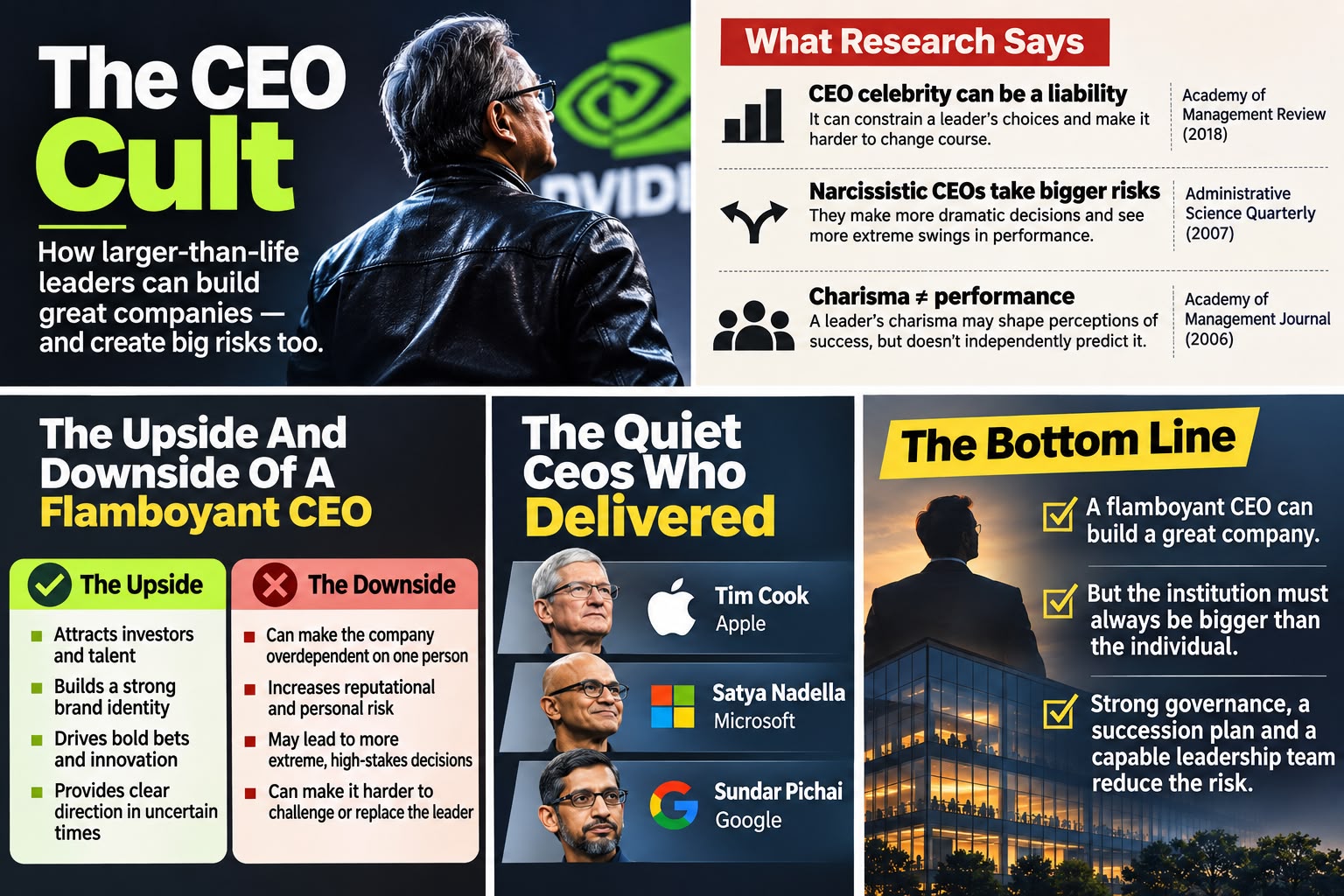
There are obvious advantages to this model. A charismatic CEO can attract investors, inspire employees, command public attention and give a company a recognisable identity. During periods of uncertainty, a confident and decisive leader can also provide direction.
But the trouble begins when the organisation starts revolving around the individual rather than the other way around.
A 2018 paper published in the Academy of Management Review, titled 'The Shackles of CEO Celebrity', examined how corporate leaders who become celebrities can find themselves constrained by the public image they have cultivated. Their carefully constructed identities can make it difficult to change course, acknowledge mistakes or respond to changing circumstances. The researchers argued that CEO celebrity can become a liability when the conditions that originally made the leader successful begin to change.
An earlier study, published in Administrative Science Quarterly in 2007, examined 111 chief executives in the computer hardware and software industries. It found that CEO narcissism was associated with more dramatic strategic decisions, including larger acquisitions, and more extreme fluctuations in organisational performance. Interestingly, the study did not find that narcissistic CEOs necessarily delivered better or worse overall performance than their less narcissistic counterparts.
READ | "He's A Fine Person, But You Never Know": Trump On Nvidia CEO's Affair
This infers that being charismatic or flamboyant does not make someone narcissistic. But when confidence becomes an inability to accept scrutiny, and when personal influence becomes concentrated power, companies can become vulnerable.
The Quieter Alternative
Consider three of the world's most powerful technology executives: Apple's Tim Cook, Microsoft's Satya Nadella and Google's Sundar Pichai.
None has cultivated the kind of theatrical public persona associated with some of the technology industry's more flamboyant leaders.
Cook's leadership at Apple has been marked by operational discipline, a focus on the company's ecosystem and a relatively restrained public presence. Nadella has emphasised cultural transformation, collaboration and a growth mindset at Microsoft. Pichai, who rose through Google's engineering and product ranks, has generally maintained a low-key public profile while overseeing one of the world's largest technology businesses.
Their leadership styles are different, but they share an important characteristic: the emphasis is largely on the institution, its products and its people rather than on the CEO as a celebrity.
This does not mean understated leaders are automatically better. Or the fact that these companies have escaped governance challenges or strategic missteps. But their examples challenge the idea that a chief executive must dominate public imagination to run a successful business.
Research offers some support for this distinction. A 2006 study published in the Academy of Management Journal, which examined 128 major US corporations and surveyed their top management teams, found that perceptions of CEO charisma were associated with subsequent perceptions of organisational performance, but did not independently predict subsequent performance.
In other words, a leader's ability to impress people and a company's ability to perform are not necessarily the same thing.
Should Companies Ditch Flamboyant CEOs?
The answer to this question is not simple. There are circumstances in which a bold, unconventional and highly visible leader can be precisely what a company needs. In a fast-changing industry, a CEO willing to take enormous risks, challenge established thinking and make unpopular decisions can create extraordinary value.
Huang himself is an example. His technical understanding, long-term bets on accelerated computing and ability to position Nvidia at the centre of the AI revolution have been instrumental in the company's rise. Reducing his leadership to his public persona would overlook the business achievements that made him influential in the first place.
Research also suggests that the relationship between CEO personality and corporate performance is more complicated than a simple good-versus-bad equation.
A 2024 study published in the Global Finance Journal, titled 'Give me uncertainty, and I will shine: CEO narcissism and corporate performance', found that narcissistic traits could be advantageous during periods of high uncertainty, when decisiveness and a willingness to attract attention can help companies navigate disruption. The same traits could become disadvantageous when uncertainty is low.
The lesson, therefore, is not that flamboyant leaders should be replaced by quiet ones. It is that companies must distinguish between a leader's ability to inspire and their ability to exercise sound judgement.
The Institution Must Always Be Bigger Than The Individual
Perhaps the most important lesson from the Nvidia controversy has less to do with Huang's personality and more to do with corporate governance.
A board's responsibility is not simply to celebrate a CEO's achievements or defend the person who delivers spectacular returns. It must also provide independent oversight, anticipate risks and ensure that the organisation can function without its most powerful executive.
READ | Alleged Chinese Spy Who Had Affair With Nvidia CEO Is Back in Beijing: Report
This includes having a credible succession plan, distributing decision-making authority and building a leadership team capable of operating independently.
The danger of a company built around one individual is that its strengths and weaknesses can become indistinguishable. The leader's vision may propel the business forward, but the leader's mistakes can also become the company's problems.
Ultimately, the best CEO is not necessarily the one who commands the loudest applause at a product launch, dominates headlines or becomes a cultural icon. It is the one who builds an organisation capable of succeeding even when they are not in the room.
-
Opinion | Sonia Gandhi Belongs Here, And She Wants Us To Know That

Sonia Gandhi was easily the most misunderstood person in Indian politics. I believe Belonging is her way of telling us who she really was and is, writes Sanjay Jha.
-
4,500 vs 34,000: NASA Scientist Flags Punjab-Haryana Farm Fires Undercount
Dr Hiren Jethva, an aerosol remote sensing scientist associated with Morgan State University and NASA's Goddard Space Flight Centre, stated that his calculations showed 34,000 farm fires in Punjab and Haryana between October 1 and November 9 this year.
-
Analysis | Politics Of Drugs: BJP Looks To Turn Punjab AAP's Biggest Challenge Into Electoral Gains
The BJP is attempting to turn the drug menace into one of its principal political weapons against the AAP government in Punjab, ahead of the assembly election
-
Real Cost Of Moving Out: Low Salary Job In Tier 2 Hometown vs Chasing Big Pay In Metropolitans
The rising cost of urban living is also changing how young couples think about marriage, children and financial independence.
-
Opinion | How Pakistan's Anti-India Obsession Turned Into A $40 Billion Blunder
The country incurred an estimated $40 billion in losses due to trade with India being suspended in 2019, with businesses facing higher sourcing and logistics costs after being forced to import goods from distant markets.
-
BJP Hunts For A Crack. Rahul Gandhi's Allies Could Be His Weak Spot
The government suffers a handicap in the sense that there is little to beat the opponents who have been out of power for long. But this is where the Congress and Rahul Gandhi need to use caution
-
Opinion | A Wounded Trump Could Soon Make The World Pay For His Defeat
The US and the rest of the world should worry more about what Trump might do next to redeem himself.