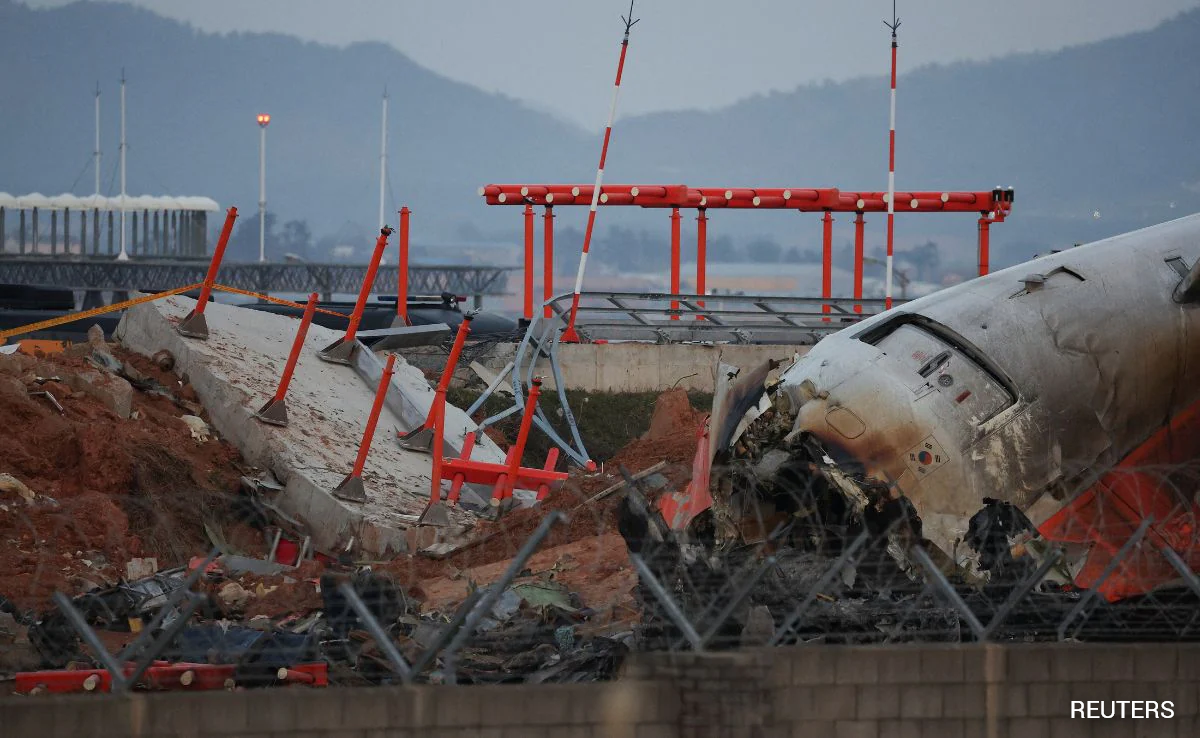
A South Korean government-commissioned report found the Jeju Air plane crash in December 2024 that killed 179 people might not have been deadly if there had not been a concrete mound at the end of the runway, an opposition lawmaker said.
The Boeing 737-800 coming from Bangkok belly-landed and overran the runway at Muan International Airport, killing almost everyone on board after it struck a concrete support for a localiser antenna. The only survivors were two flight attendants at the far rear of the plane.
A simulation contained in the report commissioned by the government-led Aviation and Railway Accident Investigation Board indicated that all on board might have survived without the concrete structure, which did not meet international safety standards, Kim Eun-hye, a member of a bipartisan parliamentary special committee on the accident, said in a press release issued on Thursday.
READ: South Korea Parliament Passes Bill To Launch Probe Into 2024 Jeju Air Crash
The simulation by a South Korean structural engineering institute found the aircraft's initial impact as it hit the runway was not strong enough to cause severe injuries and the plane would have slid about 770 m (2,526 ft) before stopping if the barrier was not there, her press release said.
It also concluded that if the navigation facility had been supported by a breakable structure, instead of a concrete mound, the aircraft could have breached a fence with only minor injuries, according to the release.
Kim's office declined to share the full report. Korea Airports Corp, which runs Muan airport, said it could not comment until the final investigation results are released. South Korea's investigation board did not respond immediately to requests for comment.
Families Step Up Pressure For Accountability
Kim said the tragedy reflected years of government negligence dating back to 1999, when the structure was built, and it was left uncorrected despite violating regulations and being flagged as unsafe.
The lawmaker's statement comes as families of the victims and opposition politicians step up pressure for full accountability, accusing authorities of delaying the release of the analysis and failing to adequately address whether the infrastructure's design contributed to the high death count.
The report focused on the structural hazard, but does not yet constitute a final official accident conclusion.
A full investigative report is still pending authorities' public disclosure after missing a one-year deadline to release a progress report. The Muan airport has been closed since the crash and is not due to reopen until April.
A representative of the victims' family association told Reuters that the report was "solid proof that the disaster was man-made" and said the families were demanding an apology from the investigation board for concealing the information.
The investigation board said in a preliminary report in January last year that both of the plane's engines sustained bird strikes.
The pilots shut off the less-damaged engine after the bird strikes, investigators said in a July update that was not released publicly due to objections from victims' families.
South Korea's parliament has launched its own probe into the crash and its aftermath amid continuing calls for greater transparency.
(Except for the headline, this story has not been edited by NDTV staff and is published from a syndicated feed.)
Track Latest News Live on NDTV.com and get news updates from India and around the world


