


On the day Iran announced Mojtaba Khamenei as its Supreme Leader, some neighbourhoods in Tehran, crowds loyal to the Islamic Republic gathered under the night sky shouting "Allahu Akbar" -- God is greatest -- celebrating. State television showed missiles fired in his name, one bearing the inscription: "At your service, Seyyed Mojtaba."
Elsewhere, a different chant echoed: "Death to Mojtaba!"
The moment marked a historic turning point for Iran. For the first time since the Islamic Revolution of 1979, the leadership of the Islamic Republic appeared to pass from father to son.
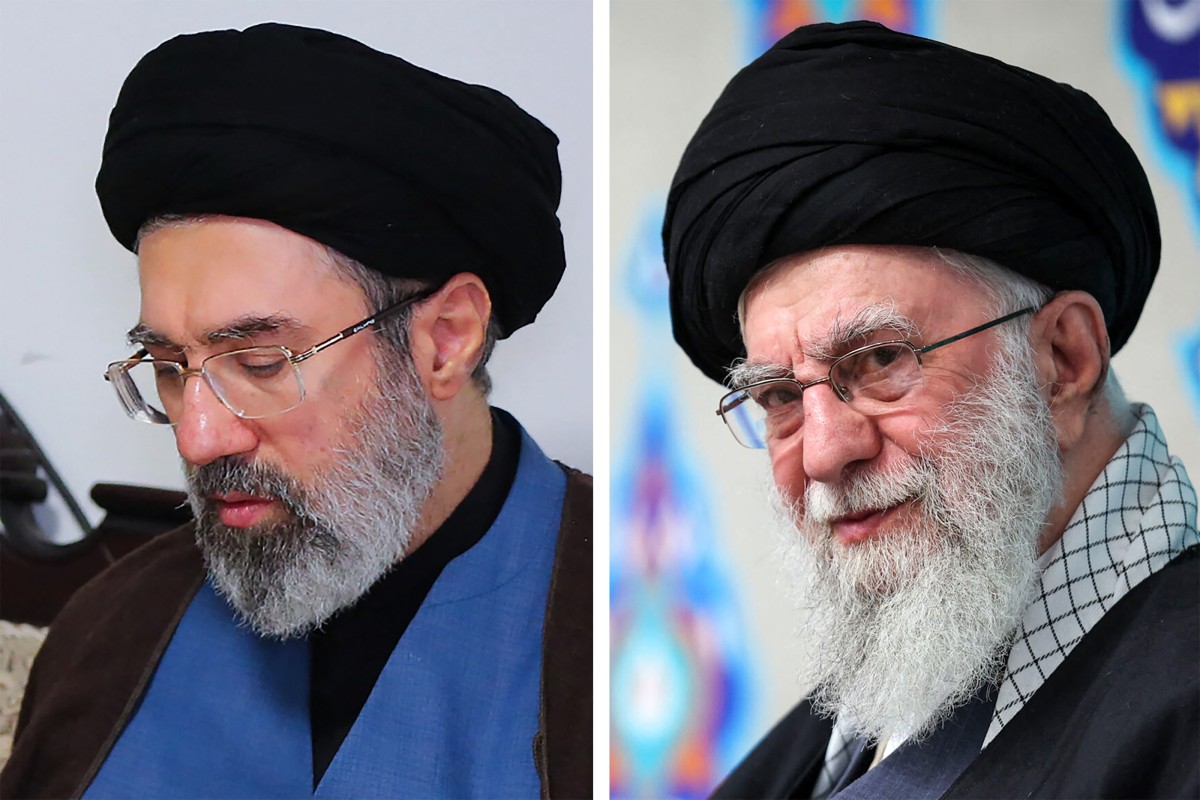
Mojtaba Khamenei, the second son of Ayatollah Ali Khamenei, has been chosen as the country's new supreme leader after his father was killed in US-Israeli strikes. At 56, he becomes the third supreme leader in the republic's history, and arguably the most controversial.
His rise comes at a moment of war and intense international pressure. It also raises a question: how different will Mojtaba Khamenei be from the father whose shadow he worked under for decades?
To understand that difference, many observers point to the contrast between a leader who rose through formal political office and a son who built influence behind the scenes.
"I guess Khamenei, the senior, was a little bit more established politically. Being president, he played quite an important role in the political landscape of the Islamic Republic during Ruhollah Khamenei's time as supreme leader and then obviously managed to become supreme leader," Professor Simon Mabon, of Lancaster University, told NDTV.
A man rides a motorcycle past a banner displayed at Valiasr Square in central Tehran on March 10, 2026, depicting Iran's late supreme leader Ayatollah Ruhollah Khomeini (L) watching as his successor the late Ayatollah Ali Khamenei (C) hands over a national flag to his son and new supreme leader Mojtaba Khamenei (R).
Photo Credit: AFP
Ali Khamenei, before becoming supreme leader in 1989, served as president of Iran, gaining national prominence during the turbulent years following the revolution and the Iran-Iraq war. Even then, his appointment was controversial.
"He wasn't the most qualified candidate in terms of his religious credentials, but he was still able to be picked," Professor Mabon explained. "And I think the son has taken a slightly different pathway."
"Similarly, he lacks the religious credentials of being an Ayatollah, but that can be rectified. Some are already calling him Ayatollah," he added.
In The Shadows
For years, Mojtaba Khamenei remained largely unknown to the wider public. He never held government office. He never gave public speeches or interviews. Only a handful of photographs and videos have ever circulated publicly. Yet behind that low profile lay a reputation for influence.
According to US diplomatic cables published by WikiLeaks in the late 2000s, Mojtaba Khamenei was widely described within diplomatic circles as "the power behind the robes" and a figure regarded as "capable and forceful" within Iran's ruling establishment.
Professor Mabon says that the difference between public authority and hidden influence lies at the heart of Mojtaba's rise.
"But what he doesn't have is the experience in formal politics. He did not hold an office. He has not been elected, unlike his father. But what he does have is a lot of experience in terms of working behind the scenes, of orchestrating things, of manoeuvring, of essentially being the 'power' behind the robe as one US diplomat put it," Professor Mabon told NDTV.
Those years working quietly inside Iran's political machinery appear to have given him influence across the country's power centres.
"And I think that gives him a lot of influence, a lot of sway in terms of influence over different parts of Iranian politics and particularly with the IRGC, the Revolutionary Guard," he added.
The IRGC Factor
The Islamic Revolutionary Guard Corps -- established in 1979 to defend the revolution -- has grown into one of the most powerful institutions in Iran. It controls major military forces and vast economic networks. Mojtaba's relationship with the IRGC dates back decades. As a teenager, he joined the organisation during the Iran-Iraq war.
Born on September 8, 1969, in Mashhad in north-eastern Iran, Mojtaba is the second of Ali Khamenei's six children. He attended the religious Alavi School in Tehran before serving briefly in the military during the war with Iraq.
The eight-year war also hardened the regime's suspicion of the United States and the West, which supported Iraq during the conflict.
Iran's Islamic Revolutionary Guard Corps on February 16 began a series of military exercises in the Strait of Hormuz, state media reported, on the eve of talks with the United States.
Photo Credit: AFP
In 1999 Mojtaba moved to the holy city of Qom, the centre of Shia theological scholarship, to continue his religious studies. It was only then, unusually late in life, that he began wearing clerical clothing.
"I think he is going to be someone who does not necessarily have the same religious credentials as others might have, as other candidates might have. But then again, the same could be said for his father, Ali Khamenei, who did not have the same level of religious emulation as his predecessor, Ruhullah Khamenei," Professor Mabon told NDTV.
In recent months, however, Iranian media close to the centres of power have begun referring to Mojtaba as "Ayatollah", a senior clerical title. Some analysts interpret that shift as an attempt to strengthen his religious legitimacy.
Still, his ascent remains controversial.
The Islamic Republic was founded after the 1979 revolution overthrew Iran's monarchy. Its ideology rejects hereditary rule, insisting that the supreme leader should be chosen based on religious authority and leadership credentials rather than family lineage.
Yet Mojtaba Khamenei has long been viewed as a potential successor.
"I don't think it's all that surprising," Professor Mabon said. "I think he was named in part because of the context of all of this. He was the second son of the former supreme leader. Very, very strong ties to the IRGC, very much on the right, the conservative, the ideologically zealous, if you will, part of the Iranian political spectrum."
The First Signs
Within Iran, his influence surfaced publicly during the 2005 presidential election that brought the hardline populist Mahmoud Ahmadinejad to power.
Reformist candidate Mehdi Karroubi accused Mojtaba Khamenei of interfering in the vote through the IRGC and the Basij militia. According to Karroubi, money was distributed to religious groups to help secure Ahmadinejad's victory.
Four years later, similar accusations emerged after Ahmadinejad's disputed re-election triggered mass protests known as the Green Movement.
(L-R) Mehdi Kalhor, Masood Zaribafan, Mojtaba Samareh Hashemi and Ali reza Zakani, represetatives of Iranian President Mahmoud Ahmadinejad, during a meeting with the Islamic republic's Supreme Leader Ayatollah Ali Khamenei (unseen) in Tehran on June 16, 2009. Khamenei met with representatives of all four candidates in the June 12 presidential elections.
Photo Credit: AFP
During those protests some demonstrators openly opposed the possibility of Mojtaba succeeding his father. The crackdown that followed was severe.
"In terms of differences, I think he is probably more hardline than his father. I think just by virtue of the types of roles that he has done, the type of political manoeuvring that he's done, he's probably a bit more hardline than his father," Professor Mabon told NDTV.
The timing of his rise could further harden his stance.
"The father came to power just after the Iran-Iraq war, whereas the son has come to power in the midst of a conflict. And I think that shapes the way that they will see the region and the world around them," he added.
How US, Israel See Him
The United States and its President Donald Trump is no fan of Mojtaba Khamenei. Israel has also been a vocal critic. Both countries pose an existential threat to Khamenei junior.
"The fact that this conflict is with the United States is, I think, really quite important for Mojtaba because it's the long-term rival, if you will. The US has long been this existential threat to Iran, or at least it is long the nefarious other against the Islamic Republic," Professor Mabon told NDTV.
In Washington and Jerusalem, his appointment is being interpreted as a sign of ideological continuity.
"For the Israelis and the Americans, they will see this as a continuation, as sort of the start of a dynastic theocracy, that Mojtaba is someone who is hardline, perhaps even more of a hardliner than his father. But it is a real doubling down on that sort of ideological hardline vision," Professor Mabon said.
"Trump said that he did not view Mojtaba as a legitimate candidate. He would not be happy with that, or in words that only Trump can use," he added.
Israeli Defence Minister Israel Katz has described whoever becomes Iran's supreme leader as "an unequivocal target for elimination".
"The face may slightly change. The terror regime does not. Mojtaba Khamenei inherits his father's legacy of repression and bloodshed," the Israeli foreign ministry said in a statement, sharing an AI-generated photo of both the Khameneis with blood on their hands.
Mojtaba Khamenei's personal circumstances may also shape the next chapter of Iran's leadership. In the Israeli strike that killed his father, several members of his family were also reported killed, including his mother Mansoureh Khojasteh Bagherzadeh, his wife Zahra Haddad-Adel and a son.
'He has been chosen as a response to the moment, a real doubling down, a sending a strong message to the US and Israel to say, look, we are firm, we are steadfast, we are committed to our project. And I don't think it is going to go down very well in Washington or in Israel for that matter," Professor Mabon said. "He is a hardliner. He is not the sort of pragmatic choice to make a deal with, let's say."

