F-35 Hit Over Iran? Hi-Tech Solution To Low-Tech Problem Likely Backfired
Iran developed air defence systems that use passive infrared sensors rather than radar to target aircraft like F-35A. This method proved effective in Yemen when used by Iranian-backed Houthi rebels
Stealth is a promise, not a guarantee. The US Air Force's F-35A Lightning 2 is the most expensive weapons programme in history, built around the premise that it can slip through the most contested airspace undetected.
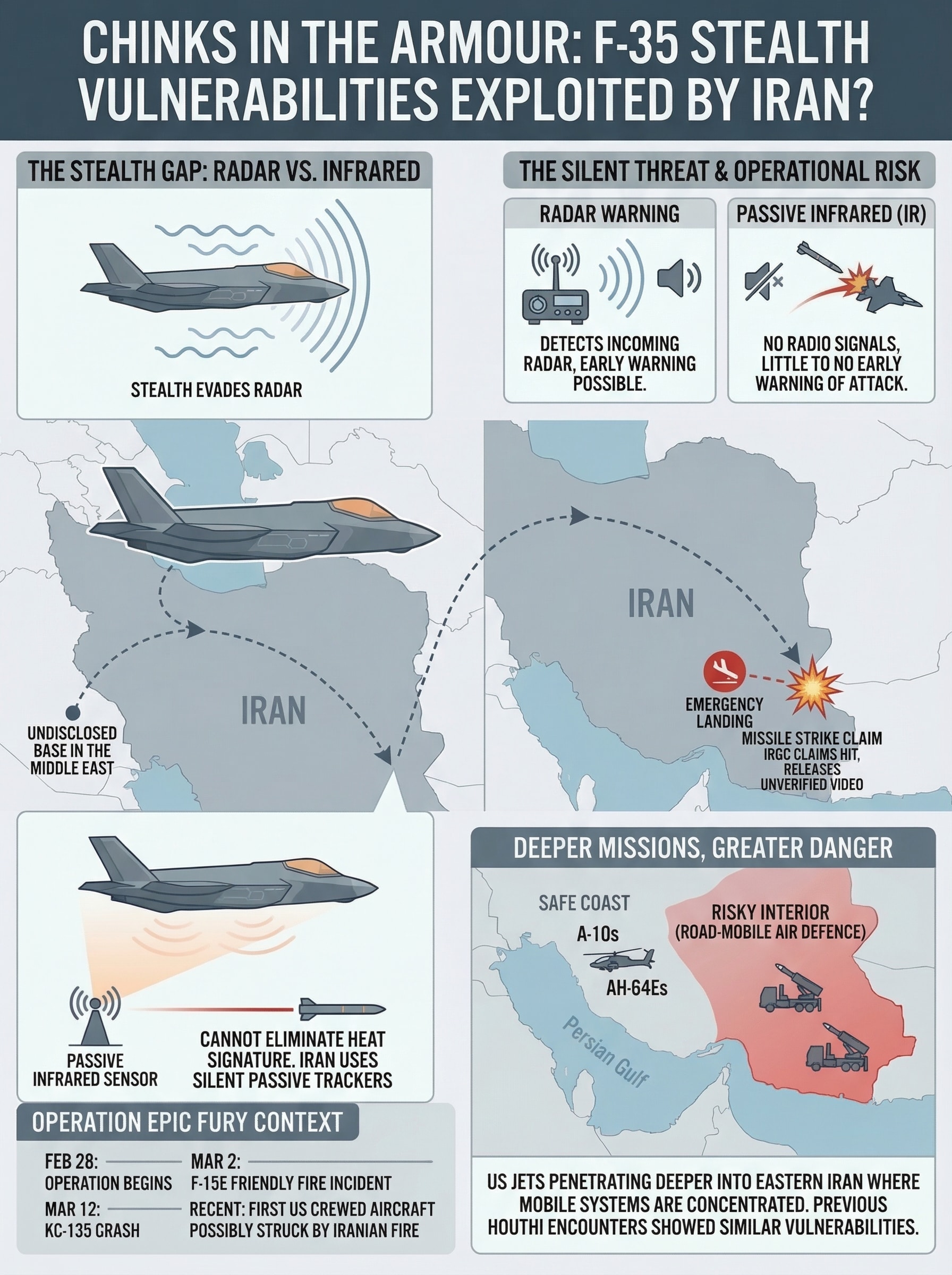
Despite that, an F-35A was forced to make an emergency landing at an undisclosed American base in the Middle East on Thursday after flying a combat mission over Iran, the Pentagon has confirmed. Iran's Islamic Revolutionary Guard Corps (IRGC) has claimed it struck the aircraft. The US military said it is investigating the claim.
Central Command (CENTCOM) spokesperson Captain Tim Hawkins said the F-35A was flying a combat mission over Iran when it was forced to divert. The aircraft landed safely and the pilot is in stable condition.
While nothing concrete is known whether Iranian fire forced the landing or what weapon Iran used, the IRGC released a video through Iran's Fars News Agency claiming to show a missile striking the F-35 on its port side.
NDTV could not independently verify the authenticity of the video.
ALSO READ | The Myth Of Stealth: Iran Puts US' Prized F-35's Name To The Test
If confirmed, it would mark the first time a US crewed aircraft has been struck by Iranian fire since Operation Epic Fury began on February 28. The incident is also more significant for what it reveals about the F-35's vulnerabilities than for the tactical damage alone.
The aircraft's stealth capabilities are calibrated primarily to defeat radar-based detection systems; it is shaped to scatter radio-frequency emissions and coated with materials that absorb them.
What it cannot do is eliminate its heat signature entirely.
Iran has developed air defence systems that use passive infrared sensors rather than radar to target aircraft. This method had already proved effective in Yemen when used by Iranian-backed Houthi rebels.
Passive systems are particularly dangerous because they emit no radio signals of their own. A radar-warning receiver on an aircraft detects incoming radar emissions, as against a passive infrared tracker that is silent right up to the moment of impact. These improvised or jury-rigged systems provide little to no early warning of a threat, let alone an incoming attack.
While the F-35A carries its own Distributed Aperture System, which is a network of six infrared cameras providing 360-degree situational awareness, detection and evasion are different problems.
The Houthi rebels, armed with far cruder systems than what Iran has, had already shown this gap. US F-35s flying against Houthi air defences were forced to take evasive actions in order to avoid being hit by surface-to-air missiles.
The trajectory of Operation Epic Fury has compounded this exposure. General Dan Caine, Chairman of the US Joint Chiefs of Staff, told reporters that US aircraft are now flying farther east and penetrating deeper into Iranian airspace. This region is where Iran's road-mobile air defence systems that are hard to locate and destroy are concentrated.

Road-mobile systems can be repositioned after each engagement and concealed in ordinary terrain. They can be hidden virtually anywhere and will remain a threat on the battlefield long after fixed air defences are destroyed.
Non-stealthy A-10 ground attack jets and AH-64E Apache helicopters are operating along the Iranian coast over the Strait of Hormuz in a sign that the US considers Iran's western airspace manageable and safe. Iran's eastern interior, however, is a different world.
The US has so far lost over a dozen military aircraft since the war began. Three F-15E Strike Eagles were downed in a Kuwaiti friendly fire incident on March 2. A KC-135 Stratotanker crashed in western Iraq on March 12, killing all six crew.
-
Is The Dreaded 'Dahiya Doctrine' Guiding Israeli Actions In Iran, Gaza, Lebanon?

Why do civilian areas and infrastructure repeatedly become part of Israeli action? An 'unofficial' but well-used military approach may be the reason.
-
Opinion | Not China, Not Russia: Why Is Pak Suddenly Everywhere In US-Iran 'Talks'?
A number of countries, including Turkey and Egypt, not to mention Russia, have been pressing Washington to end the war. But none is keen to get directly involved. Why Pakistan?
-
Trump's Iran Ceasefire Gamble Ignites Netanyahu's Strike Fury
Israel fears a premature ceasefire announced by Trump could derail its goal to dismantle Iran's nuclear missile programmes, prompting Netanyahu to order a 48-hr strike surge.
-
Why Mohammad Ghalibaf Could Be A Critical Cog In Trump's Iran Project
Born to Kurdish-Persian parents in 1961 near Mashhad, a Shiite pilgrim hub in Iran's northeast, Ghalibaf is an expert in human and political geography, who married Zahra Sadat Moshir in 1982 - their wedding officiated by Khomenei - and has three children.
-
Opinion | Inside Iran's 'Leader-Proof' War Machine, Designed To Absorb Every Blow
In Iran, key actors have long performed a 'bridging role', whether by design or by chance, in determining Tehran's domestic and foreign policies
-
Opinion | What Iran Might Really Demand From Trump Before It Backs Down
The proposed framework, if it indeed mandates the physical removal of enriched uranium, possibly with external facilitation, marks a significant escalation in demands compared to earlier nuclear agreements.
-
Opinion | The $2 Trillion Wipeout: How The Market Exposed Gold's Biggest Lie
In a world defined by 4% yields, algorithmic liquidity, and leveraged balance sheets, the traditional assumption that war automatically benefits gold no longer holds.
-
Opinion | Exit Denied? Why Iran Won't Make It This Easy For Trump To 'Pause' The War
The escalation matrix has risen rapidly, and Iran may be in no mood to give Trump the early exit he seems to be seeking so desperately now.
-
Before Drones Flew Over The Gulf, Praying Mantis Followed An Iran Mine Strike
Operation Praying Mantis was the culmination of a decade of escalating tension and proxy warfare across the Middle East. The operation redrew the balance of power in the Gulf.







-
News Updates
-
Featured
-
More Links
-
Follow Us On
