- Satellite images show Pakistan's Murid Air Base repairs after May 2025 strike have failed
- The damaged command and control centre has been completely demolished, not rebuilt
- Indian Air Force struck Murid base with penetrator munitions during Operation Sindoor
Recent satellite imagery indicates that Pakistan Air Force efforts to repair and restore a key command and control centre at its premier Murid airbase near Chakwal have failed.
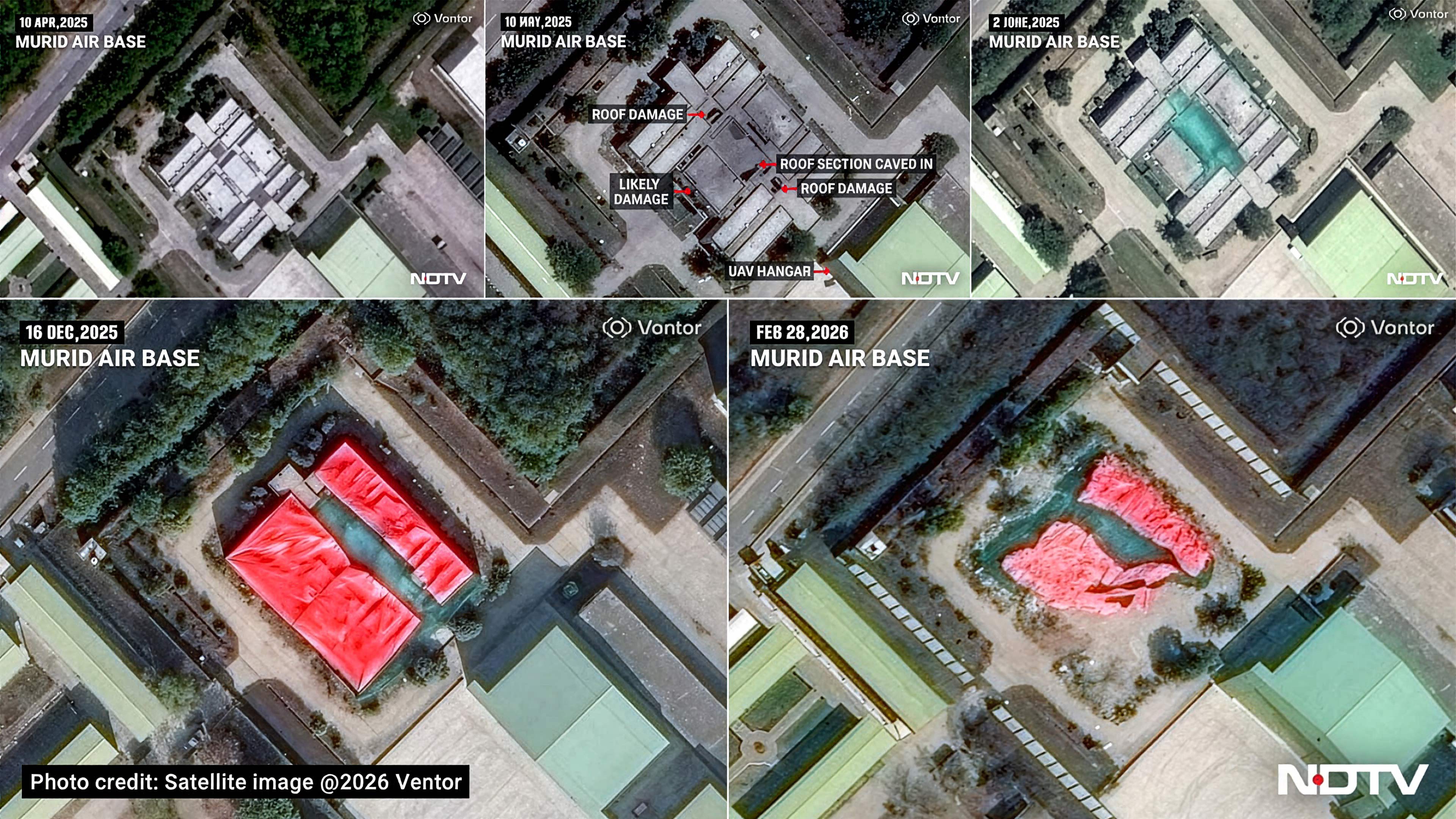
A February 28 image from Vantor, sourced by NDTV, suggests repair work at Murid Air Base has been unsuccessful. The central area of the building, which was struck and subsequently covered by tarpaulins, now shows irregular pinkish-red rubble and exposed ground, consistent with demolition or collapse rather than successful rebuilding. The long-term impact of the May 2025 strike remains evident nearly ten months later.
"Recent imagery now confirms the structure has been completely demolished," says satellite imagery analyst Damien Symon.
"This development indicates the effects of the strike likely extended far beyond the roof and into deeper portions of the building's internal structure. The decision to dismantle the facility strongly suggests the airstrike triggered significant structural failure within the building (approximately 35x30 metres), ultimately rendering the site unsafe and unfit for repair," he added.
Satellite imagery shows the condition of Murid Air Base pre and post Operation Sindoor. High res here
Murid was one of the ten Pakistani airbases struck by the Indian Air Force between 2 am and 5 am on May 10, 2025, hours before Pakistan offered to end hostilities by coming to the ceasefire table. The facility described in this report is believed to have served as a command-and-control node for Unmanned Aerial Vehicles (UAVs) operating from a complex within this base. The Indian Air Force also struck what is believed to be an underground facility at the same base.
An NDTV report earlier identified a 3-metre-wide munition impact crater barely 30 metres away from one of two entrances to this underground facility.
"Satellite imagery collected after India's May 2025 airstrike showed damage to the roof of this structure, which was later covered with tarpaulin while damage assessment activity was underway. Subsequent imagery from December 2025 revealed the entire facility had been wrapped in tarpaulin and construction mesh, suggesting repair work had begun," Symon said.
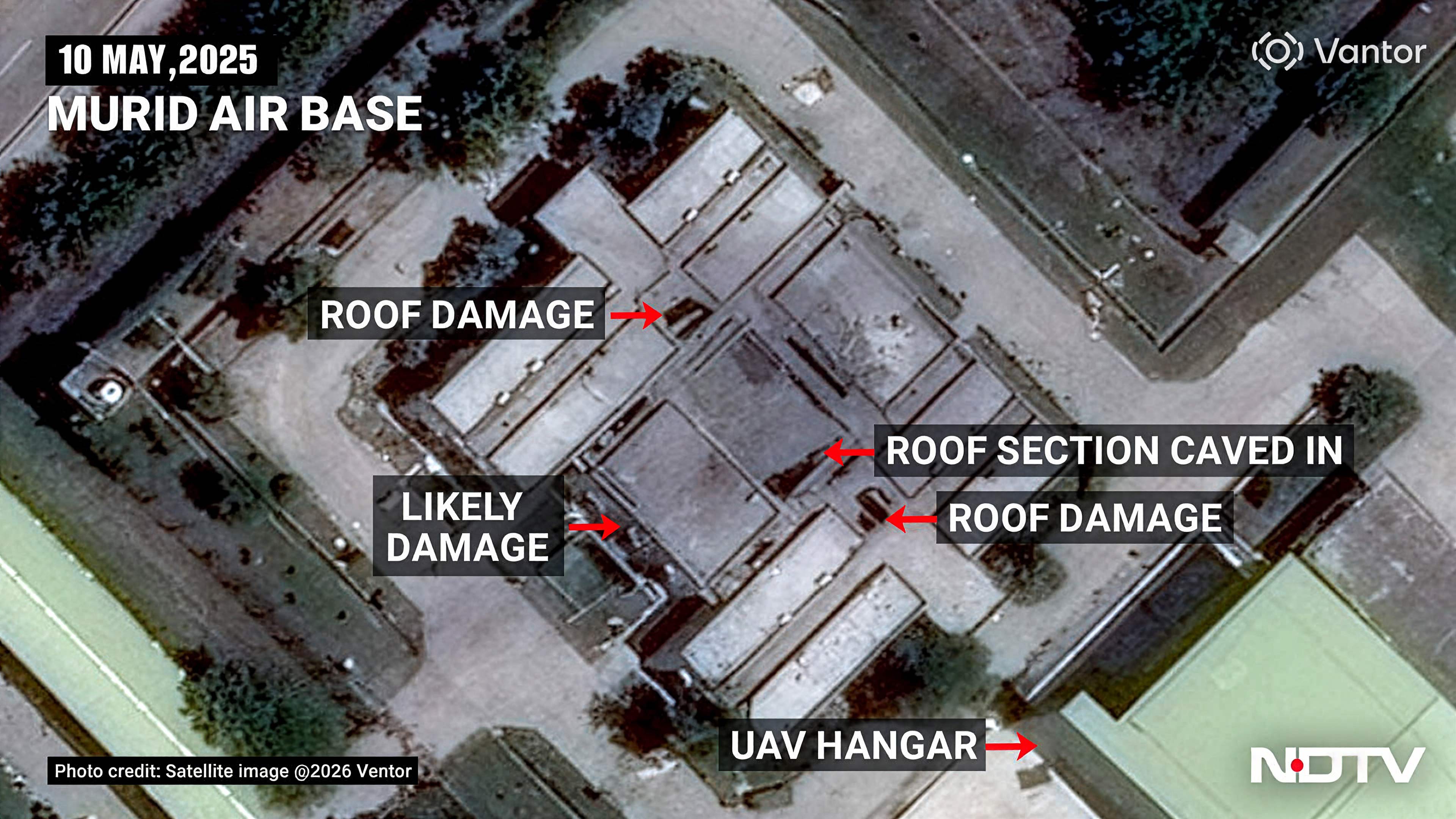
Post-strike - May 10, 2025
Imagery of the central buildings of the Murid Air Base on May 10, 2025, showed damage after India's strike during Operation Sindoor. High res here
Imagery taken on May 10 2025, shortly after the reported Indian Air Force strike, reveals clear damage to the central buildings. The damage pattern - localised roof penetration with internal collapse rather than superficial blast effects strongly suggests the use of penetrator warheads designed to breach reinforced structures before detonating inside. This is consistent with strikes on hardened military targets like command centres, where munitions punch through concrete roofs to maximise internal damage.
While the Indian Air Force has never publicly identified which weapons it has used to strike particular targets, the nature of the damage and the distance from the Line of Control and the International border could indicate the possible use of the SCALP air-to-surface precision munition launched by IAF Rafale fighters from within Indian airspace.
The SCALP can be equipped with a multi-stage (tandem) penetrator system weighing around 450 kg. An initial stage acts as a precursor shaped charge which blasts through the outer layer, such as reinforced concrete, creating an entry hole. A subsequent follow-through stage with the main-explosive charge penetrates deeper into the structure before detonating, maximising internal damage with shrapnel and overpressure.
By June 2, 2025, roughly three weeks after the strike, a green tarpaulin covered a part of the damaged central building, indicating initial cleanup and assessment. Major reconstruction had not yet begun at that stage.
Satellite imagery from December showed continued efforts to repair the central structure with large red tarpaulins now fully covering the damaged area. No new permanent roof or structural fixes were clearly visible, indicating slow or difficult progress.
The new image, posted in this report, indicates that those efforts have now failed.