NDTV Explainer: How Is A Supreme Leader Chosen, Who Will Succeed Khamenei
Khamenei, who ruled for 36 years, built Iran into a powerful anti-United States force, projecting military influence across the Middle East while suppressing repeated domestic unrest with force.
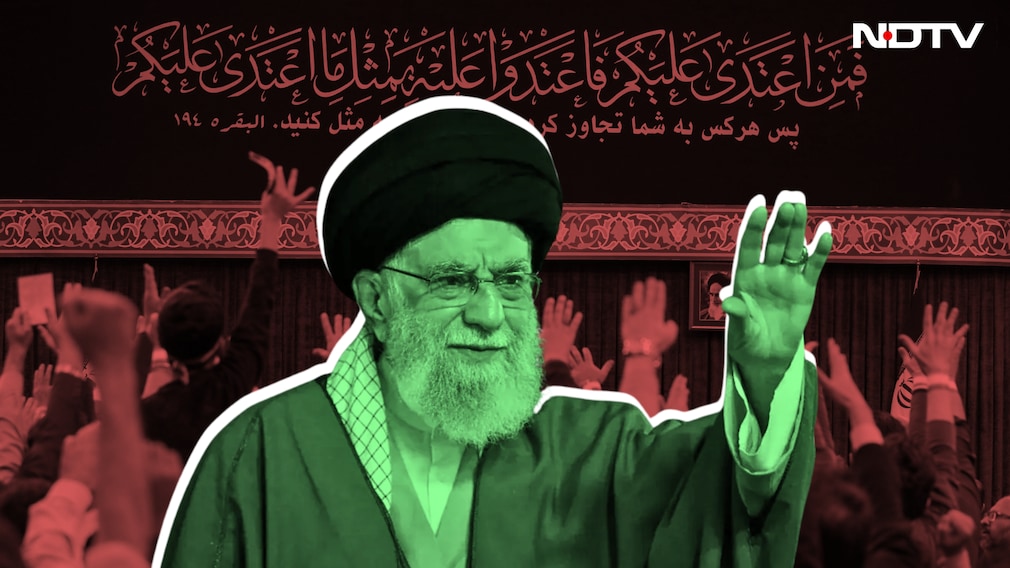
Iran has appointed senior cleric Alireza Arafi as the jurist member of a temporary Leadership Council following the reported death of its Supreme Leader Ayatollah Ali Khamenei in joint US-Israeli air strikes, according to state media. The ISNA news agency reported that the appointment took place on Sunday, placing Arafi alongside President Masoud Pezeshkian and Chief Justice Gholamhossein Mohseni Ejei on an interim body tasked with exercising the supreme leader's authority until a permanent successor is chosen by the 'Assembly of Experts'.
The transition marks the most consequential moment for the Islamic Republic since 1989, when Khamenei himself rose to power after the death of Ayatollah Ruhollah Khomeini.
Khamenei, who ruled for 36 years, built Iran into a powerful anti-United States force, projecting military influence across the Middle East while suppressing repeated domestic unrest with force. Iranian state media said he was killed on Saturday, aged 86, when Israeli and American strikes destroyed his central Tehran compound after decades of failed diplomatic efforts to resolve disputes over Iran's nuclear programme.
The announcement was repeated several times by state outlets, emphasising the immediate formation of the interim leadership structure.
Immediate Transition: The Leadership Council
Iran's constitution provides for continuity if the supreme leader dies or becomes incapacitated. Authority temporarily transfers to a three-member council consisting of the President, the head of the judiciary and a clerical jurist chosen by the Guardian Council.
Alireza Arafi's appointment as a jurist member does not mean he will become the next supreme leader. According to Professor Simon Mabon of Lancaster University, the council exists only to manage affairs until a successor is formally selected.
"What they (Assembly of Experts) are doing is they are creating a leadership council to run until it formally names a successor to Khamenei. And so Arafi has been appointed as a jurist to that leadership council to offer some sort of theological guidance," Professor Mabon told NDTV.
It is possible he could emerge as a candidate later, but there is no automatic path from interim council member to supreme leadership.
Importantly, being an Ayatollah does not mean someone is eligible or likely to become the supreme leader. Many clerics hold the title without occupying political authority.
"I think it is just important to make the distinction. You can be an ayatollah and not be the supreme leader, the threshold for theological, moral and political skill sets. So just because you are an ayatollah, it does not mean you are a supreme leader. You can be an ayatollah and just be a religious cleric," Professor Mabon told NDTV.
A System Prepared For Succession
Analysts believe Iran had already been preparing for a leadership transition, partly because of Khamenei's declining health.
Professor Mabon says that Tehran learned from previous crises, including the "12-day war" last June, when senior military figures were killed. Iran subsequently developed contingency plans to ensure continuity even in the event of leadership decapitation.
"Iran has learned a lot from the 12-day war last June. It has put a lot of planning in place. It has worked hard to ensure that in the event of these decapitation strategies working, as they did in the 12-day war last June, it would be able to operate and to respond. And I think we are seeing that now," Professor Mabon told NDTV.
"We are seeing that after the death, the killing, if you will, of key leaders in the military, the defence minister, Aziz Nasirzadeh, for example, and we are seeing coordinated responses. So I think there is lower-level strategic planning going on," he added.
Khamenei himself was known to be frail in recent years. There were suggestions -- unconfirmed publicly -- that he suffered from cancer or another debilitating illness. At 86, succession planning would have been unavoidable regardless of the strikes.
"He certainly had a very debilitating disease, and he was in his late 80s. So there would have been some thought given to succession anyway," Professor Mabon added. "There were rumours after the 12-day war that he had got people lined up to replace him. But that is not entirely how it works. So it is the Assembly of Experts that selects the supreme leader."
What Is The Assembly Of Experts
The Iranian constitution assigns the choice of supreme leader to the Assembly of Experts, a body of senior clerics elected every eight years.
"I imagine that they are currently working through some of the various candidates, if they have not already done so. It would not be a massive surprise if there was not someone in place that just needs to be formally approved. So the Assembly of Experts is a panel that is voted for every eight years," Professor Mabon said.
But besides the Assembly of Experts there is the Guardian council which approves the candidates for election.
"It is a panel that is sort of overseen by the Guardian Council, which ensures that everyone is sort of fulfilling the right criteria. So there is a real system of checks and balances, both democratic in terms of elections, but also theocratic in terms of ensuring that they have the right calibre and moral fibre. So there will be machinations afoot if they haven't already been to get this finalised," Professor Mabon explained.
Iran observes a 40-day mourning period after major deaths. Analysts expect authorities may wait until after that period before announcing a permanent successor.
How Rules Changed After 1989
Originally, Iran's system required the supreme leader to be a grand ayatollah, the highest clerical rank with broad religious authority. That requirement changed after Ayatollah Khomeini's death.
His designated successors fell out of favour or were sidelined, and constitutional revisions allowed a lower-ranking cleric to become leader.
"There was a change after Ruhollah Khomeini died. Initially, the Islamic Republic had to be ruled by a Grand Ayatollah who fulfilled certain spiritual, moral, and religious credentials and met the various criteria," Professor Mabon said.
That shift enabled Ali Khamenei, who was not then a Grand Ayatollah, to assume power.
"Ali Khamenei was able to be chosen because he was not someone worthy of that sort of spiritual emulation that Khomeini had, and that Ali al-Sistani has in Iraq, for example," Professor Mabon told NDTV.
The Main Question: Hardliner or Pragmatist?
One path, for the Assembly of Experts, would be selecting a hardline ideologue committed to the revolutionary doctrine and confrontation with Western powers. Another would involve choosing a more pragmatic or reform-minded figure to reduce domestic unrest, which has intensified in recent months.
"I think it is a really difficult choice, particularly as it plays out in the context of the war with Israel and the United States. At the same time, you have got lots of others who are vying for influence, senior political figures. Hassan Rouhani, for example, might want to try to sway things," Professor Mabon said.
"Former Iranian foreign minister Mohammad Javad Zarif
has got a lot of respect internationally, so he might be a popular choice amongst some. But then you've also got the hardliners associated with the IRGC and the Quds Force. And I think the context really matters here, the context of the domestic protests and the wider conflict with Israel in the United States," he added.
Potential Successors
Khamenei never publicly named a successor. Several figures have been mentioned over the years:
Mojtaba Khamenei, the leader's son
Hassan Khomeini, grandson of the Islamic Republic's founder
Senior clerics within the establishment
But the strikes that reportedly killed Khamenei have also raised questions about which senior advisers and power brokers survived.
No remaining figure commands the same authority Khamenei accumulated over decades. Any successor could struggle to dominate powerful institutions, particularly the Revolutionary Guards and clerical networks.
-
Blog | The Dantewada Massacre, And What India Needs To Do To Stay Maoist-Free

In 2010, I was Assistant Chief of the Air Staff controlling transport aircraft and helicopters, and on April 6 that year had to arrange An-32 aircraft to carry coffins of 75 CRPF jawans.
-
Opinion | How Iran Has Pierced The One 'Shield' That Protected America For 30 Years
In the past, US campaigns in Iraq, Afghanistan and Libya were conducted against relatively weak air defences. That has not turned out to be the case with Iran, puncturing the long-held myth of America's 'indomitable' air power.
-
Opinion | The Quiet 'Upheaval' Within US Military Over The Iran War
General Randy George's ouster carries echoes of a similar episode in 2003, in the run-up to the Iraq war. But much more is happening within the US military, courtesy Hegseth.
-
How Iran Sucker-Punched Trump Into 'Escalation Trap' 'Hellhole'
Trump is now under pressure, not just from allies but also within; the President's approval rating is the lowest it has ever been with mid-term elections in November.
-
Eagle Down: How US Carried Out Precision Search And Rescue Op In Hostile Iran
How the United States transformed a tactical failure into a narrative of national resolve.
-
Opinion | 450 Missile, 2,000 Drone Attacks Later, Why Is UAE Still Not Fighting Iran?
The UAE is Iran's second-largest trading partner and also home to roughly half a million Iranians. Why, then, has it absorbed more fire than any other Gulf state?
-
In Numbers: How Has India Kept Fuel Prices Low Even As Europe Sees 70% Spikes?
India imports 88% of its crude. Why then is it not seeing massive price hikes for fuel and LPG? Inside the unique strategy it's following...
-
Opinion | India Just Decided To Let Chinese Capital In Again. But There's A Catch
In March 2026, India eased regulations that had restricted Chinese capital in local companies, in a development that marks New Delhi's cautious approach towards capital flows from Beijing.
-
Trump's Iran 'Knocked Out' Claim Blown Up By US Intel On Missiles, Drones
Donald Trump claimed this week the war would end in two to three weeks as he threatened to send Iran back to the Dark Ages. But based on these reports the fighting is far from over, even if US President wants to push a contrary narrative.
-
Opinion | Rs 30 Petrol Hike To Currency Crisis, What Oil At $150 Can Really Do To The World
At $125 per barrel, petrol and diesel retail prices will need to rise by Rs 8-14 per litre. At $150 - which experts think is now likely - these figures could touch Rs 26-30 per litre.