Opinion | Will Congress 'High Command' Fumble Another State? Possibly
Significantly, Karnataka is the fourth Congress-ruled state seeing such mayhem under Kharge.
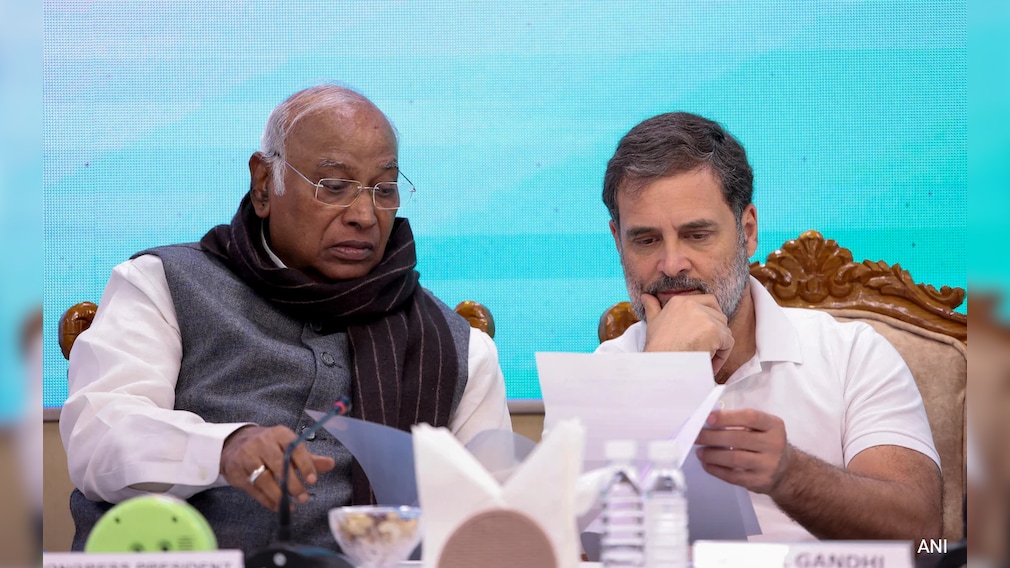
Even as the year draws to a close and the grand old party prepares to celebrate its 140th foundation day, Karnataka's 'CONG'-estion point seems to be dampening spirits.
The 83-year-old Mallikarjun Kharge is staring at the rocky politics of his home state, where a hawkish and somewhat edgy Deputy Chief Minister, DK Shivakumar, is looking for an elevation that was supposedly promised by Kharge in May 2023. Eyewitness accounts have it that it was at 51, Lodhi state, New Delhi, the residence of All India Congress Committee (AICC) General Secretary in-charge of the organisation, KC Venugopal, where the two warring men, Siddaramaiah and Shivakumar, along with Kharge, had spoken twice with Rahul Gandhi over the phone, confirming the rotational chief ministerial formula. Under the arrangement, Siddaramaiah was to run Karnataka for the first two-and-a-half years - that ended last year on November 21 - and Shivakumar would take the reins for the remaining period till May 2028.
November 21 has come and gone, but there is no sign of Siddaramaiah either stepping down or accepting any truce that grants him continuation till March-May 2026. Counting on his backward class status, Rahul Gandhi's indifference and support of party MLAs (the majority of Karnataka Congress MLAs are actually more loyal to the Congress than to Siddaramaiah, Shivakumar or any regional satrap), Siddaramaiah is hoping for Shivakumar to make just one 'wrong' move to consolidate his position.
Kharge's Failures
Significantly, Karnataka is the fourth Congress-ruled state seeing such mayhem under Kharge. The current AICC chief was a party observer for Punjab when a sordid power struggle between the then state unit chief, Navjot Singh Sidhu, and Chief Minister Captain Amarinder Singh blew up. That led to the appointment of Charanjit Singh Channi as a compromise Chief Minister. The 'experiment', a brainchild of Kharge, ultimately backfired as Singh left the party and the Congress lost to the Aam Aadmi Party (AAP) in Punjab.
Similarly, it was Kharge who was the point man of the Congress high command on September 25, 2022, the day Rajasthan Chief Minister Ashok Gehlot refused to step down or hold a meeting of the Congress Legislative Party (CLP) amid the long-festering tussle with Sachin Pilot.
In December 2018, when the Congress was selecting its Chief Minister for Chhattisgarh, Kharge, as AICC observer, had favoured Bhupesh Baghel, elbowing out TS Singhdeo. Then, too, a compromise, rotational formula was reportedly worked out. But it was never implemented.
Thus, in many ways, Karnataka exposes the Congress high command's old problem of indecision. For a party that is struggling to remain competitive nationally, Karnataka is more than just another state. It is the Congress's sole example of a functioning, full-term government with visible governance outcomes. This alone should have compelled the high command to treat the state with strategic care. Instead, the leadership appears paralysed once again, unable to convey what it intends to do with the 'secret' power-sharing promise that seemed to have brought some peace in 2023. The political temperature in Karnataka is rising.
So far, there has been no confirmation or rejection from the high quarters. This lack of clarity has created the oddest of situations: a government that is functioning on paper but is clouded by questions that refuse to go away.
Slogans, Signals And A Growing Weariness
One does not need sophisticated political analyses to read the signals: slogans for Shivakumar at the Mangaluru airport as Venugopal arrived, supporters in Belagavi openly invoking the name of the man they want as Chief Minister.
For any discerning political observer, the tone in these gatherings is not rebellious; it is weary. Workers are asking the party leadership to tell them where things stand. Karnataka, it needs to be emphasised again, is not Punjab, Madhya Pradesh or Rajasthan, where factional rivalry cost the Congress its governments. The stakes are higher. Karnataka has the country's tech capital, the largest urban middle class outside the North, and a political landscape that influences southern alliances. Losing grip here would not just weaken the party's state unit but also damage the party's credibility nationally at a time when it badly needs a success story.
While it is true that Siddaramaiah's administration has achieved significant welfare consolidation, equally important is the governance momentum created by Shivakumar, particularly in Bengaluru. The Greater Bengaluru Authority overhaul, the improved coordination in infrastructure works and the dialogue with industry leaders who once criticised the government - these are not small achievements. They have helped rebuild trust in a government that inherited a deeply fractured civic ecosystem.
Indecision As A Roadblock
The Congress leadership has to acknowledge that reforms of this magnitude require a clear chain of command. As senior ministers and departments quietly look for signs of a leadership change, governance has inevitably taken a hit. The uncertainty is beginning to take a toll: decisions that should have taken weeks are taking months; ministers are avoiding important initiatives.
After the Bihar loss, the Congress needs to demonstrate that it can run a government without falling victim to its usual habits, such as infighting. Karnataka is the party's best chance to show that it can make tough decisions instead of procrastinating indefinitely. On the contrary, each day of silence from Delhi is strengthening the perception that the Congress is still troubled by its old problem of indecisive leadership. The party cannot afford to repeat the mistakes of the past.
Shivakumar is not merely another claimant to the chair. He is the man who held the Congress together during its lowest phase, delivered its biggest southern mandate in years and forged dialogue among sceptical industry voices instead of confrontation. The Congress cannot pretend that Karnataka's rising impatience is an illusion. It is visible at airports, at district events, and in the quiet remarks of legislators who want the party to show consistency. Any further delay risks turning restlessness into resentment.
Karnataka is the Congress's opportunity to prove it can govern with discipline and clarity. The party has a choice: step in now, settle the leadership question and turn a moment of confusion into stability - or, let drift set in and watch its strongest state become another cautionary tale. Delhi must decide.
(Rasheed Kidwai is an author, columnist and conversation curator)
Disclaimer: These are the personal opinions of the author
-
NDTV Exclusive: Rifle, Tactical Gear And A Long Wait - Inside The Kill Of A Ukrainian Sniper

NDTV caught up with a sniper from the Second Corps "Khartiia" of the National Guard of Ukraine, Brigade Raid, special operations sniper unit, who spoke about the realities of the job.
-
Opinion | Amateur 'Advisors', Ignored Generals: How Trump Shunned Protocol To Launch Iran War
Recordings obtained by the Arms Control Association suggested that Witkoff misunderstood key technical aspects of Iran's nuclear programme.
-
Turning The Other Cheek: While Missiles Fly, UAE's Gamble On Restraint
Over the past 17 days Tehran has fired around 1,600 drones, including the infamous Shahed, nearly 300 ballistic missiles, and 15 cruise missiles at military and civilian targets in the UAE.
-
Opinion | 4 Leaders In Congress Are Vying For One Job - And None Is Ready To Step Aside
'Three Musketeers' in the Kerala Congress - and an unexpected fourth - are quietly redrawing the contest in Kerala.
-
Opinion | Trump And His America Are Fast Losing Touch With Reality
What is the guiding logic of the rather brash turn in American foreign policy? It is all too easy to box Trump as an irrational player, but frankly, it is a bit of an analytical copout.
-
Game Of Drones: Ukraine's Sting Answer For US' Shahed Problem
The Iranian-designed Shahed-136 drone has become one of the most recognisable weapons of the modern battlefield.
-
Opinion | Iran-Israel War, And What India Can Learn From The 'KC-135' Crash
Transparency doesn't just establish honesty; it denies the adversary the space to peddle the exaggerated claims we frequently see from Pakistan or China, where military losses erode state power.
-
Opinion | Mojtaba's First Message Makes It Clear: Iran Won't Give An Easy 'Exit' To Trump
In Iran, the assassination of a Supreme Leader demands a response, a do-or-die response. Backing down would risk undermining Mojtaba's legitimacy at home and weakening his authority among the hardline institutions that support his regime.
-
Opinion | What Happens If Saudi Arabia Really 'Asks' Pakistan To Go To War?
Since the beginning of the Iran-Israel war, questions have been raised about what role Pakistan would play on the side of the Saudis. The answer is getting murkier.
-
Oil Wars: How Iran's Hormuz Grip Is Bleeding Americans' Wallets
Tehran's response to US-Israel strikes that began Feb 28 was to target oil infrastructure in Gulf nations, an early and clear sign it is trying to force the US to answer questions from the global community about a cost-of-living crisis.