Blog | Why You Should Care Whether Schrodinger's Cat Is Dead Or Alive
Imagine going on a romantic Alpine getaway and returning with the equation that runs the modern world. The only snag: nobody can quite agree on what it says about reality.
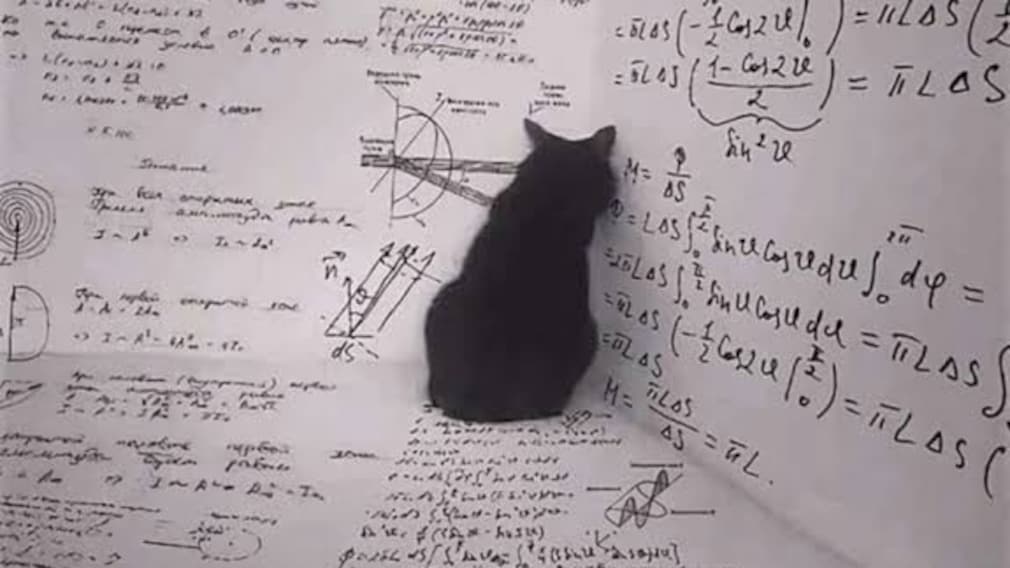
Fun fact: did you realise that you are living through the centenary year of Schrodinger's famous theory?
Come again? Never heard of it? Wait a minute - I'll tell you all you need to know. And it's quite a story.
In the winter of 1925, an Austrian physicist named Erwin Schrodinger ran off to a secluded villa in the Swiss Alps for a romantic getaway. He brought along his ski gear, two pearls to plug his ears against unwanted noise, and an undisclosed mistress. By the time he descended from the mountain in early 1926, he had written down an equation that would change the world forever.
It was a line of mathematical poetry so wildly successful that it birthed modern technology, powering everything from silicon microprocessors to medical MRIs, lasers, and quantum computers. Yet, a century later, it remains one of the single biggest mysteries in human intellectual history.
Schrodinger gave us the ultimate recipe for predicting reality, but left behind a cosmic prank: as far as I can tell, nobody actually knows what his equation is telling us about what reality truly is.
Before Schrodinger, The Physics That Made Sense
To appreciate the madness, we first have to look at what physics looked like before Erwin Schrodinger's Alpine vacation. Isaac Newton had given us a delightfully sensible universe where things exist in specific places, move in predictable paths, and stay put unless you push them. If you throw a stone from a mountain-top, classical physics tells you exactly where it will land. That's gravity, and it's been around forever.
Literally so, if you're Indian. The Rig Veda understood it 3,000 years before Newton; the Vaisheshika Sutra (6th to 2nd century BC) described objects falling to the ground because of the property of 'gurutva'; and the Surya Siddhanta (4th-5th century CE) describes gravity as Dharanatmika Shakti, under which the Earth attracts objects towards it centre like a magnet draws iron. Brahmagupta spelt this out in 628 CE, in explicit detail. But for the poor Europeans, ignorant of all these Sanskrit texts, it took an apple to fall on Newton's head for them to discover gravity, and learn physics.
Enter Electron
Then, around the turn of the twentieth century, as scientists began to study physics more closely and understand it better, they saw subatomic particles acting like unruly toddlers. Electrons were no longer behaving like tiny billiard balls bouncing against each other; they were behaving like waves, smearing out, interfering with themselves, and popping up in places they had no right to be.
Enter Schrodinger, who asked a deceptively simple question: if an electron acts like a wave, what is the wave equation that describes it?
Psi, The Showrunner
What he penned in 1926 was the time-dependent wave equation, a mathematical statement declaring that the total energy of a system, multiplied by its wave function, equals how that wave function changes over time. Stripped of its academic bandh-gala, the star of the show is the Greek letter Psi, which represents the wave function. This mathematical expression holds all the information about a quantum system, whether that system is a single electron floating in a vacuum or a complex molecule inside a leaf performing photosynthesis.
Bear with me. I am not a physicist either, but I am sharing with you what I have understood.
If you feed physical conditions into Schrodinger's equation (like, say, the electrical attraction between a proton and an electron in a hydrogen atom) the equation churns out answers with breathtaking precision, predicting the energy levels of atoms down to the decimal point. Without it, modern microprocessors would not exist. Transistors rely entirely on quantum tunnelling, a phenomenon where particles wave-function their way straight through solid barriers, something Newton would have thought of as sheer wizardry.
So, not just microprocessors and transistors, but photovoltaic solar cells, LED lights, MRIs, atomic clocks, and nuclear energy, all run on the exact formula that Erwin Schrödinger scribbled down in the Swiss Alps in 1926. His mistress clearly didn't divert him enough.
The Equation That Broke Physics
Yet, as brilliant an engineering blueprint as Schrödinger's equation proved to be, as a description of underlying reality, it completely broke physics. The trouble started almost immediately. Schrödinger initially thought his wave function represented a literal physical wave, imagining that an electron was like water sloshing around a bathtub. His contemporary, Max Born, quickly countered that if you square the magnitude of the wave function, you do not get a physical fluid at all, but a probability. According to the maths of this, before you observe an electron, it does not exist in one particular spot; instead, the wave function represents a cloud of possibilities where the electron is thirty percent likely to be in one place, fifty percent likely to be in another, and twenty percent likely to be somewhere else entirely.
This is where the existential dread creeps in, starting with the notorious measurement problem. Schrodinger's equation itself is completely smooth, deterministic, and continuous. Left to its own devices, the wave function evolves predictably forever, keeping all possibilities alive simultaneously. But the moment an experimentalist sets up a detector to measure the electron, the cloud vanishes, registering a single, point-like particle in one specific place. How a smooth wave of possibilities instantly collapses into a hard reality is something Schrödinger's equation simply fails to explain, leaving the collapse as a magical extra rule inserted only when we choose to look.
The Cat Was Supposed To Be A Joke
Schrödinger himself grew so frustrated with the absurdity of the probability interpretation that he invented his famous cat-in-a-box thought experiment to demonstrate how ridiculous it was. Surely you've heard of that?
If a microscopic particle can exist in a superposition of two states at once - decayed and not decayed - and you wire that particle to a vial of poison, the mathematics proves that the particle is both dead and alive. Imagine, Schrodinger said, you put a cat inside a box (representing that particle), the cat inside the box is simultaneously dead and alive until someone opens the lid. Schrodinger intended this example as a satire of quantum mechanics; instead, the world adopted the cat as the official mascot of quantum physics. Today, for many humanities-wallahs like me, the cat is more famous than the physicist.
A century later, physicists are still arguing over what the wave function actually means. Depending on which physicist you ask, you will get wildly different answers. The traditional “Copenhagen interpretation” advises that we should not even ask what the wave function is, treating it merely as a tool for calculating probabilities, and telling us to shut up and calculate. That's the most sensible approach, if you ask me.
The “Many-Worlds” interpretation suggests the wave function never collapses at all; instead, whenever a measurement occurs, the universe splits, creating parallel realities for every outcome. Other approaches, such as “objective collapse” theories, propose that Schrödinger's equation is slightly incomplete and that physical collapses happen automatically when systems reach a macroscopic scale, while “pilot wave” theories posit that particles remain like real billiard balls guided by an invisible wave.
None of these interpretations changes the output of the formula. They are all desperate, competing attempts to explain what Schrodinger's ghostly wave function is doing when we are not looking. Frankly, this is just the kind of vexatious debate that makes me grateful I did not study physics beyond Class 8 (yes, I know it shows).
Even Schrodinger eventually grew so weary of the endless philosophical bickering over his creation that he abandoned quantum mechanics altogether to study biology and science history instead, famously complaining that he did not like it and was sorry he ever had anything to do with it. Now if he had just paid more attention to his mistress a hundred years ago….
Yet, a century after his trip to the Alps, his equation remains the bedrock of physical science, serving as the foundation of the modern tech economy. All the marvels of technology that we admire and/or take for granted today sit atop a single line of calculus that tells us, with absolute mathematical certainty, that we still haven't the faintest idea how the universe fundamentally works.
(Note: This was one of the reasons the author gratefully moved to the Humanities stream from Class 9 onwards….)
(Shashi Tharoor has been a Member of Parliament from Thiruvananthapuram, Kerala, since 2009. He is a celebrated author and a former diplomat)
Disclaimer: These are the personal opinions of the author
-
Promote, Punish, Repeat: Decoding Mayawati's Akash Anand Puzzle

The development in the BSP is unprecedented. Never before has any Indian party elevated a family member and dumped him or her unceremoniously thrice within a span of three years.
-
Opinion | Nepal Needs $5 Billion To Rebuild. World's Climate Fund Doesn't Have Even 10% Of It
The fund caps support at USD 20 million per project; Nepal needs two hundred times that. And the board is not scheduled to sit until December.
-
Mayawati's Tough Love: Nephew Akash Anand Benched Again. What It Means For BSP
Akash Anand, the 31-year-old foreign-educated nephew of BSP boss Mayawati, finds himself out of favour, for at least the third time in three years, with the latest turn coming in Lucknow on September 3.
-
Opinion | The Rise Of Indians In US Is Making Some Americans Very, Very Angry
A new report released yesterday shows how Indians are now among the biggest targets of racist attacks in America.
-
Opinion | China, Pak, A Stalled India Visit: How Signals From Bangladesh Are Getting Louder
A fighter jet deal with China, interest in Pakistan's military bloc, and a 'stalled' visit to India - all in a month. Bangladesh's drift is getting harder to ignore.
-
Opinion | Indus Treaty, Hague, And Pakistan's Endless Search For Leverage Over India
If the IWT survived all the trials in the past, it is because India's threshold of tolerance had been unusually high. But Pakistan must know that it can't arm-twist India through international pressure.
-
Opinion | Nepal's 'Climate Compensation' Pitch Is Valid, But Its Demand From India Isn't
Nepal's vulnerability gives it a claim on multilateral climate finance. It does not follow that India bears responsibility for this.
-
Opinion | India Wants A 6th-Generation Fighter. But A Lot Could Go Wrong
India might just be building too many fighter jets to focus on any one of them well. A recalculcation is needed.
-
Reporter's Diary | Worse Than War: An Aerial View Of Nepal's Trishuli River Valley Tragedy
In many ways, reporting on natural disasters is far more harrowing than covering modern war
-
Opinion | China's Quiet Power Grab Is Hiding In Plain Sight
China's greatest advantage may be neither its military nor its markets, but a world too distracted to see what it is building.