Opinion | Why Trump And Mamdani May Not Be That Different, After All
Both Trump and Mamdani seem to be offering an emotional appeal that targets the same problem: an unaffordable America that has alienated its large majority.
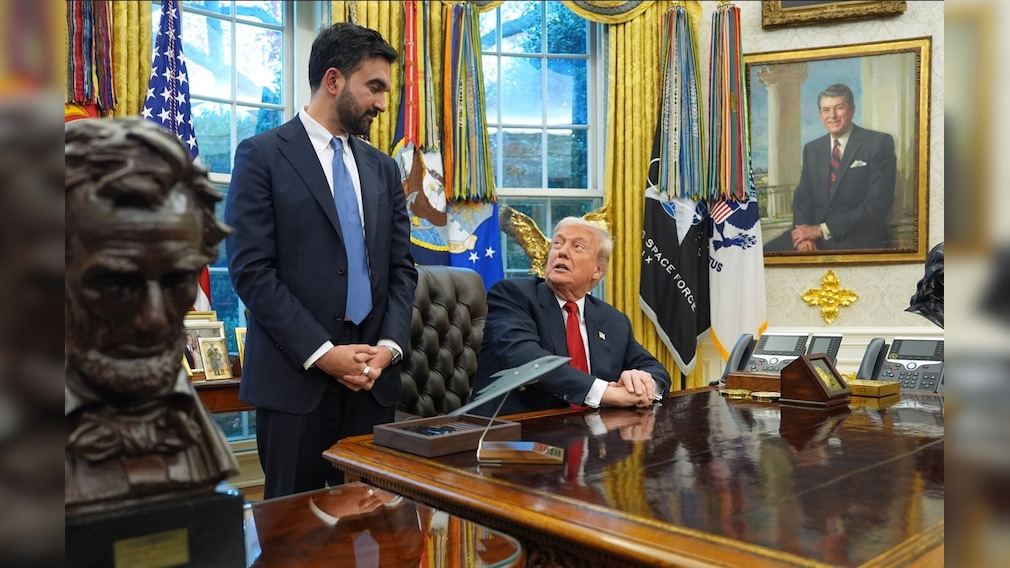
This Thanksgiving, many Americans might be willing to endure an irate Uncle at the dinner table, just the way Zohran Mamdani expected President Donald Trump to be when they met at the White House. The unexpected cordiality instead has had opinions reeling. The premise is more astute. I am reminded of George Soros telling me, over piping hot masala chai on the icy Davos slopes, that "life is a series of imperfect but necessary choices". Both Trump and Mamdani seem to be following this advice. They both offer an emotional appeal that targets the same problem: an unaffordable America that has alienated its large majority.
There is, however, one key difference. Trump's MAGA blames immigrants, while Mamdani's Democratic socialists blame the rich. Both are practising identity politics - one based on your race or place of birth and the other based on your financial success.
But while both indulge in the blame game, neither offers a real, long-term solution. Because there is no easy one. The smartest people in the world are scratching their heads to offer an alternative to the millions whose jobs were displaced in the post-globalisation era, let alone those obliterated by the furiously unfurling AI tsunami. Fed Chairman Jerome Powell recently admitted the inability of the world's largest monetary authority to meet this challenge, saying AI has left job creation close to zero.
The money is firmly in the hands of the super rich. The top 1% of the American population owns nearly a half of the US stock market, while the bottom 50% of Americans altogether hold only 1%. This is the biggest conundrum of our time.
Yes, stock markets and corporate profits are near all time highs, but the vast majority of America is feeling left out in this second coming of the Gilded Age. The beneficiaries of wealth creation in our current times are the rich and Wall Street, not the working class and Main Street.
This disparity has led to a political earthquake in America, and arguably in every country around the world, where the super-rich, through funding political frontrunners or controlling resources, are dictating policies to the vast majority. To win an election in America, you need billionaire support, and they need you to pick up the phone line when they call. Quid pro quo.
This billionaire boys' club is now dominating America's public square. Both Trump and Mamdani are rebuttals by the people. And much like life, their politics are imperfect but necessary choices.
As an immigrant myself, it is hard to get my head around the anti-immigrant policies of Trump's MAGA. But as someone who grew up in the 1980s' pre-liberalisation socialist India, it is also hard to comprehend Mamdani's economics. India's own failed experiment with socialist democracy enabled its oligarchs to gain unchecked power, whose influence even today - whether in politics or business, and irrespective of party in power - is impossible to shirk off.
This political conundrum is both a moral choice for individuals, but also a generational choice testing family loyalties. During the mayoral voting at the American Museum of Natural History, a woman in her 60s told me she had voted for Trump for President but her Ivy League-educated Gen Z sons were voting for Mamdani. She said she voted from her mind, and they voted from their hearts.
That is the dichotomy of most Americans right now. Will you choose the anti-immigrant, MAGA right or the anti-rich Democratic socialists? Ultimately, politics is performance and a promise.
Zohran Mamdani is no stranger to the power of performance. He can marry the charm of DDLJ's Shahrukh Khan in person with the fire of Deewar's Amithabh Bachchan on stage. And in his own way, Donald Trump, the consummate reality TV OG, knows how to stay in the spotlight and dominate the headlines.
Ronald Reagan famously said, "All great change in America begins at the dinner table." As Americans come together this week to celebrate Thanksgiving, families will talk about ideologies that provide answers to their crisis of unaffordability. And they will understand why Donald Trump was surprisingly cordial with Zohran Mamdani.
Both the leaders have ascended for the same reason, promising Americans a return to abundance beyond the Thanksgiving table. But till one of them provides a real solution, Americans will continue to face this challenging conundrum.
(Namrata Brar is an Indian-American journalist, investigative reporter, and news anchor. She is the former US bureau chief of NDTV)
Disclaimer: These are the personal opinions of the author
-
Opinion | Trump And Munir - Different, But Same Same

Pakistan and the United States are not obvious analogues. And yet, their respective leaders have made a comparison inevitable today.
-
A Missile On One Soldier's Shoulder Could Ground The US Air War In Iran
Iran shot down US jets while China denied arming Tehran. But reports of a Chinese spy satellite being used by Iran, the viral F-35 tutorial from a Chinese engineer, and now 1,000+ MANPADs reportedly on their way to the war suggests otherwise.
-
Opinion | Amid Trump's War On The World, How Effective Really Is India's Strategic Autonomy?
India cannot mechanistically base its positions on preferred international norms, unmindful of its own direct interests.
-
Opinion | In Stalin's Tamil Nadu vs Delhi Pitch, Flashbacks From A 2014 Jayalalithaa Episode
In 2014, Jayalalithaa had posed the question to the Tamil Nadu electorate,"Gujarat Modiyaa Tamil Nadu odu intha ladyaa"(Gujarat's Modi or this lady of Tamil Nadu), and tasted electoral success, winning 37 of the 39 seats in the state.
-
'Help', Said Trump In Iran. Why US' European Allies Hesitated, Walked Away
47 days into the war, Europe has rejected Trump's attacks on Iran on the back of $25B Hormuz blockade shock that spiked inflation to 2.5% and prompted 59% of EU voters to call the strikes illegal (71% Spain), while Trump's Pope spat draws ire from Italy.
-
Assassination That Took 20 Years: Spies, Missed Chances, Then A Final Moment
Before Osama bin Laden became the global face of transnational terrorism, there was another figure-more elusive, less theatrical, but arguably more influential in the evolution of modern guerrilla warfare. He was Imad Mughniyeh.
-
The Malacca Gambit: How China Oil-Choke Strategy Could Backfire On Trump
US President Donald Trump seems to be weaponising oil chokepoints - Venezuela, Hormuz, and Malacca - to pressure China, but Beijing's pipelines, reserves, and shadow fleets mean the real test is which side dares escalate further.
-
Opinion | 38% vs 18%: How Bengal Exposes The Biggest Irony Of Women's Reservation
Bengal with its duality - 38% women in Parliament versus 18% in the state contest - captures the core tension of the Bill better than any other example.
-
Opinion | Mines, Submarines, Drones: Why World's Mightiest Navy Won't Get Too Close To Hormuz
Iran is relying on the symmetric advantage of geography to fight against the brute power of the world's largest and most powerful navy, the US.
-
'Tawakkul al-Allah': Meet Sheikh Moussa, The Man Israel Can't Move
Sheikh Moussa refuses to leave his family home in Beirut's Dahieh despite decades of Israeli missile strikes. His faith - tawakkul al-Allah - keeps him rooted amid rubble, memories, and a doctrine designed to break Israel's rivals.