Opinion | Why Trump And Mamdani May Not Be That Different, After All
Both Trump and Mamdani seem to be offering an emotional appeal that targets the same problem: an unaffordable America that has alienated its large majority.
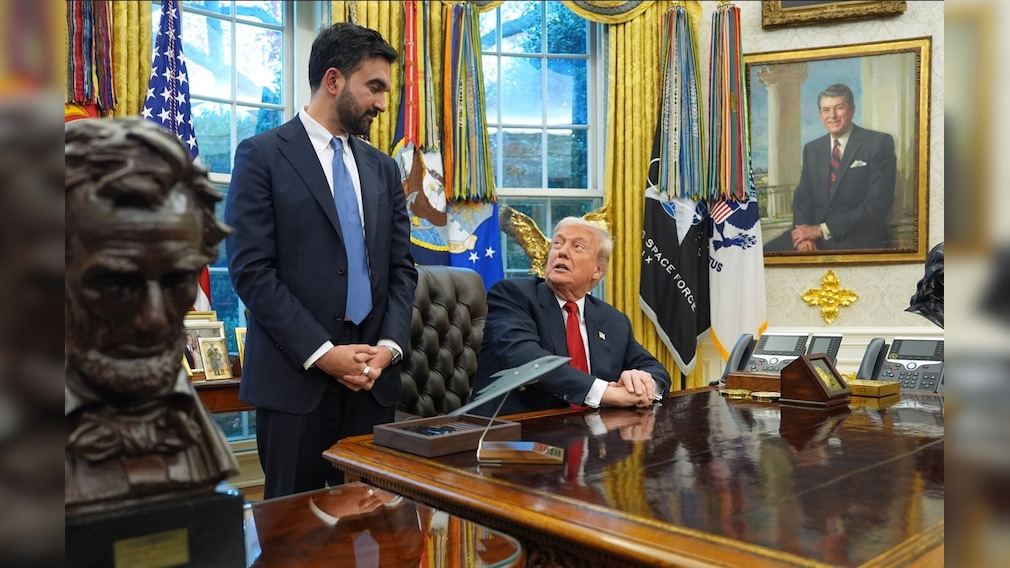
This Thanksgiving, many Americans might be willing to endure an irate Uncle at the dinner table, just the way Zohran Mamdani expected President Donald Trump to be when they met at the White House. The unexpected cordiality instead has had opinions reeling. The premise is more astute. I am reminded of George Soros telling me, over piping hot masala chai on the icy Davos slopes, that "life is a series of imperfect but necessary choices". Both Trump and Mamdani seem to be following this advice. They both offer an emotional appeal that targets the same problem: an unaffordable America that has alienated its large majority.
There is, however, one key difference. Trump's MAGA blames immigrants, while Mamdani's Democratic socialists blame the rich. Both are practising identity politics - one based on your race or place of birth and the other based on your financial success.
But while both indulge in the blame game, neither offers a real, long-term solution. Because there is no easy one. The smartest people in the world are scratching their heads to offer an alternative to the millions whose jobs were displaced in the post-globalisation era, let alone those obliterated by the furiously unfurling AI tsunami. Fed Chairman Jerome Powell recently admitted the inability of the world's largest monetary authority to meet this challenge, saying AI has left job creation close to zero.
The money is firmly in the hands of the super rich. The top 1% of the American population owns nearly a half of the US stock market, while the bottom 50% of Americans altogether hold only 1%. This is the biggest conundrum of our time.
Yes, stock markets and corporate profits are near all time highs, but the vast majority of America is feeling left out in this second coming of the Gilded Age. The beneficiaries of wealth creation in our current times are the rich and Wall Street, not the working class and Main Street.
This disparity has led to a political earthquake in America, and arguably in every country around the world, where the super-rich, through funding political frontrunners or controlling resources, are dictating policies to the vast majority. To win an election in America, you need billionaire support, and they need you to pick up the phone line when they call. Quid pro quo.
This billionaire boys' club is now dominating America's public square. Both Trump and Mamdani are rebuttals by the people. And much like life, their politics are imperfect but necessary choices.
As an immigrant myself, it is hard to get my head around the anti-immigrant policies of Trump's MAGA. But as someone who grew up in the 1980s' pre-liberalisation socialist India, it is also hard to comprehend Mamdani's economics. India's own failed experiment with socialist democracy enabled its oligarchs to gain unchecked power, whose influence even today - whether in politics or business, and irrespective of party in power - is impossible to shirk off.
This political conundrum is both a moral choice for individuals, but also a generational choice testing family loyalties. During the mayoral voting at the American Museum of Natural History, a woman in her 60s told me she had voted for Trump for President but her Ivy League-educated Gen Z sons were voting for Mamdani. She said she voted from her mind, and they voted from their hearts.
That is the dichotomy of most Americans right now. Will you choose the anti-immigrant, MAGA right or the anti-rich Democratic socialists? Ultimately, politics is performance and a promise.
Zohran Mamdani is no stranger to the power of performance. He can marry the charm of DDLJ's Shahrukh Khan in person with the fire of Deewar's Amithabh Bachchan on stage. And in his own way, Donald Trump, the consummate reality TV OG, knows how to stay in the spotlight and dominate the headlines.
Ronald Reagan famously said, "All great change in America begins at the dinner table." As Americans come together this week to celebrate Thanksgiving, families will talk about ideologies that provide answers to their crisis of unaffordability. And they will understand why Donald Trump was surprisingly cordial with Zohran Mamdani.
Both the leaders have ascended for the same reason, promising Americans a return to abundance beyond the Thanksgiving table. But till one of them provides a real solution, Americans will continue to face this challenging conundrum.
(Namrata Brar is an Indian-American journalist, investigative reporter, and news anchor. She is the former US bureau chief of NDTV)
Disclaimer: These are the personal opinions of the author
-
Gyanesh Kumar Has An Immunity Pin. Why A Petition Says He Can't Use It

The Opposition wants the Chief Election Commissioner prosecuted for alleged manipulation of voter rolls, but a 2023 law stands in the way. A petition in the Supreme Court now says the law has a gap.
-
Opinion | Is The World Staring At A Big Stock Market Crash - And Recession? 5 Uneasy Signs
On Wednesday, the US bond market recorded its worst day since Trump's "Liberation Day" tariffs rattled markets in April 2025. The 30-year US Treasury yield topped 5.43%, putting it on track for its highest close since 2004.
-
Form 6 For New Voters: When A Small Change Triggered A Big Row
In July 2026, the online version of Form 6 on the ECI's ECINet portal was modified to include a new declaration.
-
Opinion | Saudi Arabia's China Turn Has Begun - After Learning Much The Hard Way
Leaning on China just makes sense for the Saudis right now. The question is, can its other great 'ally' stomach it?
-
Opinion | Bihar Assault, Hisar Marriage Ban: Who'll Stop The Guardians Of Indian 'Culture'?
Why exactly does the sight of a young couple seeking a bit of alone time somewhere tend to particularly provoke a certain kind of Indian men?
-
Opinion | The Trump-Xi Summit, And India's Many Worries Of Its Own
Washington and Beijing may have chosen coexistence over confrontation. For India, that could be both a relief and a warning.
-
Opinion | China Claims It Has Cut Troops At The Indian Border. But The Math Doesn't Add Up
The reduction likely has more to do with the deployment along the LAC than the total strength active in the region
-
Opinion | China Is No Longer Waiting For Trump To Set The Rules. And He Knows It
America's old diplomatic tricks with China won't work any longer. Because China has changed, and so has its ambitions.
-
Opinion | As UN Interviews Its Next Chief, The Interviewers Have Some Explaining To Do
On the panel sit governments whose wars, vetoes, and unpaid dues have helped make the organisation ineffective.